This site is supported by our readers. We may earn a commission, at no cost to you, if you purchase through links. This content is for general informational and educational purposes only and is not a substitute for professional medical, dermatological, or nutritional advice.

Most people reach for a scrub when their skin looks dull—grainy beads, maybe a walnut shell situation, some aggressive circular motion. It feels productive. It’s also doing more harm than good.
Chemical exfoliation works differently. Instead of physically grinding away at your skin, acids quietly dissolve the bonds holding dead cells to the surface, letting them shed the way they’re supposed to. The result is smoother texture, smaller-looking pores, and that lit-from-within glow that no amount of highlighter actually replicates.
Knowing how to use chemical exfoliants correctly is the difference between a skin transformation and a raw, irritated barrier that takes weeks to recover. The details matter—and they’re not complicated once you understand the logic behind them.
Table Of Contents
- Key Takeaways
- What Are Chemical Exfoliants?
- Choose The Right Exfoliating Acid
- Patch Test Before First Use
- Apply Chemical Exfoliants Correctly
- Build Your Weekly Routine
- Avoid Over-Exfoliation Mistakes
- Top 4 Chemical Exfoliant Products
- Frequently Asked Questions (FAQs)
- Can I exfoliate before microcurrent?
- Can chemical exfoliation help with KP?
- Can exfoliating remove hyperpigmentation?
- Does exfoliating help with collagen production?
- Can chemical exfoliants be used during pregnancy?
- How do acids interact with prescription acne medications?
- Are chemical exfoliants safe for darker skin tones?
- Can you use exfoliating acids around the eye area?
- Do chemical exfoliants expire or lose potency over time?
- Conclusion
Key Takeaways
- Chemical exfoliants dissolve the bonds holding dead skin cells together rather than scrubbing them off, delivering more even, deeper results without the risk of micro-tears from physical scrubs.
- Matching the right acid to your skin type is essential — AHAs suit dry skin, BHAs cut through oily pores, and PHAs are the gentlest option for sensitive or reactive skin.
- Starting once a week, applying at night, and always following up with SPF the next morning protects your skin barrier while letting the acids do their job safely.
- Signs like tight, shiny skin or persistent redness mean you’ve pushed too far — scale back immediately, skip other actives like retinol on the same night, and rebuild with ceramide-rich hydration.
What Are Chemical Exfoliants?

Chemical exfoliants are acids that dissolve the bonds holding dead skin cells to your face — no scrubbing required. They work differently depending on their molecular structure, which is why picking the right one for your skin type actually matters. Here’s what you need to know before choosing yours.
That’s why pairing your chemical exfoliant with a gentle follow-up routine — like the ones featured in this guide to top-rated face scrubs and skin barrier support — helps minimize irritation and keep your skin balanced.
Acids Versus Scrubs
Scrubs work through friction and pressure — granular particles physically buffing away dead cells. Acids take a different approach entirely, dissolving the bonds holding those cells together without any rubbing required.
Key differences at a glance:
- Acids offer consistent, even coverage
- Scrubs exfoliate only where particles contact skin
- BHAs reach deep into pores; scrubs stay surface-level
- Granular particle risks include micro-tears on sensitive skin
- You might consider alpha hydroxy acids to target signs of aging.
How Acids Loosen Dead Skin
Think of your skin’s surface like tiles held together with grout. Acids work by weakening cell adhesion — dissolving that "grout" so dead cells release naturally.
Through hydrogen ion activity, they trigger stratum corneum sloughing, loosening the outermost layer without friction. The result is accelerated surface cell turnover, revealing fresher skin underneath without a single scrub involved.
Texture, Pores, and Brightness
Once dead cells release, the surface changes in ways you can actually see. Smooth skin reflects light evenly, which is what creates that lit-from-within glow. Rough texture scatters light in every direction, making skin look dull and flat.
Pores appear larger when uneven texture casts shadows around them. Clear, smooth skin minimizes those shadows — pores look smaller almost immediately.
Why Skin Type Matters
Your skin type isn’t just a label — it shapes how well your barrier holds moisture, regulates oil, and reacts to acid exfoliation.
Dry skin loses water faster and reacts more sharply to stronger acids. Sensitive skin may sting at concentrations oily skin experiences easily. Matching the acid to your skin type protects your skin barrier health while still delivering results.
Choose The Right Exfoliating Acid
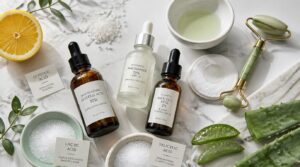
Not all acids work the same way, and that difference matters more than most people realize. Your skin type is really the deciding factor for picking the right one. Here’s a breakdown of the best options and what each one actually does for your skin.
AHAs for Dry Skin
Dry, flaky skin is basically your skin struggling to shed dead cells evenly. Alpha hydroxy acids fix that. They loosen the bonds between surface cells so fresher skin shows through.
- Lactic acid exfoliates while attracting moisture — ideal for dry types
- Glycolic acid boosts cell turnover for visible brightness
- Mandelic acid works gently, thanks to its larger molecular structure
BHAs for Oily Pores
Oily, acne-prone skin has a different problem: congestion building inside the pore. That’s where beta hydroxy acid — specifically salicylic acid — earns its reputation.
Unlike AHAs, it’s lipid-soluble, meaning it cuts through oil and travels into the follicle itself, dissolving the sebum and debris that cause blackheads. Its comedolytic action actively decongests pores, making it the go-to for persistent clogged pores and shine.
PHAs for Sensitive Skin
Polyhydroxy acids work differently from the start. Their larger molecular structure means they can’t penetrate as deeply as AHAs, which dramatically reduces stinging and redness — making them ideal for rosacea-prone or reactive skin.
Gluconolactone and lactobionic acid also act as humectants, drawing moisture into the skin while they exfoliate. You get barrier-supportive exfoliation, not a trade-off between results and comfort.
Lactic Acid for Beginners
If you’re new to chemical exfoliants, lactic acid is the safest entry point. Unlike most acids, it exfoliates and attracts moisture simultaneously — making it unusually forgiving.
For a gentler approach to anti-aging overall, exploring bakuchiol as a retinol alternative pairs beautifully with lactic acid in a sensitive-skin routine.
Start at 5% concentration, applied leave-on at night:
- Gentler on sensitive skin than glycolic
- Boosts skin hydration while it resurfaces
- Try wash-off formats first to gauge tolerance
Keep the pH above 3.5 to avoid unnecessary irritation.
Mandelic Acid for Gentleness
Mandelic acid moves slowly — its larger molecular size means it absorbs gradually, giving your skin time to adjust without the sting. That’s why it suits sensitive skin, rosacea, and post-acne hyperpigmentation better than most AHAs.
It also carries mild antibacterial properties, making it quietly effective for acne-prone skin without stripping your barrier dry.
Patch Test Before First Use
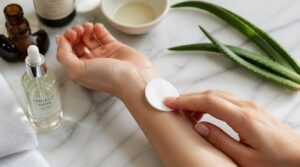
Before you apply a new acid to your whole face, a patch test is your first line of defense — it’s a quick step that can save your skin a lot of grief. Acids are active ingredients, and even gentle ones can react differently depending on your skin’s chemistry. Here’s exactly how to do it right.
Test Behind The Ear
Before applying any acid exfoliant to your full face, dab a small amount behind one ear. This spot works well because the skin sensitivity there mirrors facial skin without risking your entire complexion.
Use a cotton pad to keep product distribution even — fingertip application can concentrate too much in one spot, increasing the chance of localized stinging or barrier disruption.
Wait Twenty-four Hours
Once you’ve applied the product behind your ear, leave it alone for a full twenty-four hours.
Your skin barrier becomes temporarily more permeable after acid contact, so reactions don’t always show up right away. Delayed irritation — redness or tightness that builds hours later — is easy to miss if you check too soon. Give your skin the full window before drawing any conclusions.
Check Redness or Stinging
After the full window, examine the test site carefully. Recognizing irritation patterns early is exactly the point. Check for:
- Skin redness (erythema) — visible flushing or blotchiness
- Burning or stinging sensations, even without a visible rash
- Swelling or itch — early contact dermatitis signs
- Tightness pointing to skin barrier damage
Any reaction signals this acid may trigger skin irritation your skin can’t handle.
Avoid Broken Skin
Never patch test on active blemishes, open spots, or visibly broken skin — acids applied to compromised areas can worsen irritation and set back your barrier repair.
After rinsing, pat dry with a soft cloth rather than rubbing. Follow with a fragrance-free moisturizer to keep that test site protected. Tight or stinging skin between checks is your cue to ease off.
Stop if Irritation Appears
If stinging continues or worsens after application, that’s your skin telling you to stop — not push through. Rinse immediately without rubbing, then pat dry and apply a plain, fragrance-free moisturizer to begin skin barrier repair.
Skip chemical exfoliants entirely until the irritation fully clears, then restart at a lower frequency or gentler acid.
Apply Chemical Exfoliants Correctly
Getting the application right makes a bigger difference than most people expect. Even a great product can irritate your skin if you’re not applying it the way it was meant to be used. Here’s exactly how to do it properly, step by step.
Cleanse and Dry Skin
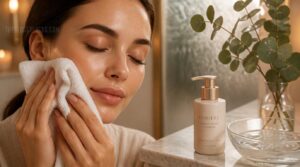
Clean skin is your acid’s best starting point. Use a hydrating cleanser — one with glycerin or ceramides — so your barrier stays intact before exfoliation begins. Once rinsed, pat dry with a soft towel rather than rubbing; friction stresses the skin unnecessarily.
- Choose cleansers with hyaluronic acid, glycerin, or ceramides
- Avoid anything that leaves skin feeling tight
- Pat, never rub, to reduce irritation
- Leave skin slightly damp to ease post-cleanse tightness
- A calm, settled skin tolerates exfoliants far better
Use Hands or Cotton Pad

Both hands and cotton pads work — your choice depends on what you’re targeting. Cotton pads help isolate specific zones, like an oily T-zone, while hands distribute product more evenly across larger areas.
Whichever you choose, pat rather than swipe. Swiping adds friction that compounds the acid’s action. Pads absorb some product, so soak them generously. Hands transfer more directly, but wash them first.
Apply a Thin Layer
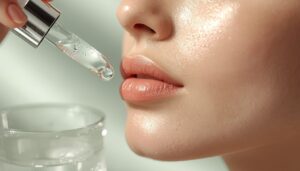
Less is genuinely more here. A thin, uniform film is all your skin needs — if you can see the product pooling or feel it staying tacky, you’ve applied too much.
Think of it like painting a wall: one even coat works better than a thick glob. Excess product doesn’t accelerate results; it just raises your irritation risk and leaves uneven patches behind.
Avoid Eyes and Lips
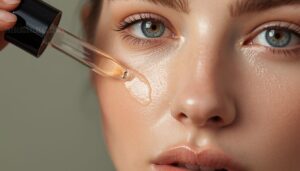
The eye and lip line are off-limits — full stop. Both zones are far more sensitive than the rest of your face, and acid contact there can cause real irritation fast.
Keep your application focused on the mid-face area, stopping well short of the lower lash line and lip edges. Product migrates more than you’d expect, especially with facial movement.
Follow With Moisturizer
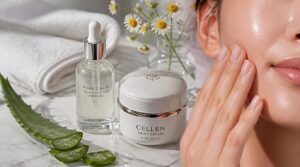
Skin absorbs acid fast, so don’t wait long before moisturizing. Apply while your skin is slightly damp — humectants work much harder when there’s surface moisture already present to hold onto.
- Glycerin or hyaluronic acid — draws water into the outer skin layer
- Ceramides — rebuild a damaged skin barrier
- Emollients — soften and smooth surface texture
- Occlusives — seal moisture in and slow evaporation
Build Your Weekly Routine

Getting consistent results from chemical exfoliants comes down to how you structure your week, not just which product you choose. A simple, paced routine protects your skin barrier while giving acids enough time to actually work. Here’s how to build one that fits your skin’s needs.
Start Once Weekly
Your first application is a tolerance test, not a transformation. Apply your chemical exfoliant once a week, then observe. Does your skin redden, sting, or feel unusually tight? Those reactions are useful signals worth tracking.
| Week | Focus |
|---|---|
| 1 | Apply once; watch for irritation |
| 2 | Stay weekly; track texture changes |
| 3+ | Increase only if skin tolerates |
Recovery windows between sessions give your barrier time to normalize. Staying at once weekly makes your exfoliation routine easy to track — and easy to adjust.
Use Acids at Night
Night is when your skin shifts into repair and regeneration mode, making it the ideal window for chemical exfoliants to work. Applying acids in the evening also keeps you away from direct UV exposure while actives are still fresh on your skin.
- No midday sun cutting short the process
- Time to follow up with hydrating products
- Morning SPF ready to protect newly sensitized skin
Increase Slowly if Tolerated
Once SPF is part of your morning habit, the next piece is knowing when to use your chemical exfoliant more often.
Increase frequency gradually — most people move from once weekly to twice weekly only after two to three weeks of no irritation. Mild tingling that fades is fine; persistent redness or tightness means your skin barrier needs more time.
Avoid Retinol Same Night
Retinol and chemical exfoliants both accelerate cell turnover — and running them together on the same night is basically doubling up on exfoliation. That combination raises your risk of skin barrier disruption, leading to redness, stinging, or that uncomfortably tight feeling.
Alternate instead: acids one night, retinol the next. It’s a simple split that also helps you identify which active causes irritation if something goes wrong.
Wear SPF Every Morning
Acids make your skin more vulnerable to UV rays — that’s not a scare tactic, it’s chemistry. Skipping sunscreen after exfoliation undoes your progress fast.
Apply broad-spectrum SPF 30 or higher every single morning, even on cloudy days. UVA rays age skin quietly while UVB rays burn it.
Avoid Over-Exfoliation Mistakes
Even when your routine feels like it’s working, it’s easy to push things a little too far. Over-exfoliation is one of the most common skincare missteps, and the signs can creep up before you realize what’s happening. Here’s what to watch for — and how to course-correct before your barrier pays the price.
Skip Harsh Physical Scrubs
Gritty scrubs feel satisfying, but abrasive particles create microtear risks that chemical exfoliants never do. Physical exfoliants strip barrier lipids unevenly, causing mechanical irritation and rough texture — classic overexfoliation signs that derail your skincare routine.
Skip the scrub because:
- Microtears worsen sensitivity and stinging
- Barrier lipid stripping leaves skin tight and reactive
- Uneven removal creates patchy, inconsistent skin texture
Do Not Layer Too Much
Think of your skin like a sponge — it can only absorb so much before it starts pushing back. When you stack an exfoliating toner on top of an acid serum, cumulative acid exposure climbs fast, even if each product seems mild on its own.
That buildup disrupts your skin’s pH and weakens the skin barrier quietly, long before redness appears.
Watch for Tight Shiny Skin
Your skin will tell you when it’s had enough. Tight, shiny skin on treated areas isn’t a glow — it’s a warning sign that your barrier is compromised and inflammation has set in.
Tight, shiny skin after exfoliation is not a glow — it is your barrier breaking down
That stretched, almost reflective look means the skin is reacting, not renewing. Pull back on exfoliation immediately and focus on barrier-repair hydration until your skin feels soft and calm again.
Pause During Eczema Flares
Eczema flares change the rules entirely. When your skin is actively inflamed, chemical exfoliation must stop — full stop. Flare-affected skin has a compromised barrier, which means acids that you normally tolerate will sting, redden, and worsen the inflammation fast.
Hold off until the flare settles completely before reintroducing any exfoliant, starting at lower frequency than before.
Repair With Soothing Hydration
When over-exfoliation hits, your skin needs rebuilding, not more actives. Reach for a ceramide-rich cream to restore barrier lipids and cut transepidermal water loss. Layer a humectant moisturizer — hyaluronic acid, glycerin, or panthenol — underneath to lock in water.
Allantoin and panthenol together calm visible redness fast. Skip chemical exfoliants entirely until tightness and sensitivity fully resolve.
Top 4 Chemical Exfoliant Products
Knowing which acid suits your skin is one thing — finding a product that actually delivers is another. The options below have earned their place in a lot of skincare routines for good reason. Here are four worth knowing about.
1. Zelens Pha Plus Bio Peel Pads
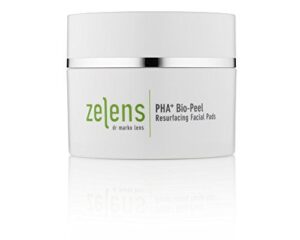
The Zelens PHA Plus Bio Peel Pads take a gentler approach to exfoliation, which makes them a smart pick if your skin leans sensitive or reactive. Each pre-soaked pad delivers lactobionic acid and salicylic acid together — one hydrating and resurfacing at the surface, the other clearing debris from inside pores. You get 50 pads per pack, sized for quick nightly use.
The formula also binds moisture to skin as it works, so you won’t wake up feeling stripped.
| Best For | Anyone with sensitive or reactive skin who wants effective exfoliation without the harshness of stronger acids. |
|---|---|
| Active Acid | PHA, AHA & BHA |
| Formula Type | Exfoliating pads |
| Pore Benefits | Minimizes enlarged pores |
| Texture Improvement | Refines and smooths skin |
| Skin Tone | Evens out skin tone |
| Sunscreen Advised | Yes |
| Additional Features |
|
- Combines PHA, AHA, and BHA in one pre-soaked pad for a genuinely well-rounded exfoliation without the fuss of layering products
- Hydrates as it resurfaces, so skin feels smoother and more radiant rather than tight or dry after use
- 50 pads per pack makes it easy to build into a consistent nightly routine
- Chemical acids mean you’ll need to be diligent about wearing sunscreen during the day
- At 50 pads, it may feel like a pricey commitment if you’re still figuring out whether it suits your skin
- Biodegradable disposal requirements add a small extra step compared to tossing a regular cotton pad
2. Ordinary Lactic Acid Exfoliating Serum
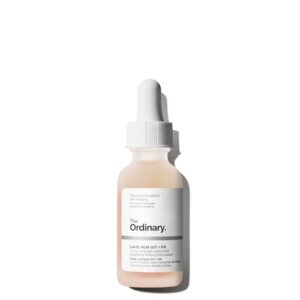
If you’re newer to acids, The Ordinary Lactic Acid Exfoliating Serum is a reliable starting point. At 10% lactic acid with a pH of roughly 3.8, it exfoliates the surface without overwhelming your skin. Tasmanian pepperberry extract helps keep irritation in check, while 2% hyaluronic acid replenishes moisture as the acid works — so you’re not trading hydration for texture.
Apply a thin layer to clean skin at night, then follow with moisturizer.
| Best For | Dry or sensitive skin types who are new to chemical exfoliation and want a gentle, hydrating acid treatment for smoother, more even-toned skin. |
|---|---|
| Active Acid | Lactic Acid 10% |
| Formula Type | Lightweight liquid serum |
| Pore Benefits | Clears clogged pores |
| Texture Improvement | Smooths and reduces flakiness |
| Skin Tone | Visibly evens skin tone |
| Sunscreen Advised | Yes |
| Additional Features |
|
- Combines 10% lactic acid with 2% hyaluronic acid, so you get effective exfoliation without stripping moisture
- Tasmanian pepperberry extract helps minimize irritation, making it more tolerable for sensitive skin
- Lightweight, water-based formula with no alcohol, oil, or silicone — sits comfortably under moisturizer
- Increases sun sensitivity, so daily sunscreen is non-negotiable
- May cause stinging or burning if your skin is highly reactive — a 5% version is a safer starting point
- Best used at night only, which limits flexibility in your routine
3. Paula Choice BHA Liquid Exfoliant
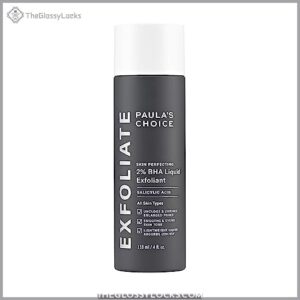
If your skin leans oily or your pores feel perpetually congested, Paula’s Choice 2% BHA Liquid Exfoliant is worth serious attention. Salicylic acid at 2% is oil-soluble, meaning it slips past surface debris and clears buildup from inside the pore — not just on top of it.
The formula is lightweight, fragrance-free, and absorbs cleanly before moisturizer. Apply it at night after cleansing. Expect gradual improvement in blackheads and skin texture over several weeks of consistent use.
| Best For | Anyone with oily or combination skin who struggles with blackheads, clogged pores, or uneven texture and wants a gentle, no-fuss daily exfoliant. |
|---|---|
| Active Acid | Salicylic Acid 2% |
| Formula Type | Leave-on liquid |
| Pore Benefits | Reduces blackheads & congestion |
| Texture Improvement | Smooths fine lines and texture |
| Skin Tone | Improves overall skin tone |
| Sunscreen Advised | Yes |
| Additional Features |
|
- The 2% salicylic acid penetrates deep into pores to clear out buildup — not just surface-level gunk
- Fragrance-free, lightweight formula that plays well with the rest of your routine, including makeup and sunscreen
- Works on multiple concerns at once: blackheads, enlarged pores, fine lines, and overall skin tone
- Can cause tingling, dryness, or flaking if you use too much too soon — especially for sensitive skin
- Daily sunscreen becomes non-negotiable since it increases your skin’s sensitivity to UV exposure
- The bottle’s dispenser tends to be messy and can lead to wasted product over time
4. Caudalie Vinopure Salicylic Acid Serum
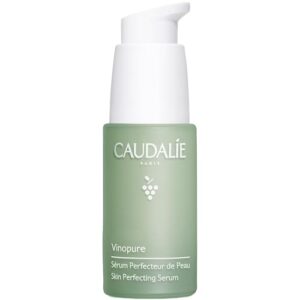
Where Paula’s Choice keeps things stripped back, Caudalie’s Vinopure Salicylic Acid Serum brings a more botanical approach — natural salicylic acid paired with niacinamide and antioxidant polyphenols that help curb sebum oxidation and reduce blackheads at the source.
The lightweight texture absorbs without grease and won’t disrupt your morning routine, since the formula is non-photosensitizing. Clinical data shows 82% of users saw tightened pores. At $49 for 30 mL, it suits oily and combination skin wanting results with a cleaner ingredient philosophy.
| Best For | Oily and acne-prone skin types who want effective pore-tightening and blackhead control with a more natural, botanical ingredient approach. |
|---|---|
| Active Acid | Natural Salicylic Acid |
| Formula Type | Liquid serum |
| Pore Benefits | Tightens & unclogs pores |
| Texture Improvement | Refines skin texture |
| Skin Tone | Brightens with niacinamide |
| Sunscreen Advised | Recommended |
| Additional Features |
|
- Natural salicylic acid combined with niacinamide and antioxidant polyphenols tackles blackheads, excess oil, and enlarged pores from multiple angles
- Non-photosensitizing formula means it’s safe to use in your morning routine without disrupting your skincare schedule
- 82% of users reported visibly tightened pores in clinical testing
- At $49 for just 30 mL, it’s on the pricier end for a serum of this size
- Can cause dryness or tingling, which may require dialing back to once-daily use for sensitive skin
- Not suitable for pregnant or breastfeeding women, and sunscreen is still recommended during daytime use
Frequently Asked Questions (FAQs)
Can I exfoliate before microcurrent?
Yes, but timing matters. Exfoliate at least 24–72 hours before your microcurrent session. Freshly exfoliated skin is more sensitive, which can cause discomfort and reduce how effectively the device interacts with your skin.
Can chemical exfoliation help with KP?
Chemical exfoliation can genuinely help with KP. Lactic acid softens keratin plugs, while salicylic acid clears follicle openings. Consistent use smooths those rough bumps over time — just start slow to avoid irritation.
Can exfoliating remove hyperpigmentation?
Exfoliating can fade surface pigmentation, but it won’t erase deeper discoloration like melasma. Consistent, gentle use reveals fresher skin underneath — pair it with daily SPF, or dark spots will keep coming back.
Does exfoliating help with collagen production?
Acids stimulate your skin’s repair response, prompting fibroblasts in the dermis to ramp up collagen production. The result builds gradually — think weeks, not days — but consistent exfoliation genuinely helps achieve firmer, smoother-looking skin over time.
Can chemical exfoliants be used during pregnancy?
Pregnancy shifts your skin into new territory. Most low-strength AHAs like lactic and glycolic acid are generally considered safe, but consult your doctor before use — salicylic acid needs particular caution.
How do acids interact with prescription acne medications?
Using acids alongside prescription acne treatments can stack irritation fast. Retinoids and topical antibiotics already stress the barrier, so adding exfoliating acids on the same night often worsens dryness, redness, and sensitivity a lot.
Are chemical exfoliants safe for darker skin tones?
Yes — but the stakes are higher. Inflammation triggers pigmentation in deeper skin tones, turning a small reaction into a lasting dark mark. Start low, go slow, and daily SPF is non-negotiable.
Can you use exfoliating acids around the eye area?
The skin around your eyes is thinner and more reactive, so standard exfoliating acids don’t belong there. Stick to moisturizers and eye creams specifically formulated for that delicate zone.
Do chemical exfoliants expire or lose potency over time?
Yes — a product can be perfectly sealed and still be quietly losing its edge. Chemical exfoliants do expire. Most stay effective for 6 to 12 months after opening before acids degrade and results fade.
Conclusion
Chemical exfoliation is less like a shortcut and more like patient, consistent chemistry—small changes compounding quietly until the skin you wanted is simply the one you have.
Learning how to use chemical exfoliants correctly doesn’t require getting everything exactly right. Start slow, choose the right acid for your skin type, and protect your barrier every single day. The glow isn’t a product of luck. It’s the result of showing up consistently.