This site is supported by our readers. We may earn a commission, at no cost to you, if you purchase through links. This content is for general informational and educational purposes only and is not a substitute for professional medical, dermatological, or nutritional advice.

Your kitchen probably holds more skin-brightening power than your bathroom cabinet. Ingredients like turmeric, lemon, and raw potato have been used for generations across South Asian and Latin American beauty traditions—not because of trend cycles, but because the science behind them holds up.
Curcumin inhibits melanin production at the cellular level. Papain dissolves dead skin cells. Vitamin C blocks the enzyme responsible for dark spots.
These aren’t folk myths—they’re mechanisms. If uneven skin tone has felt like something you just have to live with, these five natural remedies for skin whitening offer a practical, evidence-backed place to start.
Table Of Contents
- Key Takeaways
- Natural Skin Whitening Remedies You Can Try at Home
- Key Active Compounds That Brighten Skin Naturally
- Safe Application Tips for Natural Skin Lightening
- Sun Protection and Exfoliation for Even Skin Tone
- Lifestyle Habits That Support Skin Brightening Results
- Frequently Asked Questions (FAQs)
- Which is best for skin whitening homemade?
- How to glow in 7 days naturally?
- How can I lighten my skin naturally?
- What is the best home remedy for skin whitening?
- How can I lighten my dark skin fast?
- Can diet impact natural skin whitening results?
- Are there any remedies for sensitive skin?
- How long do natural remedies take to work?
- What are the best remedies for oily skin?
- Can natural remedies help with acne scars?
- Conclusion
Key Takeaways
- Turmeric, lemon, papaya, and raw potato work because of real chemical mechanisms—curcumin suppresses melanin at the cellular level, vitamin C blocks the enzyme that triggers dark spots, and papain dissolves dead skin cells without any scrubbing.
- Patch test every remedy on your inner forearm first, dilute acidic ingredients like lemon juice with equal parts water, and skip any application if your skin is broken, red, or already irritated.
- Natural lightening makes your skin more sun-sensitive, so applying SPF 30+ every day—and reapplying every two hours outdoors—is non-negotiable if you want your results to stick.
- Consistency over 6–8 weeks beats any shortcut—sleep, hydration, and an antioxidant-rich diet quietly do as much brightening work as anything you put on your face.
Natural Skin Whitening Remedies You Can Try at Home

Your kitchen might already have everything you need to start brightening your skin.
For gentle guidance, explore natural skin-brightening remedies for an even-toned glow and always moisturize afterward.
From turmeric to honey, these everyday staples are surprisingly powerful—check out these natural skin-brightening remedies you can make at home using ingredients already in your pantry.
These five remedies are simple to make, easy to use, and backed by real science.
Here’s what you can start trying today.
Lemon Juice and Water Mixtures
Lemon juice is one of the most accessible natural skin whitening remedies you’ll find in your kitchen. Mixed equally with water, it delivers vitamin C and citric acid that gently inhibit melanin production.
Regular consumption of lemon water can boost overall hydration benefits, which is essential for skin health.
Keep these safe natural lightening ingredients tips in mind:
- Use fresh lemon juice; shelf life drops quickly once cut
- Water ratio adjustments matter — never apply undiluted
- pH monitoring helps prevent skin barrier impact
- Always pair with photoprotection afterward
Turmeric and Yogurt Masks
Another kitchen staple worth trying: a turmeric and yogurt mask.
Mix 1 teaspoon turmeric powder into 2 tablespoons plain yogurt — mixing ratio matters here — until you get a spreadable, thick-cream texture consistency.
Leave it on for 15–20 minutes, then rinse thoroughly.
| What to Watch | Why It Matters |
|---|---|
| Stain management | Turmeric stains towels and skin |
| Leave on timing | Stick to 20 minutes max |
| Storage stability | Discard after 24 hours |
| Safe natural lightening ingredients | Patch-test first, always |
Papaya and Lemon Juice Pastes
Fresh papaya mashed with equal parts lemon juice makes one of the natural skin whitening remedies you’ll find in DIY home skincare routines. Aim for a thick paste consistency — smooth enough to spread evenly, but not watery. Apply for 10–15 minutes max, since lemon juice increases sun sensitivity quickly.
- Use ripe papaya for better papain activity
- Even coverage prevents patchy results
- Rinse immediately if you feel sharp stinging — that’s your irritation indicator
- Store any leftover paste refrigerated; discard within 24 hours
Gram Flour and Honey Brightening Masks
Gram flour and honey make one of the most practical DIY brightening masks using kitchen foods you already own.
Mix 4 teaspoons of gram flour with 1 teaspoon honey and enough milk to reach a smooth paste viscosity — thick, not runny.
For more on how natural ingredients like these compare to popular remedies, simple natural skin solutions can help you sort the science from the hype.
Get your ingredient ratios right, apply for 20 minutes, then rinse.
Store leftovers refrigerated and discard after 24 hours.
Potato Juice and Vitamin C Treatments
Raw potato juice is one of those DIY brightening masks using kitchen foods that quietly punches above its weight. Cold press extraction — blending unpeeled potato and straining it fresh — preserves vitamin C potency and the catecholase enzyme, both working as synergistic antioxidants against hyperpigmentation.
Apply with a clean cotton pad, leave for 15 minutes, and practice irritation monitoring closely. Potato skin benefits are real, but consistency wins.
Key Active Compounds That Brighten Skin Naturally

The real magic behind these natural remedies isn’t just tradition — it’s chemistry. Each ingredient works because of specific compounds that interact directly with how your skin produces pigment.
Here are the key ones worth knowing about.
Vitamin C and Tyrosinase Inhibition
Vitamin C is one of the most effective natural skin lightening agents you’ll find — and the science backs it up. It targets tyrosinase directly, using copper chelation to disrupt the enzyme’s ability to produce melanin. Think of it like pulling the fuel line on a engine.
Vitamin C disrupts melanin production by targeting tyrosinase directly through copper chelation
- Dose-dependent inhibition means more consistent application brings stronger results
- Stability challenges require fresh lemon juice or well-formulated delivery systems
- Synergistic antioxidants in your diet enhance what topical vitamin C starts
Curcumin’s Role in Melanin Suppression
Turmeric’s active compound, curcumin, works deeper than most natural skin lightening agents.
It triggers PI3K/Akt activation and ERK/p38 MAPK modulation, basically sending "slow down" signals to your melanocytes.
This drives MITF downregulation, cutting production of tyrosinase and related enzymes.
The result is real melanosome protein reduction and dose-dependent suppression of melanin — making curcumin one of the most scientifically grounded safe natural lightening ingredients available.
Papain Enzyme for Dead Skin Removal
Papaya’s papain enzyme works like a tiny cleanup crew for your skin. This proteolytic enzyme targets dead keratinocytes, digesting protein bonds so dull cells shed naturally — no scrubbing required.
As an enzymatic peel, timing matters: leave it on for 10–20 minutes for ideal pH range activity.
Always do allergy screening first, especially if you’re latex-sensitive.
The result? Real texture improvement and brighter, fresher skin.
Aloin and Aloesin in Aloe Vera
Aloe vera’s real brightening power comes from two lesser-known compounds: aloin and aloesin. Both interfere with melanin production by suppressing tyrosinase activity.
They’re among the safe natural lightening ingredients worth knowing — but extraction methods matter, since these compounds concentrate in the latex layer, not the inner gel.
Stability concerns and regulatory limits on aloin mean synergistic formulations with calming ingredients reduce irritation potential substantially.
Catecholase in Potato for Hyperpigmentation
Raw potato is quietly one of the most overlooked home remedies for hyperpigmentation. Its secret weapon? Catecholase — an enzyme that targets tyrosinase, slowing melanin production right at the source.
Here’s how to use it:
- Catecholase Mechanism — Interrupts melanin synthesis for gradual lightening
- Potato Slice Application — Rub directly on dark spots for 15–20 minutes
- Enzyme Activity — Only active in fresh, raw potato preparations
- Storage Stability — Use immediately; enzyme degrades quickly after cutting
- Skin Sensitivity — Patch test first, especially on reactive skin
Safe Application Tips for Natural Skin Lightening
Getting results from natural remedies isn’t just about what you put on your skin — it’s about how you use it. A few smart habits can be the difference between glowing skin and an irritated mess.
Here’s what you need to know before applying anything to your face.
How to Patch Test Before Use
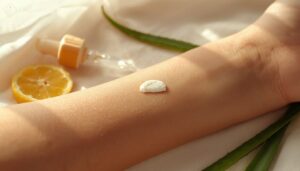
Before trying any natural skin whitening remedies or home remedies for hyperpigmentation, patch testing safety is non‑negotiable. Choose your patch area — the inner forearm works best. Apply a quarter‑sized application amount, then wait 24 hours as your observation period.
Watch for reaction indicators like redness, itching, or swelling. No reaction? You’re good to proceed.
Diluting Acidic Ingredients Safely
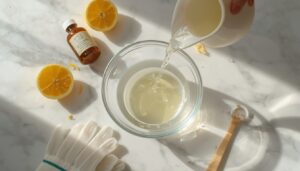
Once you’ve cleared your patch test, it’s time to talk acid dilution ratios — because lemon juice and apple cider vinegar can genuinely irritate if used straight.
Follow the Water First Rule every time:
- Pour water into your bowl first
- Add citric acid or lemon juice slowly
- Stir gently for temperature control
- Use gloves — basic protective gear matters
Equal parts water-to-juice keeps skin pH balance safe.
Frequency Guidelines for Lightening Masks
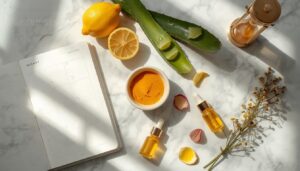
Now that your formula is properly diluted, how often you actually use it matters just as much.
For most brightening masks, a weekly session count of two to three times works well — with at least one rest day spacing between each use.
Stronger actives need more downtime.
Watch for irritation monitoring cues like redness or tightness, and plan your course duration across six to eight weeks for real results.
Avoiding Application on Broken or Irritated Skin
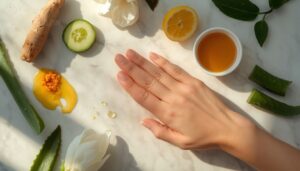
Even with the right frequency nailed down, timing matters just as much as routine. If your skin is broken, inflamed, or already stinging, skip the mask entirely.
Here’s what to do instead:
- Barrier Integrity Checks – Look for redness, swelling, or open areas before applying anything.
- Irritation Warning Signs – Burning or tightness means stop immediately.
- Gentle Cleansing Methods – Rinse with cool water and mild soap only.
- Avoiding Fragrance Triggers – Fragranced products worsen sensitized skin fast.
- Post-Application Skin Care – Moisturize after every session to support skin barrier repair.
Sun Protection and Exfoliation for Even Skin Tone
Getting your skin tone even isn’t just about what you put on your face — it’s also about protecting what you’ve worked for. Natural lightening treatments can leave your skin more sensitive, so skipping sunscreen or over-exfoliating can undo your progress fast.
Here’s what you need to know to keep your skin safe and your results on track.
Since most formulas work their magic in under 10 minutes, choosing the right one matters, so check out this roundup of the best hair removal creams for men before you buy.
Why SPF 30+ Matters After Lightening Treatments
Your skin is most vulnerable right after a lightening treatment — skip sunscreen, and you’re undoing all that effort.
| Protection Goal | SPF 30 Action | Without SPF |
|---|---|---|
| UVB Inhibition | Blocks ~97% UVB | Pigment flares re-form |
| Post-Treatment Pigment Control | Stabilizes recovery | Dark spots worsen |
| Barrier Sensitivity Reduction | Lowers inflammation | Prolonged discoloration |
Apply broad-spectrum SPF 30 daily, and reapply every two hours outdoors. Consistent photoprotection and smart reapplication timing keep your results intact.
Avoiding Phototoxicity From Citrus-Based Remedies
Citrus photosensitivity is real — and lemon juice left on your skin before stepping outside can trigger a phototoxic reaction. Here’s how to stay safe:
- Choose distilled citrus oil over cold-pressed oil, which retains phototoxic furanocoumarins.
- Always use a dilution carrier choice like honey or rose water.
- Follow an immediate rinse protocol — wash off within 20 minutes.
- Respect your sun exposure window: avoid UV for 12–24 hours post-application.
Phototoxicity risk drops substantially with these safety precautions for natural skin treatments. Sunscreen still applies.
Gentle Exfoliation Techniques for Brighter Skin
Exfoliating doesn’t have to mean aggressive scrubbing — your skin responds better to patience. A simple Oatmeal Scrub mixed with honey works beautifully: use Light Pressure and small Circular Motion for about 30 seconds, then rinse with Lukewarm Rinse water. Prefer chemical-style options? An Enzyme Mask using papaya (papain) dissolves dead cells without any friction at all.
| Technique | Best For |
|---|---|
| Oatmeal Scrub | Sensitive or dry skin |
| Enzyme Mask | Dull, uneven tone |
| Papaya Paste | Hyperpigmentation |
| Sugar-Coconut Scrub | Normal, resilient skin |
| Gram Flour Mask | Daily brightening |
These DIY exfoliation methods using kitchen items are genuine Gentle skin care tools. Exfoliation techniques with fruit enzymes and natural exfoliants support Exfoliation and moisturization for brighter skin when used consistently — two to three times weekly, maximum.
Moisturizing After Exfoliation to Protect Skin Barrier
After exfoliation, your skin barrier is open and ready — don’t leave it exposed. Apply moisturizer within 5–10 minutes for ideal Moisturizer Timing and Humectant lock‑in while skin is still damp.
Focus on:
- Barrier Lipid Recovery with ceramide-rich creams
- Post-Exfoliation Soothing using gentle panthenol formulas
- Gentle Massage Application to absorb without friction
This completes exfoliation and moisturization for brighter skin.
Lifestyle Habits That Support Skin Brightening Results

skincare routine only tells part of the story — what happens off your face matters just as much. The habits you build every day can either support your brightening efforts or quietly work against them.
what to focus on.
Hydration and Daily Water Intake for Skin Clarity
Think of your skin as a sponge — it works best when it’s not dried out. Aiming for about 2 liters daily strengthens your skin’s hydration barrier interaction and helps reduce TEWL (transepidermal water loss), meaning your skin holds moisture better.
Spread your fluid distribution habits throughout the day for ideal water timing.
Consistent daily intake monitoring over weeks, not days, is what actually moves the needle on skin hydration and overall skin health.
Antioxidant-Rich Diet and Melanin Regulation
What you eat shows up on your skin. Dietary antioxidants like vitamin C, Berry Anthocyanins, and Green Tea Catechins work by neutralizing the reactive oxygen species that trigger excess melanin production.
Add Carotenoid-Rich Vegetables, Omega-3 Anti-Inflammatory fats, and Vitamin E Protection through whole foods daily. This antioxidant-rich approach promotes natural lightening from the inside — no complicated routine required.
Sleep Quality and Skin Cell Regeneration
Your diet sets the stage, but sleep seals the deal.
During deep sleep, your body releases a growth hormone boost that drives collagen synthesis and speeds cell turnover.
Nighttime microcirculation delivers oxygen straight to renewing skin cells, while inflammation reduction keeps pigment flare-ups in check.
Aim for 7–9 hours to keep your circadian turnover rhythm working for you overnight.
Frequently Asked Questions (FAQs)
Which is best for skin whitening homemade?
As the old saying goes, the best tool is the one you’ll actually use.
For most skin types, turmeric with honey offers the safest balance of ingredient stability, cost-effectiveness, and a realistic result timeline without irritation.
How to glow in 7 days naturally?
Start simple: cleanse morning and night, apply a turmeric-honey mask twice this week, and finish each session with a cold water rinse. Seven days of consistency beats any shortcut.
How can I lighten my skin naturally?
Think of your skin as a mirror — what you put in and on it reflects back.
Natural lightening works through consistent DIY methods using safe natural lightening ingredients like lemon, turmeric, and papaya.
What is the best home remedy for skin whitening?
Lemon juice mixed with honey tops the list — it’s affordable, easy to make, and gentle enough for most skin types.
Just remember: fresh is best, so toss any leftover mix after 24 hours.
How can I lighten my dark skin fast?
Fair warning — there’s no real "fast lane" here, but smart choices do speed things up.
Enzyme Spot Peels with papaya, lemon juice, and honey work faster than most natural lighteners when used consistently.
Can diet impact natural skin whitening results?
Yes, diet plays a real role.
Vitamin C intake, Omega-3 Fatty Acids, Zinc Consumption, Low Glycemic Foods, and Fermented Food Probiotics all support clearer, more even skin from the inside out.
Are there any remedies for sensitive skin?
Sensitive skin needs extra care.
Stick to gentle skin care with Fragrance-Free Formulas, Barrier Repair moisturizers, and Calming Botanicals like Aloe vera, honey, and cucumber.
Always patch test first, and lean on anti-inflammatory agents for gentle hydration.
How long do natural remedies take to work?
Most natural remedies take 2–6 weeks before you notice real skin brightening. Patience and consistency are everything — skipping sessions breaks the cycle your skin needs to fade dark spots gradually.
What are the best remedies for oily skin?
Oily skin thrives with a salicylic acid cleanser, clay mask types, niacinamide serum, and oil-free moisturizers.
Try aloe vera, gram flour, or turmeric masks, and use paper strip blotting for midday shine control.
Can natural remedies help with acne scars?
They can — especially for post-inflammation hyperpigmentation.
Ingredients like vitamin C, turmeric, and aloe vera support inflammation reduction and gentle exfoliation, gradually fading acne scars while encouraging healthier, more even-looking skin over time.
Conclusion
Brighter, balanced skin begins in your kitchen—not a pharmacy. Every natural remedy for skin whitening covered here works with your skin’s biology, not against it.
Turmeric calms, lemon clarifies, papaya resurfaces.
But consistency is what actually moves the needle.
Patch test first, protect with SPF daily, and give each remedy three to four weeks before judging results.
Your skin didn’t change overnight, and it won’t reverse overnight—but it will respond.