This site is supported by our readers. We may earn a commission, at no cost to you, if you purchase through links. This content is for general informational and educational purposes only and is not a substitute for professional medical, dermatological, or nutritional advice.
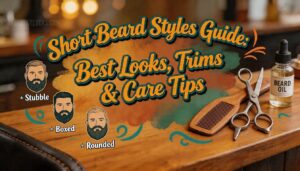
The right beard length changes everything.
few extra millimeters can shift your look from polished professional to weekend adventurer—or land you somewhere awkward in between.
Most men pick a style based on what they saw on someone else, grow it out, and wonder why it doesn’t quite work on them.
The truth is short beards aren’t one-size-fits-all.
Your face shape, hair texture, and daily routine all determine which style actually flatters you.
This short beard styles guide breaks down the best looks, trim them with precision, and how to keep them sharp without a complicated routine.
Table Of Contents
- Key Takeaways
- What Counts as a Short Beard?
- How to Choose Your Best Style
- Best Short Beard Styles to Try
- Short Beards for Every Face Shape
- How to Trim and Shape
- Daily Care for Short Beards
- Frequently Asked Questions (FAQs)
- How can I fix uneven beard growth?
- What foods promote healthy beard growth?
- How do seasonal changes affect beard health?
- What are ideal short beard styles for professionals?
- Can short beards work with bald heads?
- Do short beards affect kissing or intimacy comfort?
- How does climate impact short beard growth and care?
- Do short beards look good on older men?
- Conclusion
Key Takeaways
- Your face shape is the foundation — ignoring it means even a clean, well‑trimmed beard can throw your whole look off balance.
- Most short beards live between 4–15mm, and finding your sweet spot in that range beats chasing a style that doesn’t fit your hair texture or daily routine.
- Clean necklines and sharp cheek lines do more for your beard’s appearance than length ever will — precision is what separates polished from rough.
- Short beards still need consistent care: beard oil, the right wash technique, and trimming on schedule keeps irritation, patchiness, and flakes from killing the look.
What Counts as a Short Beard?

Not all beards are created equal, and knowing where yours falls makes grooming a whole lot easier. Short beards cover more ground than most guys realize — from barely-there stubble to a clean boxed style sitting just past the chin.
Whether you’re just getting started or keeping things casual, short beard grooming tips and shaving basics can help you nail the look without overcomplicating your routine.
Here’s what separates them from the rest.
Stubble Vs Short Beard Vs Full Beard
Not all facial hair is created equal. Short stubble sits at 1–2 mm, heavy stubble hits 4–5 mm, and a short beard climbs toward 10 mm.
- Short stubble: minimal short beard maintenance, suits busy routines
- Heavy stubble: stronger social perception, still low product costs
- Full beard: bold statement, seasonal adjustments matter more
Each stage changes how your skin irritation risk and growth timeline stack up. The short beard length range is defined as 4‑15 mm.
Typical Short Beard Length Range
Most short beards live between 4 mm and 15 mm. That’s your real sweet spot — past stubble, before bulk.
Around 10 mm hits a practical middle ground: full enough to cover patchy areas, short enough for easy short beard maintenance.
| Length | What It Looks Like |
|---|---|
| 4–5 mm | Heavy stubble territory |
| 7–8 mm | Defined, controlled coverage |
| 10 mm | Fuller, still tidy |
| 13–15 mm | Approaching medium length |
Hair texture impact matters too — coarser hair looks denser at shorter lengths.
Guard Sizes for Common Short Styles
Guard numbers are your roadmap. A number 1 guard (3.2 mm) nails light stubble, while a number 2 (6.4 mm) builds heavy stubble.
Step up to a number 3 or 4 for a proper short beard length. Think of it as your Guard Size Chart in practice — chin guard increment up, cheek guard ratio tighter.
Taper lever adjustment fine-tunes everything between steps.
Why Shorter Beards Are Easier to Maintain
Once you’ve dialed in your guard size, keeping things surprisingly simple. Less hair means faster drying time after washing, reduced product usage, and less debris buildup throughout the day.
Your trim frequency stays low — usually once or twice a week.
That’s what makes short beard maintenance so appealing: a quick grooming routine manages most of the upkeep, making low-maintenance short beard choices genuinely easy.
How to Choose Your Best Style

Picking the right short beard isn’t just about what looks cool — it’s about what actually works for your face, your routine, and the image you want to project.
A few key factors will help you narrow it down fast.
Here’s what to think about before you commit to a style.
Face Shape Considerations
Your face shape is the blueprint — ignore it and even the cleanest beard can look off.
Round faces need chin length balance and styles that draw the eye downward. Square faces benefit from jawline softening rather than adding more angle. Oval faces handle almost any short beard styles for men.
Sideburn proportion and cheek line definition fine‑tune how facial hair angles frame everything.
Beard Density and Patchy Growth
Patchy growth isn’t a dead end — it’s just information.
Follicle Density varies by genetics, so Genetic Predisposition plays a bigger role than effort. Hormonal Influence from DHT determines thickness, while Nutritional Support through zinc and vitamin D keeps follicles active.
For stubborn sparse spots, Minoxidil Treatment has shown real results.
Smart short beard options for patchy growth, and proper short beard maintenance and grooming tips, turn thin coverage into a clean, intentional look.
Personal Style and Lifestyle Fit
Your beard should match how you actually live.
If you’re always on the move, low-maintenance short beard choices like stubble offer real Travel Convenience — minimal upkeep, consistent results.
Into fitness? Fitness Integration is easy with compact styles that stay neat through workouts.
Minimalist Aesthetic calls for clean lines, while Creative Expression suits bolder shapes.
Personal style selection starts with honest self-awareness.
Professional Vs Rugged Appearance
The same short beard can walk into a boardroom or a campsite — it all depends on how you shape it.
A short beard can command a boardroom or a campsite — shaping it makes all the difference
- Cheek Line Precision creates clean boundaries that signal Workplace Image and professional appearance.
- Neckline Positioning higher up reads polished; lower feels rugged.
- Texture Contrast — tighter trim for office-appropriate short beard looks, looser for raw edge.
- Outfit Synergy seals the statement: crisp collar or worn denim.
- Sharp lines equal short-beard styling techniques that shift perception instantly.
Low-maintenance Vs High-definition Styles
Your growth rate decides everything here. Fast growers need sharp edges touched up weekly — that’s the high-definition path, and it demands consistent trimming, precision tools, and real short beard upkeep.
Low-maintenance short beard choices like stubble forgive a 10 to 14 day gap naturally.
Think about how much maintenance time you actually have before committing to edge consistency over relaxation.
Best Short Beard Styles to Try
There’s no shortage of short beard styles worth trying, and each one hits differently depending on your face and vibe. Some are clean and professional, others add edge without going overboard.
Here are nine solid options to explore.
Three-day Stubble

Three-day stubble is the ideal grab-and-go style — and mastering it’s simpler than you think.
Keep your short stubble beard trimmed to 1–3 mm, hitting that sweet spot around 1.5 mm.
Growth Cycle Timing matters here: trim every two to three days.
Use lightweight stubble grooming products suited for Skin Sensitivity Management, since short skin exposure demands gentle ingredients.
Heavy Stubble

Step up from short stubble, and heavy stubble hits differently — bolder, more commanding, and still manageable.
Sitting at 4–5 mm after roughly 10 days of growth, this style delivers serious Weight Distribution along your jawline without demanding a full commitment.
- Trim every 2–3 days for Growth Cycle control
- Apply beard oil daily for Texture Management
- Keep neckline tight — clean lines make your beard trim look intentional
Seasonal Growth shifts may affect density, but consistent beard grooming keeps it sharp.
Short Boxed Beard
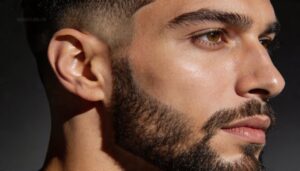
Want structure without the bulk? The short boxed beard is your next move — sitting at 10–15 mm, it frames your face shape with clean angular edges that look intentional every single day.
| Feature | Detail |
|---|---|
| Length | 10–15 mm |
| Trim Frequency | Weekly |
| Best Face Shape | Oval, Round |
| Key Product | Beard oil |
| Maintenance Level | Low–Medium |
Circle Beard

The circle beard connects your mustache and chin hair into one clean ring — no sideburns, no bulk. Your growth timeline runs about two to three weeks before you can shape it properly.
Nail the symmetry techniques early, because this style lives or dies by its outline. Mustache integration is everything here.
Styling variations range from rounded to slightly squared edges depending on your face.
Goatee

The goatee strips everything back — just chin hair, clean cheeks, no fuss.
Historical Roots go back centuries, but Pop Culture kept it alive through the ’90s and beyond.
Van Dyke adds a detached mustache for a sharper take.
Different Goatee Shapes suit different faces, and smart Accessory Pairings like a clean fade make it hit harder.
Skin Health stays simple when there’s less hair to manage.
Balbo Beard

The Balbo beard has serious style pedigree.
Its historical roots trace back to Italian aviator Italo Balbo in the 1920s, and celebrity influence reignited it when Robert Downey Jr. wore it as Tony Stark.
Gap Styling — that clean 3–5 mm separation between mustache and chin — is what makes it distinct.
Try the Extended Balbo or Handlebar Pairing for more personality.
Anchor Beard

The anchor beard is one of the sharpest short beard styles for men who want structure without bulk. It combines a pointed chin beard, soul patch, and mustache — shaped like a ship’s anchor.
Short beard grooming tips here start with precision: use a trimmer and razor to define clean edges. It works best on square and round face shapes, adding strong lower-face definition.
Chin Strap
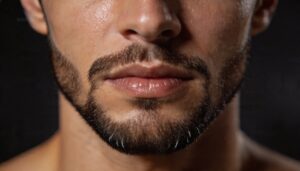
The chin strap is one of those styles with real historical origins — it was a gentleman’s staple from the late 1700s through the mid-1800s.
Width options range from a razor-thin 2mm to a bolder 10mm, so you can dial in your look by face shape. Round and square faces both benefit here.
Trim every 2–3 days, keep edges sharp, and use beard oil daily for smart short beard maintenance and grooming tips.
Short Full Beard
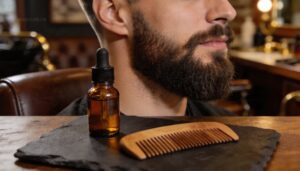
short full beard is the sweet spot between "just started growing" and "full lumberjack." It keeps hair across your cheeks, jaw, chin, and upper lip — trimmed to a clean 5–10 mm for ideal beard weight distribution.
Three things that make it work:
- Uniform length benefits your overall shape
- Beard oil keeps skin healthy underneath
- beard comb trains your growth pattern management daily
In warmer months, seasonal styling tips favor trimming tighter. Keep edges clean, and this style fits any setting.
Short Beards for Every Face Shape
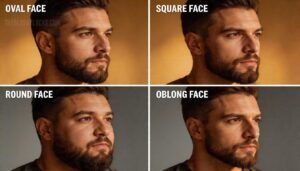
Your face shape is the starting point for picking a beard that actually works for you. The right style can sharpen your features, add balance, or create the illusion of length — all without much extra effort.
Here’s what works best for each face shape.
Best Styles for Round Faces
Round faces need one thing above all else: face elongation. The goal is chin focus — keeping volume where it counts and cutting it where it doesn’t.
Styles like the goatee, Balbo, and anchor beard deliver angular definition without adding bulk to the sides. Think minimal side volume, crisp edges, and a clean neckline. That’s your slimming effect.
Short beard options for round faces work best when they pull the eye downward, not outward.
Best Styles for Square Faces
Square faces carry strong angles — and the right short beard works with that, not against it. Your goal is jawline softening through a rounded cheek contour and extended chin focus. Styles like the goatee and Balbo keep sideburn taper control tight while drawing the eye downward.
A gentle edge blend beats hard lines every time. That’s how short beard styles for men with square faces win.
Best Styles for Oval Faces
Oval faces already have the balanced structure most men chase. That symmetry — with cheekbones as the widest point and a softly rounded jaw — means choosing a short beard based on face shape is genuinely easy here.
Stubble or a circle beard delivers cheekbone emphasis without adding bulk. Want a subtle chin lift? A light goatee achieves that. Maintenance simplicity is your reward for good natural proportions.
Best Styles for Long Faces
Long faces need width, not length. That’s the opposite of what oval faces require — so your approach shifts here.
Keep these four things in mind:
- Add a Side Volume Boost to widen the jaw visually
- Use a Rounded Chin Contour instead of a point
- Set a Higher Cheek Line for added horizontal emphasis
- Maintain a Balanced Edge Shape with Light Stubble Texture
A short boxed beard works best.
Best Styles for Diamond Faces
Diamond faces flip the script from long faces. Your cheekbones are the star here — wide and prominent — while your forehead and jaw stay narrower.
That means your beard needs to work on Chin Width Emphasis and Lower Face Balance, not on volume on the sides.
| Style | Why It Works |
|---|---|
| Goatee | Adds chin focus and visual width |
| Circle Beard | Softens pointed features below the mouth |
| Short Boxed Beard | Frames the jaw without crowding cheekbones |
| Structured Stubble | Light coverage for natural Cheekbone Contour |
| Anchor Beard | Builds lower face presence with clean edges |
Keep sides clean. Build width low.
Best Styles for Heart-shaped Faces
Heart-shaped faces — think wider forehead, narrower chin — are basically the inverse of diamond faces. Your job is adding Chin Weight Balance low on the face to fix that Facial Proportion Tips imbalance at the top.
Heavy stubble or a short boxed beard are your strongest moves. Both use Low Volume Stubble and Sideburn Length Control to keep width off your cheeks while building presence at the jaw.
How to Trim and Shape
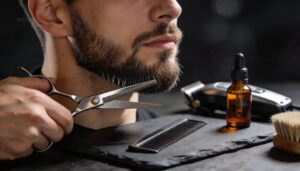
A sharp beard doesn’t happen by accident — it comes down to the right tools and a consistent routine.
Knowing where to trim, how much to take off, and how to clean up your edges makes all the difference.
Here’s what you need to get it right.
Tools Needed for Precise Trimming
The right tools make short beard trimming almost easy. Start with an adjustable trimmer guard on your electric trimmer for consistent length control across cheeks and jaw. A precision detail trimmer tackles tight spots like moustache corners and neckline edges.
Keep stainless beard scissors nearby for stray hairs, and use a clear shaping guide plus a three-way mirror to keep both sides perfectly balanced.
Choosing The Right Trimmer Setting
Pick your guard based on the beard you want. Stubble lives at 1–3 mm; short boxed styles sit in the 4–10 mm range.
Guard Increment Precision, use Stepwise Length Adjustment — drop settings by 0.5–1 mm at a time and check as you go.
Skin Sensitivity Settings matter too: if irritation is a concern, stay at longer guards. Small changes hit differently with short beards.
Creating Clean Cheek Lines
Most guys overcomplicate cheek lines. Follow your beard’s Natural Cheek Curve — that soft arc is already doing the work.
Use the Edge Shift Technique: trim stray hairs above the main line first, working top-down in small passes. Do a Visual Symmetry Check from arm’s length.
Clean cheek lines and necklines transform short beard grooming from rough to sharp, instantly.
Setting a Neat Neckline
A bad neckline can wreck an otherwise sharp beard. Nail it with these steps:
- Neckline Height — Place it two fingers above your Adam’s apple
- U‑Shape Curve — Follow a gentle arc, never a straight line
- Guideline Marking — Mark the line before trimming anything
- Mirror Angle — Tilt your chin up slightly for a clear view
- Touch‑Up Schedule — Clean it up every two to three days
Short beard maintenance and grooming tips start here — beard line definition lives and dies at the neckline.
Blending Sideburns Into The Beard
A smooth blend transforms good short beard styles into great ones.
Start with Ear Baseline Alignment — place your trimmer at the bottom of your ear and work upward. Use the Gradient Guard Shift, stepping down guard sizes incrementally. The Feathering Technique with a 45° Angle Comb Position pulls hair outward for a natural fade. Finish with a Symmetry Check Routine on both sides.
Fixing Uneven or Fast-growing Areas
Uneven growth isn’t failure — it’s just your beard having opinions. The fix is simple: trim faster-growing areas down to match your slowest sections. That’s the heart of length balancing tips.
- Use the guard shift method — drop one size on bulky spots only.
- Comb direction trimming reveals which patches sit higher.
- Build an evenness trim schedule with touch-ups every 2–3 days for fast growth control.
- Keep the overall beard slightly shorter to mask imbalance while slower areas catch up.
Daily Care for Short Beards

A short beard still needs regular attention to stay sharp and healthy. The good news is that the routine doesn’t have to be complicated or time-consuming.
Here’s what your daily care should actually look like.
Washing Without Drying The Skin
Washing your beard incorrectly strips the skin fast. Use a mild beard cleanser with lukewarm water — hot water pulls away natural oils and leaves skin tight.
Apply only where needed, rinse quickly, then pat dry with a soft towel. Leave the skin slightly damp before your next step.
| Step | What to Do | Why It Matters |
|---|---|---|
| Gentle Cleanser Choice | Use fragrance-free beard wash | Prevents skin irritation |
| Lukewarm Rinse / Limit Rinse Time | Quick rinse, fingertips only | Reduces dryness risk |
| Pat Dry Method / Leave Slightly Damp | Soft towel, no rubbing | Protects skin barrier |
Using Beard Oil and Balm
Once skin is damp, that’s the moment to reach for beard oil. Apply three to four drops while the hair is still slightly moist — Application Timing matters because damp hair absorbs argan or jojoba oil faster.
Then layer beard balm over it for control. This Product Layering approach keeps your short beard soft, shaped, and irritation‑free all day.
Combing and Brushing Correctly
After the oil and balm settle, grab your tools.
Always comb beard hair dry first — wet strands snap easily.
Use the Directional Grooming Flow: comb outward, then downward to settle shape.
A beard brush with natural bristles spreads product better than synthetic ones.
- Use a wide-tooth comb for thick hair to prevent knots.
- Apply the Dry Brushing Technique on fully dry hair only.
- Brush slowly with the grain, sides to chin.
- Clean your tools weekly — buildup makes them snag.
Trim Frequency by Beard Style
How often you trim depends on the style you’re running.
| Beard Style | Trim Frequency |
|---|---|
| Stubble Maintenance Cycle | Every 2–4 days |
| Boxed Beard Schedule | Every 7–10 days |
| Goatee Trim Interval | Every 1–2 weeks |
| Chin Strap Upkeep | Every 1–2 weeks |
| Balbo Refresh Rate | Every 1–2 weeks |
Stubble moves fastest — a few skipped days and the whole look shifts.
Structured styles like the short boxed beard need tighter beard trim frequency because the lines show every mistake.
Preventing Itch, Flakes, and Irritation
Itch and flakes aren’t just annoying — they’re signs your skin needs attention.
Stay ahead of the problem with these habits:
- Use Alcohol-Free Products to avoid stripping moisture
- Apply Barrier Repair Moisturizers to lock in hydration
- Try Temperature-Controlled Rinsing with warm, not hot, water
- Practice Soft Towel Drying — pat, don’t rub
- Add beard oil daily for skin irritation prevention
Consistent beard hygiene practices keep flare-ups away before they start.
Beard Care Kit Essentials
A solid kit doesn’t need to be complicated. Start with a beard shampoo, beard oil built on carrier oils like argan or jojoba, and a beard balm for hold and moisture.
Add an antimicrobial beard trimmer for clean edges and a silicone brush for even product distribution.
Pack travel kit essentials in a compact bag.
These grooming products keep any short beard sharp daily.
Frequently Asked Questions (FAQs)
How can I fix uneven beard growth?
Patchy growth patterns aren’t permanent problems.
Trim to a uniform stubble length, practice regular exfoliation, and support beard thickness management through a nutrient-rich diet.
Stress reduction and consistent grooming make a visible difference fast.
What foods promote healthy beard growth?
Beard hair is made of keratin, which your body builds from protein.
Since the nutrients you eat travel through your bloodstream to each follicle, how your diet affects beard growth and thickness matters more than most people realize.
Eat eggs, fish, and lean meats daily.
Add iron, zinc, omega-3 fats, and vitamin-rich vegetables to keep follicles strong and hydrated.
How do seasonal changes affect beard health?
Your beard feels the seasons before you do. Winter dryness strips moisture fast, summer heat brings frizz and sweat, and humidity impact shifts texture daily.
Adjust skin hydration, and growth variability stays manageable.
What are ideal short beard styles for professionals?
The short boxed beard and heavy stubble are top picks for office-ready length and client-facing appearance.
Both stay neat, signal intention, and fit professional grooming etiquette without demanding heavy daily effort.
Can short beards work with bald heads?
Yes, absolutely. A short beard adds contrast against a smooth scalp, sharpens jawline emphasis, and creates intentional scalp balance.
It’s a natural confidence boost that turns a minimalist aesthetic into a powerful, deliberate look.
Do short beards affect kissing or intimacy comfort?
Stubble can feel like sandpaper against a partner’s skin. Friction sensitivity is real.
Using beard oil softens the hair, and adjusting your kissing angle reduces direct contact, making intimacy noticeably more comfortable for both of you.
How does climate impact short beard growth and care?
As they say, dress for the weather — your beard should, too. Humidity Swelling makes edges blur fast. Dry Air Brittleness calls for heavier oil.
Cold Weather Moisture and UV Sun Damage, quietly wear hair down.
Do short beards look good on older men?
Absolutely.
A well-kept short beard on a mature man signals confidence, not age.
Gray or salt-and-pepper tones add refinement.
For men over 40 or 50, it’s one of the smartest grooming moves you can make.
Conclusion
The right beard doesn’t just happen—it’s built. Every trim, every clean line, every drop of oil is a quiet decision about how you show up.
This short beard styles guide gives you the blueprint, but the result belongs to you. Find the style that fits your face and your life.
Keep it sharp. Keep it intentional.
A great beard doesn’t demand attention—it commands it without saying a word.