This site is supported by our readers. We may earn a commission, at no cost to you, if you purchase through links. This content is for general informational and educational purposes only and is not a substitute for professional medical, dermatological, or nutritional advice.
Your curls soak in more than shampoo every morning. Hard water carries calcium and magnesium ions that bind directly to your hair’s protein structure, and curly strands trap these minerals faster than straight hair because of their spiral shape. The result: chalky residue near your roots, crunchy strands after drying, and curls that lose their bounce no matter how much product you layer on.
This isn’t a styling problem. It’s a water chemistry problem, and it demands a filtration solution built for your specific mineral count and porosity level.
The right shower filters for curly hair can reverse months of dullness, but only if you understand what each filtration technology actually removes, and what it can’t.
Table Of Contents
- Key Takeaways
- How Hard Water Damages Curly Hair
- Test Your Shower Water First
- Compare Shower Filter Technologies
- Know What Shower Filters Remove
- Choose Filters for Curly Hair
- Top 3 Shower Filters for Curly Hair
- Compare Performance, Features, and Value
- Install and Maintain Shower Filters
- Maximize Curly Hair Filter Results
- Frequently Asked Questions (FAQs)
- What are the downsides of using shower filters?
- How to protect curly hair when showering?
- Do shower filters actually work for hair?
- Do showerhead filters really work?
- Can shower filters help with frizzy or flat curls?
- Will a shower filter make my water pressure drop?
- Do shower filters work with tankless water heaters?
- Can I install a shower filter in a rental?
- How do I know if my filter is expired?
- Conclusion
Key Takeaways
- Hard water’s calcium and magnesium bind to your curls’ protein structure, causing chalky residue, crunchy strands, faded color, and lost curl definition over time.
- No shower filter actually softens water since true softening requires ion exchange (95%+ mineral reduction), while shower filters only manage 1-12% mineral reduction on their own.
- Before buying a filter, test your water hardness (in grains per gallon) and check your curls’ porosity, since these two factors determine which filtration type—KDF, vitamin C, calcium sulfite, or multi-stage—actually fits your needs.
- Pairing your filter with monthly chelating shampoo, diluted vinegar rinses, and deep conditioning closes the gap filters can’t reach, helping fully restore moisture retention and curl definition.
How Hard Water Damages Curly Hair
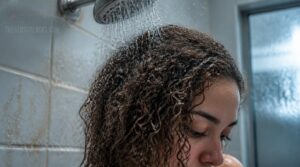
If your curls feel dry, dull, or oddly stiff no matter what you put on them, hard water is likely the culprit. Those calcium and magnesium minerals don’t just sit on the surface; they actively change how your hair behaves, from the roots to the ends. Here’s exactly what’s happening to your strands, broken down in five key ways.
Over time, that mineral buildup can worsen moisture loss, which is why learning how to restore hydration to water-damaged curls makes such a difference.
Calcium and Magnesium Buildup
Because calcium and magnesium ions bind to your curls’ protein structure, mineral buildup accumulates faster than on straight hair, where spirals trap dissolved solids at every bend.
- Dulling, weighed-down texture
- Chalky white residue near your roots
- Stiff, crunchy strands after drying
- Soap that won’t lather properly
A basic shower filter interrupts this cycle before deposits harden into scale, offering real mineral deposit prevention over water softening alternatives.
Understanding water hardness classification helps explain why mineral deposits form more readily in certain water supplies.
Increased Dryness and Porosity
That residue doesn’t just sit there. Hard water’s pH of 8.5-9 forces your cuticle open against hair’s natural 4.5-5.5 range, and once lifted, moisture escapes as fast as it enters.
| Porosity Level | Moisture Behavior |
|---|---|
| Low | Retains hydration steadily |
| High | Loses up to 30% more moisture |
| High | Dries within an hour post-styling |
| High | Craves frequent reapplication |
| High | Struggles to hold scalp oils |
Weakened Curl Definition
Once moisture escapes, curls lose the elasticity that gives them spring-back and shape. Mineral buildup coats each spiral, tightening its circumference and blurring definition into a smeared, flat texture.
Watch for:
- Curls that won’t hold their spiral shape after wash day
- Reduced bounce, even with your usual styling products
- Inconsistent pattern, defined in spots, limp elsewhere
Curl definition loss signals it’s time to rethink your water source, not just your products.
Scalp Irritation and Residue
Curl loss isn’t the only warning sign. That tight, itchy feeling after washing? It’s often a mineral film trapping calcium and magnesium against your scalp, blocking moisturizer absorption.
Watch for dullness that lingers post-rinse, tingling, or symptoms that fade when you skip a product. That pattern points to residue buildup, not just sensitivity, and it’s fixable with the right shower filter.
Color Fading and Brittleness
Dye molecules don’t stand a chance against hard water’s one-two punch. Minerals bond with pigment while pH shifts lift the cuticle, letting color wash out fast, especially on color-treated curls exposed to sun.
UV exposure and heat styling speed the damage further, leaving strands brittle and prone to hair breakage. Protein treatments and cold rinses help lock in vibrancy and restore moisture retention.
Test Your Shower Water First
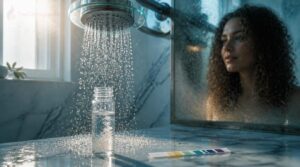
Before you buy any filter, you need real data on what’s actually coming out of your showerhead. Guessing at your water quality wastes money and leaves your curls exposed to minerals you never identified. Here’s how to diagnose your water in five practical steps.
Check Local Water Reports
Before buying anything, call your water utility. Your local water report (published annually or quarterly) lists calcium, magnesium, and chlorine residual data specific to your address, not a national average.
Check hardness levels (mg/L), source water type, and treatment methods listed. This tells you whether you’re fighting mild buildup or genuinely hard water before choosing a filter.
Use Hardness Testing Strips
If your water report leaves questions unanswered, hardness testing strips give you a fast, at-home reading. Dip the strip in a properly rinsed sample container, then match the resulting color to the chart within seconds for accuracy.
Test monthly, and again after installing any shower filters. Results guide how much mineral reduction your curly hair actually needs.
Measure Chlorine Levels
Chlorine hides better than minerals do. Test strips give quick free-chlorine readings in seconds, but a digital colorimeter offers tighter accuracy within 0.1 mg/L. For real confidence, lab testing catches levels as low as 0.05 mg/L.
Test weekly for a month post-installation. Anything above 0.5 ppm signals your shower filters need attention before hard water and chlorine keep damaging curly hair.
Identify Mineral Buildup Signs
Your bathroom tells the truth before any test strip does. Look for chalky tub grout, cloudy soap scum film, or spotting on fixtures.
Check these four spots:
- Showerhead nozzle holes for crusty scale
- Glass or tile for white residue
- Faucet edges for dull buildup
- Hair strands for waxy texture
That coating signals mineral buildup already stressing your curls before filters even help.
Evaluate Your Hair Symptoms
Your curls are already talking. Are you listening?
Run a hand down a few strands: coarse, rough, or coated means mineral buildup. Check for frizz control failure, flat curl definition, or a scalp that’s dry and flaky. If moisture retention feels impossible no matter what you apply, hard water is the culprit, not your products.
Compare Shower Filter Technologies
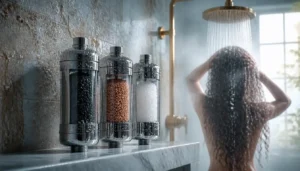
Not all shower filters work the same way, and the technology inside determines what actually comes out of your water. Some media target chlorine, others tackle minerals, and a few try to do both at once. Here’s what you need to know about each type before choosing one for your curls.
KDF Filtration Media
Copper and zinc granules drive KDF’s redox reaction, converting chlorine into harmless chloride while binding heavy metals like lead and iron before they ever touch your cuticle.
That electrochemical process also curbs scale-forming minerals through surface plating. KDF media lasts 6-12 months and relies on periodic backwashing to flush precipitates, keeping performance steady for curly hair craving moisture retention.
Activated Carbon Filters
KDF works well with metals, but it doesn’t touch odor and taste the way activated carbon does.
Its porous structure, sourced from coconut shell or coal, packs over 32,000 square feet of surface area per gram, driving serious adsorption efficiency. Pore size dictates capture ability, and saturation timing means your shower filter needs regular swaps to keep working.
Vitamin C Filtration
Odor and taste are one problem; chlorine’s chemical presence in your water is another, and that’s where a Vitamin C filter takes over.
Ascorbic acid neutralizes chlorine and chloramines almost instantly, achieving up to 99% removal while releasing skin-friendly antioxidants. Filter lifespan runs roughly 3 months, mineral reduction stays minimal (5-15%), and water pressure impact remains negligible, holding steady near 2.5 gpm.
Calcium Sulfite Media
Ascorbic acid experiences chlorine, but sulfur compounds need a different fix, which is where calcium sulfite media comes in.
Its chemical reduction process targets sulfur dioxide, forming inert byproducts trapped in the bed. It doesn’t soften hard water directly, but performance in hard water improves when paired with carbon.
- Standard 10" cartridge compatibility
- Limited regeneration, requiring replacement
- Media lifespan tied to usage
Multi-stage Filtration Systems
Layered defense works best against hard water minerals. Multistage filtration combines sediment screens, carbon blocks, and mineral-reducing media in sequence, so each stage protects the next and boosts overall filter lifespan.
This stage sequencing logic creates a true contaminant reduction cascade, achieving 40-70% mineral reduction. Filter media teamwork matters more than any single technology for restoring curl definition and moisture retention.
Know What Shower Filters Remove
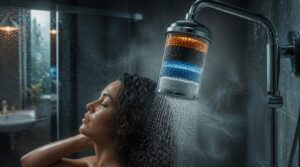
Not every filter experiences the same problem, and knowing the difference matters before you spend your money. Chlorine removal, mineral reduction, and sediment filtration each work through separate mechanisms with very different success rates. Here’s what these filters actually pull out of your water, and where their limits show up.
Chlorine Removal Effectiveness
Chlorine removal isn’t one-size-fits-all: KDF media hits 99% at hot shower temps but drops below 10% past 60 days, while vitamin C filters hold 99.9% removal for their entire lifespan.
Check for NSF/ANSI 177 certification before buying, since it verifies real-world performance, not lab claims.
Test your water’s chlorine level and replace filters on schedule to protect your curls.
Hard Mineral Reduction
Here’s the truth most labels won’t print: no shower filter softens water. True softening requires ion exchange, swapping calcium and magnesium for sodium, achieving 95%+ reduction. Shower filters only manage 1-12%.
No shower filter truly softens water; only ion exchange swaps calcium and magnesium for sodium at 95% efficiency
- KDF: under 2% mineral reduction
- Calcium sulfite blends: 70-85% scale reduction
- Multi-stage systems: strongest overall results
For real softening, add a whole-house system or monthly chelating shampoo.
Sediment and Impurity Filtration
Gritty water leaves more than mineral film behind. Sediment filtration traps sand, silt, and rust through particle size straining, catching debris a standard showerhead can’t. Micron ratings determine capture precision: lower ratings snag finer particles.
Cartridges load with debris over time, raising flow resistance as pores fill. This reduces turbidity noticeably, clearing cloudy water before it reaches curls, though it won’t touch dissolved hard water minerals at all.
Shower Filter Limitations
No shower filter is magic. Filter media saturation caps how much chlorine and mineral content any cartridge controls before performance drops off.
Flow rate, water temperature, and installation constraints all matter too:
- High flow rate shortens contact time
- Hot water lowers mineral reduction
- Pressure drop affects handheld heads most
Curly hair still needs realistic expectations here.
Filters Versus Water Softeners
Filters and softeners aren’t interchangeable. A water softener uses the Ion Exchange Process, swapping calcium and magnesium for sodium via Sodium Replacement, delivering true Scale Prevention across your Whole House. Shower filters can’t perform Mineral Exchange at that scale.
For curly hair, pair a dedicated softener with your filter if you want real mineral reduction, not just chlorine control against hard water.
Choose Filters for Curly Hair
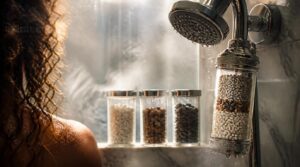
Choosing the right shower filter isn’t a one-size-fits-all decision, especially when your curls have their own porosity, color treatment, and water pressure needs to think about. Your specific hair goals and water hardness level will point you toward one filter over another. Here’s what to weigh before you buy.
Match Your Water Hardness
Before buying anything, know your number. Water hardness runs on a scale measured in grains per gallon (gpg): soft (under 1), moderately hard (1-7), hard (7-10.5), very hard (above 10.5).
Soft water needs only basic carbon filtration. Moderately hard water calls for KDF plus vitamin C. Hard water demands multi-stage systems. Very hard water often needs a dedicated softener alongside your filter for real mineral reduction.
Consider Curl Porosity
Your gpg number tells you how hard your water is, but porosity tells you how your curls respond to it. Run the wetting test: water beading over 30 seconds means low porosity, quick even soaking means high.
- High porosity curls need multi-stage filters plus monthly protein treatments
- Low porosity curls do best with lightweight, mineral-reducing options
- Track seasonal porosity changes to adjust filtration and moisture routines
Protect Color-treated Curls
Color-treated curls need more than porosity awareness, they need mineral reduction paired with the right shampoo.
Hard water strips dye fast, so pair your shower filters with sulfate-free, color-safe shampoo. Look for silicone-free formulas, pH-balanced cleansing, and built-in UV protection. That combination helps gentle color preservation and keeps pigment from fading between salon visits.
Maintain Strong Water Pressure
Pigment protection means nothing if water barely trickles out. Check your flow rate before buying: run a 30-second test, measure ounces collected.
Low pressure often traces to clogged aerators, a failing pressure regulator, or a partly closed main valve. Clean aerators monthly, confirm regulator setpoint near 50 psi, and choose filters with proven filter compatibility across showerhead types.
Calculate Replacement Costs
Three cartridges a year at $15-$30 each beats one clogged filter ruining your wash-day routine. Run the numbers: filter lifespan (3-6 months) times replacement cost equals your annual spend. Weigh that against labor savings on damaged strands.
A shorter replacement interval costs more upfront but protects porosity better, so find your cost-performance balance before committing.
Top 3 Shower Filters for Curly Hair
You’ve tested your water, matched your porosity, and now it’s time to see the actual filters worth your money. Each option below experiences hard water differently, with its own trade-offs in mineral reduction, flow rate, and cartridge lifespan. Here’s how three top contenders stack up for your curls.
1. AquaBliss SF220 Shower Filter Bundle
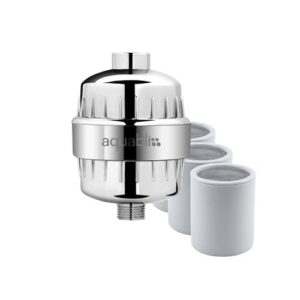
The SF220 Bundle pairs Redox Media, calcium sulfite, and coconut activated carbon in a three-stage cartridge (SFC220) that fits fixed, rain, and handheld heads without tools.
It won’t strip dissolved calcium or magnesium, but the carbon and sulfite combo cuts chlorine effectively, which curbs the dryness and color fade chlorine causes on top of hard water damage.
You get one installed cartridge plus three spares, roughly a year’s supply if you’re replacing every three months.
| Best For | People in hard water areas who want to cut chlorine, odors, and scale buildup without giving up water pressure, especially if dry skin, dull hair, or brittle nails are a concern. |
|---|---|
| Product Type | Glueless wig |
| Main Benefit | Natural body-wave look |
| Ideal Use | Daily wear and events |
| Size | 24 in, 9.14 oz |
| Care Needs | Blend lace and brush gently |
| Key Limitation | May shed or thin |
| Additional Features |
|
- Multi-stage filtration (activated carbon, calcium sulfate, and other media) tackles chlorine, dirt, and odors while easing scale buildup
- Tool-free, universal fit works with fixed, rain, and handheld shower heads
- Comes with a pre-installed cartridge plus three spares, giving about two years of use at the recommended 6-month replacement schedule
- Doesn’t remove dissolved hardness minerals like calcium and magnesium, only softens their effects
- Not built to handle heavy sediment or high iron levels without extra pre-filtration
- Plastic housing may show wear over time, like peeling or flaking on the inside
2. Aquabliss Chrome Shower Filter SF100
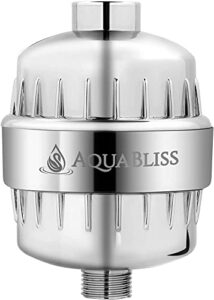
Where the SF220 leans on chlorine removal, the SF100 flips the priority toward vitamin C infusion, neutralizing chlorine near 99% while pulling only 20-25% of dissolved minerals from your water.
Its 12-stage cartridge blends mineralized beads, ceramic balls, redox media, and calcium sulfite, installing tool-free on standard shower arms in under two minutes.
For curls sensitive to chemical irritation more than mineral buildup, particularly color-treated strands, that trade-off favors scalp comfort and pigment retention over aggressive descaling.
| Best For | People with color-treated or chemically sensitive hair who want gentle chlorine removal without stripping out beneficial minerals. |
|---|---|
| Product Type | Lace closure wig |
| Main Benefit | High-density blonde styling |
| Ideal Use | Daily wear and travel |
| Size | 26 in, 13.44 oz |
| Care Needs | Detangle and adjust straps |
| Key Limitation | Can tangle over time |
| Additional Features |
|
- Neutralizes nearly 99% of chlorine while preserving 75-80% of beneficial minerals in water
- Tool-free installation on standard shower arms in under two minutes
- 12-stage cartridge combines mineralized beads, ceramic balls, redox media, and calcium sulfite for balanced filtration
- Lower mineral removal means less protection against scale buildup on fixtures
- Plastic threading can strip if over-tightened or cross-threaded during setup
- May need plumber’s tape or washers to prevent leaks on tapered NPT connections
3. Aqua Earth 20 Stage Shower Filter
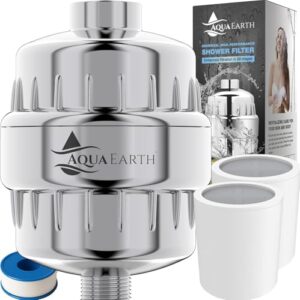
Twenty stages sounds excessive until you consider what’s layered in: coconut shell activated carbon, calcium sulfite, KDF media, and antioxidant cartridges working together against chlorine, sediment, and scale.
It screws onto standard shower arms with no tools required, though swapping cartridges later can feel snug given the tight housing fit.
For budget-conscious curlies wanting broad-spectrum filtration without committing to a single mechanism, this option offers reasonable versatility, even if independent mineral-reduction data remains less documented than competitors.
| Best For | Budget-conscious curly-haired folks in hard water homes who want broad-spectrum filtration without relying on just one filtration method. |
|---|---|
| Product Type | Drawstring wig |
| Main Benefit | Quick natural-texture blend |
| Ideal Use | Wear-and-go styling |
| Size | Up to 24 in, 8.48 oz |
| Care Needs | Moisturize and detangle curls |
| Key Limitation | Ends may thin slightly |
| Additional Features |
|
- Combines 20 filtration stages, including activated carbon, KDF-55, calcium sulfite, and vitamin-infused cartridges, for well-rounded coverage against chlorine, sediment, and scale
- Installs in seconds onto standard shower arms with no tools needed, and fits handheld, rainfall, and combo shower heads alike
- Keeps water pressure strong while helping soften skin and hair and cutting down on mineral buildup in fixtures
- Replacing the filter cartridge can be a tight, fiddly process due to the snug housing fit
- TDS meter readings may rise after installation, which can be confusing since it’s from released minerals rather than added impurities
- Independent data on its mineral-reduction performance is less established compared to some competing filters
Compare Performance, Features, and Value
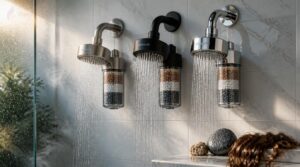
Picking the right filter means weighing more than just a brand name or price tag. Each of these three systems controls mineral reduction, lifespan, and fixture compatibility differently, which matters for your specific water hardness and curl type. Here’s how they stack up side by side.
Filtration Stages and Media
Not all filters are built the same, and cartridge design explains why.
- KDF media (copper-zinc alloy) for redox-based chlorine reduction
- Vitamin C beads neutralizing chlorine without harsh reactions
- Calcium sulfite layers targeting chloramines
- Activated carbon for sediment and organic compounds
- Multistage sequencing, sediment first, active media after
Stage order and contact time determine effectiveness, not just ingredient count.
Mineral Reduction Potential
None of these three filters soften water, and none claim to.
| Filter | Mineral Reduction | Media Type |
|---|---|---|
| AquaBliss SF220 | Low-moderate | KDF, mesh, sediment |
| AquaBliss SF100 | Low | Vitamin C, ceramic |
| Aqua Earth 15-Stage | Moderate | KDF-55, calcium sulfite, carbon |
Calcium and magnesium largely pass through unchanged since these are chlorine-reduction systems, not ion exchange units. Expect visible scale reduction near 12%, not true hardness correction.
Cartridge Lifespan
Low mineral reduction means media saturates faster, since calcium and magnesium slip through rather than binding to it. Even so, chlorine exposure and water hardness both shorten cartridge lifespan.
Expect replacement every 3 to 4 months for the AquaBliss SF220 and Aqua Earth, sooner if your flow rate runs high. The SF100’s vitamin C media depletes faster, closer to 8 to 10 weeks under daily curly-hair washing routines.
Fixture Compatibility
Cartridge life means little if the filter won’t seal onto your fixture. All three units fit standard ½ inch NPT threads (14 TPI), so wall-mounted arms work without adapters.
Handheld hoses need hose diameter match for leakproof sealing. Worn washers compromise seal integrity, letting hard water bypass filtration entirely, so check O-rings before toolfree setup.
Overall Cost and Value
A leak-free seal means nothing if the price doesn’t pencil out. Initial filter cost runs $20 to $60, with replacement cartridges adding $15 to $40 every 3 to 6 months.
Twelve-month spending averages $100 to $180 for a mid-tier system. Weigh that against cost per gallon treated: longer cartridge lifespan and steady water pressure maintenance ultimately deliver the best cost-performance balance.
Install and Maintain Shower Filters
Buying the right filter is only half the job; installing it correctly determines whether you actually get the mineral reduction you paid for. Your shower setup—wall-mounted, handheld, or rainfall—changes how the filter attaches and how well it seals.
Here’s what you need to know to install it right and keep it working at full strength.
Wall-mounted Shower Installation
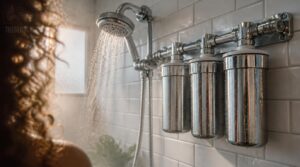
A fixed shower filter is only as good as its mount. For wall-mounted shower installation, use plumber’s tape, hand-tighten, then adjust with a wrench.
- Check mounting bracket alignment against studs
- Confirm waterproof backer board is intact
- Keep valve access panel reachable
- Set height ergonomics adjustment (72–78")
This protects curl-friendly mineral reduction performance while meeting plumbing code compliance for hard water households.
Handheld Shower Compatibility
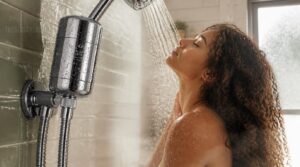
Because handheld units rely on standard ½ inch NPT fittings, most shower filters install without adapters. Confirm your hose material (stainless steel resists scale better than vinyl) and mounting bracket type first.
Check flow rate compatibility, ideally 1.5-2.5 GPM, and preferred spray pattern before buying. The Culligan WSHC125 works well here, giving hard water curly hair households reliable mineral reduction with handheld shower compatibility built in.
Rainfall Shower Installation

Since rain heads sit overhead, installation demands more planning than a standard wall unit. Confirm ceiling height clearance (80+ inches), secure wall mounting brackets to a joist, and verify waterproofing requirements behind the surface.
- Place the thermostat valve placement within easy reach
- Add a pressure regulator installation for steady 40-60 psi
- Center the filter for even mineral reduction against hard water
Cartridge Replacement Timing
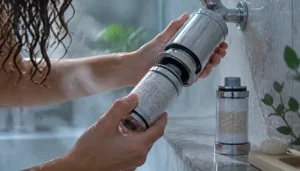
Because media saturation varies by usage, plan on a 3 to 6 month replacement interval for most cartridges. Heavier household water usage and harder supplies shorten this window considerably.
Seasonal water changes, like spring mineral spikes, can accelerate degradation too. Budget $15-40 per cartridge annually, and keep a spare on hand so filter replacement never disrupts your wash day routine.
Signs Filters Need Replacing
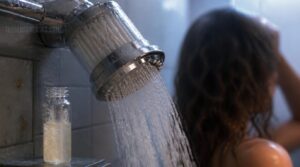
Your body tells you before the calendar does. Watch for cloudy or milky water, chlorine or sulfur odor returning, weak flow pressure, or scalp irritation and lost curl definition creeping back within two weeks.
Vitamin C gels also turn clear when depleted. Ignoring these signs lets mineral buildup and hair porosity damage resume, undoing months of progress fast.
Maximize Curly Hair Filter Results

A shower filter controls chlorine and reduces mineral load, but it won’t undo years of hard water damage on its own. Your curls need a few supporting habits to fully restore moisture balance and curl definition. Here’s what to add to your routine for the best results.
Use Monthly Chelating Shampoo
Even a great filter won’t strip everything, which is why chelating shampoo earns a spot in your routine. Formulated with EDTA chelating agents, it binds mineral buildup and lifts it from the shaft, restoring shine and moisture retention.
- Softer, bouncier curls
- Renewed shine
- Lighter-feeling strands
- Better product absorption
- Real relief from dullness
Use it monthly, on soaked hair, worked through fully.
Add Protective Pre-poo Treatments
Even the best shower filter can’t catch every mineral, so pre-poo treatments close the gap. Coconut and avocado oils form a protective barrier against hard water buildup, while hibiscus extract smooths cuticles for slip and easier detangling.
Apply to dry hair for 30-60 minutes, or overnight under a satin scarf, for maximum moisture retention and color protection.
Try Diluted Vinegar Rinses
Pre-poo oils guard your strands going in, but a diluted apple cider vinegar rinse takes care of what’s already there. Mixing 1 part vinegar to 3-4 parts water restores hair’s natural pH (4.5-5.5), triggering cuticle sealing that boosts shine and curl definition.
- Removes mineral deposits
- Prevents scalp irritation
- Improves moisture retention
- Reduces frizz
- Weekly use for non-color-treated curls
Deep Condition After Cleansing
Once your ACV rinse restores pH, deep conditioning finishes the job while cuticles are still receptive.
Section hair into four parts and apply protein-free formulas with shea butter or glycerin for 5 to 10 minutes.
| Step | Action | Duration |
|---|---|---|
| 1 | Apply warm-water cleanse | Opens cuticle |
| 2 | Deep condition by section | 5-10 min |
| 3 | Cool rinse | 30 sec |
Track Curl Moisture Improvements
Once your rinse routine settles in, track results instead of guessing. Use a capacitance moisture meter weekly to log curl hydration levels; a 15% rise signals real progress.
- Frizz reduction and shine gains
- Porosity improvement after 30 days
- Scalp moisture balance and less flaking
After eight weeks, expect moisture retention scores to stay elevated, proof filtered water is reshaping curl definition for good.
Frequently Asked Questions (FAQs)
What are the downsides of using shower filters?
Like a garden hose pinched halfway shut, filtration media chokes your water flow. Expect 20-40% pressure loss, flow rate reduction to 43 GPM, no true mineral removal, and installation issues from trapped air or misaligned fittings.
How to protect curly hair when showering?
Coat strands with a pre-shower oil treatment, use finger detangling with slip-heavy conditioner, finish with post-rinse cold water for moisture retention, then blot using the microfiber drying technique instead of rubbing, which curbs frizz against hard water damage.
Do shower filters actually work for hair?
Yes, but only when matched correctly: real mineral reduction, real chlorine removal. Done right, you’ll notice moisture retention boost, better curl definition return, and genuine scalp comfort increase within a few wash cycles.
Do showerhead filters really work?
They work, within limits. A quality shower filter cuts chlorine removal noticeably and offers real mineral reduction against hard water, but cartridge lifespan, maintenance frequency, and water pressure impact determine whether curly hair actually sees lasting results.
Can shower filters help with frizzy or flat curls?
Picture a rotary phone dripping with mineral scale, that’s hard water buildup on your curls.
Mineral reduction restores moisture retention, improving curl definition within weeks, while stronger water pressure rinses product residue away, calming frizz and preventing flatness at the root.
Will a shower filter make my water pressure drop?
Minor flow rate dips are normal, but most quality filters hold 0-5 GPM. Proper sizing prevents real pressure drop, so hard water clarity won’t cost you a strong, satisfying rinse.
Do shower filters work with tankless water heaters?
Tankless compatibility is straightforward: install your filter on the cold line before the heater. This protects media longevity, preserves water pressure, and keeps flow rate steady, just confirm filter placement matches manufacturer installation guidelines.
Can I install a shower filter in a rental?
Renting doesn’t lock you out of better water. Most no-drilling solutions use universal ½ inch connections for toolfree installation, so DIY installation stays landlord-friendly, reversible, and damage-free at move-out.
How do I know if my filter is expired?
Watch for a Color Change Indicator shifting toward red, a Flow Pressure Drop, or Symptom Reappearance like scalp itch. A Timer Alert or your Replacement Schedule (every 3-6 months) also signals it’s time for a new filter cartridge.
Conclusion
One morning, you’ll rinse your curls and feel something unfamiliar: softness that doesn’t fade by noon. That’s the real test.
Calcium buildup, chlorine damage, and porosity struggles don’t resolve overnight, but consistent filtration changes the trajectory within weeks.
Among tested options, shower filters for curly hair solve what shampoo alone can’t touch.
Your water chemistry sets the baseline for every curl you’ll ever style. Fix that first, and definition, moisture, and shine stop fighting against you. They start working for you.