This site is supported by our readers. We may earn a commission, at no cost to you, if you purchase through links. This content is for general informational and educational purposes only and is not a substitute for professional medical, dermatological, or nutritional advice.

A surprising twist about mullets: the most iconic haircut isn’t one silhouette but a spectrum, from a sharp, 1–2 inch crown to a dramatic, long tail that can stretch past your shoulders. That variety isn’t just genetics; it’s a conversation about texture, maintenance, and attitude.
A mullet can read rebellious in denim and boots or modern and sleek with fades and curls. The common thread? intention.
Short front, long back, or anything in between, mullets invite you to shape your look to match how you live. Ahead, a practical map of the styles you’ll actually want to try.
Table Of Contents
- Key Takeaways
- What is a Mullet Haircut?
- Classic and Length-Based Mullet Types
- Modern, Textured, and Hybrid Mullets
- Fade, Taper, and Undercut Mullet Variations
- How to Choose, Style, and Maintain a Mullet
- Frequently Asked Questions (FAQs)
- What are the best mullet styles?
- Is mullet a queer haircut?
- What is a 401k mullet?
- What is a modern day mullet called?
- Can women pull off mullet hairstyles successfully?
- How long does hair need to be?
- Whats the cost of a professional mullet?
- Do mullets work for thinning or fine hair?
- How often should I trim my mullet?
- What celebrities have popularized the modern mullet?
- Conclusion
Key Takeaways
- The mullet isn’t one fixed look — it’s a spectrum of lengths, textures, and fade styles that you tailor to your face shape, hair type, and lifestyle.
- Intention is what separates a sharp modern mullet from an accidental one, so matching your crown-to-tail contrast with the right fade or taper is the difference-maker.
- Modern variants like the shullet, curly mullet, and bowl-cut mullet have pushed the style well beyond its retro roots, making it genuinely versatile across aesthetics from punk to polished.
- Maintenance is straightforward but non-negotiable — trim every 4–6 weeks (or 2–4 if you’re rocking a fade) and use lightweight, matte-finish products to keep the silhouette clean without stiffness.
What is a Mullet Haircut?
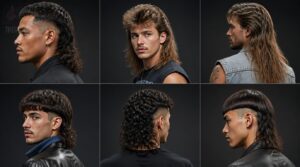
The mullet haircut is defined by a short, tapered front and sides with a longer back, creating a “business in the front, party in the back” silhouette.
(https://theglossylocks.com/taper-fade-haircut-styles/) expands smoothly on how the taper fade guiding lines influence overall shape, helping tailor a modern mullet to your head contour.
Classic mullets vary by length and history, from the traditional 2–4 inch front to a 4–8+ inch tail, to 80s retro volume and country-back styles.
Short, medium, and long mullets describe top-length contrasts, while modern variants include cropped tops, curly tails, shullet, and bowl-cut tails.
Classic and Length-Based Mullet Types
Classic and Length-Based Mullet Types introduces you to the essential family first: the shorter in front, longer in back look defines the classic mullet, with variations that range from traditional to the modern longer silhouettes.
You’ll see how length categories shape style—from subtle transitions to dramatic backs—so you can pick a starting point that fits your vibe.
Get ready for the lineup below, where every option is framed by practical length choices you can actually wear.
Traditional Mullet

You’ve probably heard the line “business in the front, party in the back”—that’s the Traditional Mullet. Short on top and sides, with noticeably longer hair at the back, it creates a clear length contrast of about 3 to 12 inches.
The traditional mullet keeps top and sides short while leaving the back noticeably longer for a clear business-in-front, party-in-back contrast
Keep the back strong and defined with blunt ends, and regular trims every 4–6 weeks to preserve the silhouette.
Think Classic Mullet, barbershop vibes, and hair length contrast done right.
80s Retro Mullet

If you’re craving that rock-infused energy from the 1980s, the 80s retro mullet delivers bold volume, dramatic layers, and an unapologetic attitude. This classic style defined an era, blending rebellion with creative expression.
- Glam rock mullet: extra volume with bold highlights for stage-ready flair
- Rocker mullet: spiked tips and edgy texture
- Shaggy bangs: softer, laid-back layers
- Cultural perceptions: symbol of individualism despite mixed reactions
- Maintenance: regular trims and volumizing products; texture powder and strong-hold spray for that iconic look
Country Mullet

The country Mullet blends rugged pride with a feathered, natural back and trimmed sides. Modern takes keep the back feathered while clean sides, anchored in Southern pride and Midwest barbering.
The back remains feathered and full, while trimmed sides emphasize Southern pride with clean Midwest barbering.
Expect a pronounced shoulder-length or longer top, a distinct crown-to-nape contrast, and minimal layering for movement.
Practical wear leans casual denim, boots, and hats, with regular 6–8 week trims to preserve balance.
Short, Medium, and Long Mullets

A tighter contrast keeps the vibe clean. Go Short Mullet for 1 to 2 inch crown and 3 to 5 inch tail. Medium Mullet gives 5 to 7 inch back with 2 to 4 inch sides. Long Mullet stretches to 8 to 14 inch tail, with 2 to 5 inch top, so Classic Mullet energy stays real.
- Trim every 2 to 3 weeks
- Use light conditioner so the tail doesn’t get heavy
- Add leave-in and heat protectant
- Keep sides tapered, not chunky
Modern, Textured, and Hybrid Mullets

Modern, textured mullets fuse sharp structure with relaxed texture for a bold, contemporary vibe. You’ll see purposeful volume and motion across the crown, paired with a longer, tactile back that stays current without shouting.
This section leads into a curated lineup of enclosures that dial in exactly how these looks take shape.
Modern and Cropped Mullets
Modern Cropped mullets are for people who love control. Keep your crown short, 2–4 inches, and shrink the tail, 1–3.
Go textured with point-cutting and layering, but keep the back blunt. Choose a Cropped Mullet Fade or Temple Fade Mullet, then trim every 4–6 weeks.
Want contrast? A Modern Mullet with a short fringe works too.
Curly and Wavy Mullets
Go for a Curly Middle Part Mullet or a Tousled Wavy Mullet that keeps top length 1.5–3 inches above your ears, then lets the back run longer.
Style on damp hair with leave-in plus light gel, scrunch while drying, and skip brushing. If your hair’s frizz-prone, keep hold light. Trim every 6–8 weeks.
Try Tapered and Blended Wavy Mullet too.
Shullet
Shullet stands out with a longer back than the crown, creating bold contrast. The fringe is blunt or minimal, meeting a sharp nape connection. It pairs well with undercuts or fades for a punk-infused silhouette.
Back length is 3–6 inches beyond crown; sides/top 1–4 inches, 60/40 or 70/30 balance. Maintain with 2–6 week trims. Long, straight hair works best.
Long Curly Mullet adds drama but softens with curls.
Bowl Cut Mullet
Yes, it’s a bowl cut, and yes, it’s a mullet.
Bowl Cut Mullet has a bowl-shaped fringe that hits mid-length, while the back keeps going 1–4 inches past your ears.
Ask for a short crown-to-nape and heavy horizontal fringe.
Best on straight or mildly wavy hair.
Trim often, comb the curve, cool-dry, and keep temples from overhanging.
Classic Mullet energy, modern payoff for Mens Haircuts.
Mohawk Mullet
Mohawk Mullet blends a shaved crown with a long tail for bold vertical contrast.
Crest is 2–6 inches, tail 3–8+ inches; sides stay tight to highlight the ridge.
Wash with sulfate-free shampoo, condition mid-lengths to ends, and style with light paste to sculpt the crest while keeping the tail free-flowing.
Fringe and Quiff Mullets
Fringe and quiff mullets pair a bold front fringe with a compact back, ideal for square or oval faces. Fringes 25–40% of length, dry from temple to mid-brow; shape with light layering for lift.
Quiff adds 2–4 inches atop, crown volume, then taper sides. Use strong-hold product and a matte finish; blow-dry with a vented brush, backcomb at the crown for subtle height.
Maintain every 6–8 weeks.
Fade, Taper, and Undercut Mullet Variations
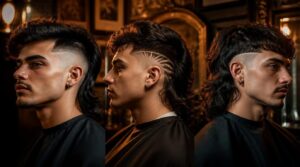
A mullet fade is the quickest way to look intentional, not accidental. Ask your barber for a high-contrast fade at the temple line, then taper it so it fades to 0 at the crown for that clean mullet silhouette. If you want slick and sharp, go skin fade, with the sides blended to your scalp tone in that 0.5–1.5 cm zone.
Want streetwear energy? Request a burst fade, with curved, radial lines behind the ear.
For softer edge, choose a classic taper that shortens from the parietal ridge to the neckline, preserving your top length. Or go low taper near the ear, dropping 2–3 cm for subtle contrast. Whisper taper barely shows, reducing sides by 1–2 cm.
If you crave contrast, do an undercut mullet: undercut sides to 0.5–3 cm while your top stays. Long-under-cut keeps more nape length. Connected undercut links panels for one continuous fringe when you lift it.
How to Choose, Style, and Maintain a Mullet
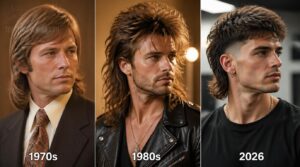
Picking a mullet is about dialing in the length, texture, and fade so it actually flatters you. Then you style it fast for daily life and keep it looking sharp between cuts. Here’s the game plan, step by step.
Choose The Right Length
Pick your length like you’re balancing a stunt, business front and party back, 2–4 inches shorter up top. Go short mullet for nape under 2 inches, medium mullet for 2–4, or long mullet for 6+ with controlled volume. Use your neck and jaw shape, then keep trims every 6–8 weeks.
- Match proportions
- Keep contrast
- Plan growth
Try ShoulderLength Mullet With Bangs, classic 80s mullet, or a modern mullet.
Match Texture And Shape
Match your texture to your silhouette so the whole thing looks intentional, not accidental. For straight hair, keep distribution even. For fine hair, use blunt tail ends so crown and back separate cleanly.
Wavy and curly mullet hair need shape control: shorten the tail about 0.5–1 inch for curls, add crown layering for waves. Aim for a balanced V, not a lopsided blob.
Select Fade Or Taper
The difference is basically upkeep. A mullet fade tightens near temples and nape, so the top looks cleaner, but you’ll want edits every 2–4 weeks.
A taper fade keeps more side length, with a softer shift, and you can stretch appointments to 4–6 weeks without obvious regrowth.
Want sharp contrast? Go fade. Want easy? Go taper.
Style For Daily Wear
Daily wear should feel easy, not precious. Keep low-shine hair styling products handy, and tame flyaways fast. A flexible hold keeps your Modern mullet, wavy mullet, or curly mullet doing the right thing without crusty flakes. For a natural texture that moves, matte finish styling products give mullets grip without that stiff, over-styled look.
- Dry hands, quick shape
- Matte finish mornings only
- Light brush, no back-combing
- Trim split ends, 6–8 weeks
Maintain Your Mullet
Keep hair maintenance simple. Shampoo often enough that scalp oils and product film don’t creep into the crown and nape. Sweat means more washing in summer.
Condition mostly on length, not roots, and rinse like you mean it thoroughly. Trim and mix every few weeks to keep the short front/sides versus longer back contrast sharp, with clean hair texture.
Use lighter hair styling products, then blow dry.
Frequently Asked Questions (FAQs)
What are the best mullet styles?
The best mullet styles have basically colonized every single barber chair on the planet. Classic mullet, modern mullet, undercut mullet, long mullet, short mullet. Pick the vibe that matches your personality and run with it.
Is mullet a queer haircut?
The mullet’s a rebellious style worn by almost everyone. It’s picked up queer associations in some communities, but it’s really about individual expression. It’s an unisex hairstyle, a fashion statement, and pure confidence through appearance.
What is a 401k mullet?
401k mullet refers to a retirement plan strategy combining a 401(k) with a high-back, long-hair mullet aesthetic, jokingly describing a look that’s as bold as it is protective of retirement savings.
What is a modern day mullet called?
Today’s version goes by modern mullet or "shullet," featuring textured hair, a longer crown, and clean fade haircut sides that feel way more intentional than your dad’s business-in-front look.
Can women pull off mullet hairstyles successfully?
Shocking, as it may seem. Women have been rocking the modern mullet and wavy mullet confidently for decades. Hair volume techniques and a mullet with bangs already prove that bold cuts really don’t care about gender norms.
How long does hair need to be?
You’ll need at least 2-3 inches on top to get started. The back needs 4-7 inches for that classic contrast. Plan on 6-18 months of growth, depending on how dramatic you want it to go.
Whats the cost of a professional mullet?
Business up front, party in your wallet: a professional mullet haircut usually runs $20–$ Bigger cities will push that cost higher. Always budget for a barber tip and any styling add-ons or hair product recommendations.
Do mullets work for thinning or fine hair?
Yes, they absolutely can. Layered mullet cuts redistribute hair mass and boost crown lift, making fine strands look noticeably fuller. Keep your front cropped a bit shorter, and finish with volumizing mousse for serious body.
How often should I trim my mullet?
Think of it like a garden: let it go too long and you’ve got a wild, patchy mess. Trim every four to six weeks. Got a mullet fade? Bump that to two to four weeks.
What celebrities have popularized the modern mullet?
David Beckham normalized it in the 90s. Miley Cyrus revived it hard in Rihanna gave it high-fashion edge. Celebrity influence basically made the modern mullet unavoidable.
Conclusion
Picture a hair salon wall plastered with dusty 80s headshots, every single guy rocking the same forgettable, play-it-safe cut, all utterly committed to the comfortable, safe embrace of mediocrity. That’s the world without the types of mullets laying out exactly what’s possible.
Your hair is a statement, and now you’ve got the full playbook. Pick the texture. Own the fade. Commit hard to the tail. The mullet never asks for permission, and neither should you.