This site is supported by our readers. We may earn a commission, at no cost to you, if you purchase through links. This content is for general informational and educational purposes only and is not a substitute for professional medical, dermatological, or nutritional advice.
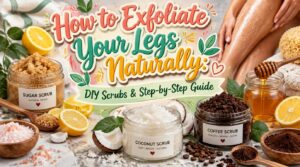
Your legs shed dead skin cells constantly, and when those layers build up, you get the rough, dull texture that no amount of lotion seems to fix. Natural ways to exfoliate legs cut straight to the source, clearing the stratum corneum so your skin can actually absorb moisture and feel smooth to the touch.
Rough knees, ingrown hairs, and uneven texture aren’t permanent. They’re problems with a direct, low-cost fix sitting in your kitchen right now.
Here’s exactly how to scrub smarter, pick the right ingredients for your skin type, and protect your barrier every step of the way.
Table Of Contents
- Key Takeaways
- What Natural Exfoliation Can Do for Your Legs
- Choose a Gentle Leg Exfoliation Method for Your Skin Type
- DIY Natural Leg Scrubs for Your Legs
- How to Exfoliate Your Legs Step by Step
- How Often to Exfoliate Your Legs Without Irritation
- Frequently Asked Questions (FAQs)
- What ingredients work best for sensitive skin?
- How long do homemade scrubs stay fresh?
- Can you exfoliate legs before or after shaving?
- Whats the difference between wet and dry exfoliation?
- Are there natural alternatives to chemical exfoliants?
- Should you exfoliate your legs before or after shaving?
- Can you safely exfoliate legs during pregnancy?
- Does dry brushing work as well as scrubs?
- Can exfoliation help reduce keratosis pilaris on legs?
- Is it safe to exfoliate sunburned or irritated legs?
- Conclusion
Key Takeaways
- Dead skin buildup is the root cause of rough, dull legs, and physical exfoliation clears it where lotion alone can’t reach.
- Your skin type determines which scrub, pressure level, and frequency actually work — oily skin tolerates coarser textures, while dry or sensitive skin needs finer grains and a moisturizing base.
- Kitchen staples like brown sugar, coffee grounds, and sea salt mixed with honey or coconut oil deliver real results without harsh chemicals or expensive products.
- Once a week is the right starting point, and your skin’s response — not a fixed schedule — should dictate how often you exfoliate next.
What Natural Exfoliation Can Do for Your Legs
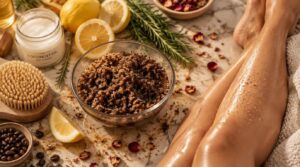
When dead skin cells pile up faster than your body can shed them, rough texture becomes impossible to ignore. Skin dullness spreads across your legs in patches, and that uneven, lackluster look won’t let up no matter how much lotion you layer on.
Salicylic acid accelerates that shedding process, and understanding how salicylic acid and hyaluronic acid work together explains why pairing them keeps skin smooth without tipping into dryness.
Natural exfoliation strips away the outermost layer of dead stratum corneum, clearing the micro-roughness that makes your legs feel sandpaper-rough. The result? Smoother, more even skin you’ll actually see and feel.
It also clears debris near hair follicles, which cuts down on ingrown hairs and bumps. And when cellulite formation appears more pronounced under dry, thickened skin, regular exfoliation helps the surface look tighter and more refined overall.
Your legs deserve far better than just surface buildup.
Your legs deserve more than lotion layered over buildup that never goes away
Choose a Gentle Leg Exfoliation Method for Your Skin Type

Getting smoother legs is one thing. Getting there without skin damage means reading your skin type first.
Natural ways to exfoliate legs don’t look the same for every skin type. Oily skin controls friction well. Dry skin needs finer particles and a carrier like oil or honey. Inflamed or reactive skin needs extra caution.
Use this as your guide:
- Oily or normal skin tolerates coarser textures and frequent exfoliation
- Dry legs need fine particles and a moisturizing base to protect the barrier
- Sensitive skin care means short contact time, light pressure, fragrance-free
- Recently shaved or irritated skin needs rest, not scrubbing
Exfoliation frequency by skin type and customizing homemade scrubs are the foundation of DIY scrubs safe techniques that work.
Pairing the right exfoliation schedule with your skin type becomes even more effective when you also explore gentle shaving and skin prep tips for curly-haired skin, since both practices share the same goal of minimizing irritation.
DIY Natural Leg Scrubs for Your Legs
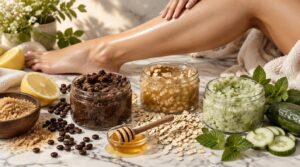
You don’t need a fancy product to get seriously smooth legs. Three simple scrubs cover every skin type and goal, from brightening to tightening. Pick the one that matches your skin, grab your ingredients, and get to work.
Brown Sugar and Honey Scrub
Think glowing skin you can feel. The brown sugar and honey scrub is one of the most affordable natural ways to exfoliate legs.
Pair it with these homemade face remedies for glowing skin to extend that natural radiance from head to toe.
Brown sugar’s fine crystals buff flakes without scratching. Honey binds the grains, adding slip so there’s no harsh drag. Adjust the ratio: more sugar for grit, more honey for gentleness.
- Honey’s antibacterial properties protect skin while scrubbing
- Higher sugar-to-honey ratios increase abrasion for rough patches
- Warm the mix slightly before applying for easier spreadability
Coffee and Coconut Oil Scrub
Swap honey for coconut oil moisturizer and the texture shifts. This homemade exfoliator for legs pairs coffee grounds with natural ingredients that give your skin real friction where it’s rough and needs more than a gentle pass.
| Variable | Effect on Skin |
|---|---|
| Fine grounds | Gentle exfoliation |
| Coarse grounds | Targets rough patches |
Coffee scrub for cellulite boosts circulation. Apply with steady pressure.
For best results, use firm, circular strokes on problem areas — this DIY coffee body scrub guide walks you through technique and timing to maximize that circulation boost.
Sea Salt and Carrier Oil Scrub
Mixing sea salt with a carrier oil creates one of the best natural alternatives to chemical exfoliants. This sea salt and essential oil scrub follows fundamental DIY scrubs safe techniques: oil reduces drag so crystals glide, not scratch.
Prepping your skin for exfoliation means dampening your legs first. When you apply your scrub, use short, circular passes with light pressure.
For a full walkthrough of prep and technique, how to exfoliate your legs covers everything from water temperature to motion patterns that protect sensitive skin.
How to Exfoliate Your Legs Step by Step
Start with a warm shower or a five-minute soak. Prepping your skin for exfoliation this way softens the outer layers, making your DIY scrubs far more effective and reducing the risk of micro-tears.
How to apply your scrub matters just as much as the natural ingredients inside it. Scoop a generous amount and work it across your legs using light, circular motions. Avoid grinding pressure.
- Keep movements circular, not back-and-forth.
- Spend extra time on rough spots like knees and ankles.
- Rinse completely so no residue stays on your skin.
Aftercare and moisturizing essentials seal the work in. Pat dry, never rub, then apply your favorite body lotion or oil immediately while skin’s still slightly damp to lock in deep hydration.
For an extra hydration boost, reach for a rich body lotion for dry skin that contains shea butter or hyaluronic acid to keep freshly exfoliated skin soft all day.
How Often to Exfoliate Your Legs Without Irritation

Most people who start a DIY scrub routine overdo it in the first week. More scrubbing doesn’t mean better results.
Once a week is where to begin when figuring out how often to exfoliate your legs without irritation. Protecting your skin barrier health means giving it time between sessions to recover and rebuild. Give it that window. Between sessions, applying a skin barrier repair body cream helps your skin rebuild its protective layer so it’s ready for the next round.
Watch for these signals after any gentle exfoliation session:
- Redness or stinging that lingers afterward: reduce frequency right away
- Dry or sensitive skin needs more recovery time than oily or normal skin
- Irritation past 48 hours means your barrier is overwhelmed
- Rough texture that worsens signals natural ingredients being applied too aggressively
Adjust based on how your skin responds, not a rigid schedule.
Frequently Asked Questions (FAQs)
What ingredients work best for sensitive skin?
For sensitive skin, finely ground brown sugar is your best pick. It’s far gentler than coarse sea salt. Pair it with coconut oil and honey to protect your skin barrier and calm irritation while exfoliating.
How long do homemade scrubs stay fresh?
Your homemade exfoliator for legs stays fresh one to two weeks when stored in a small, airtight jar kept cool and dark. Oil-based natural ingredients last longer. Smell off or see mold? Toss it.
Can you exfoliate legs before or after shaving?
Think of exfoliation as clearing the path first. Exfoliate before shaving to lift dead skin cells and let your razor glide much more smoothly.
Scrubbing right after only stresses already-stressed skin. Before wins every time.
Whats the difference between wet and dry exfoliation?
Dry exfoliation uses stiff bristles on bare skin before your shower. Wet exfoliation works on damp skin, where water softens the surface, reducing friction and making your DIY body scrub gentler and far more effective.
Are there natural alternatives to chemical exfoliants?
Natural ingredients run circles around harsh chemical exfoliants. Brown sugar and sea salt physically lift dead skin cells. Mix with coconut oil or honey, and you’ve got an effective scrub that actually delivers real results.
Should you exfoliate your legs before or after shaving?
Picture a razor dragging across freshly scrubbed, raw skin. That’s exactly how irritation stacks up. Exfoliate your legs after shaving to sidestep compounding friction. If you scrub first, give your skin at least an hour.
Can you safely exfoliate legs during pregnancy?
Worried your skin can’t handle it during pregnancy? It absolutely can. Stick to fine-grain sugar or sea salt DIY scrubs, apply safe techniques with light pressure, avoid fragrances, and moisturize well with natural ingredients after.
Does dry brushing work as well as scrubs?
Calling them identical is the biggest myth in skincare. A sugar or sea salt scrub outperforms dry brushing every single time for sheer grit. Brushing is gentler. Sensitive skin? Go with that. Moisturize after either.
Can exfoliation help reduce keratosis pilaris on legs?
Exfoliation can temporarily smooth keratosis pilaris bumps by clearing dead surface skin. But it won’t dissolve the keratin plugs causing them. For lasting texture change, you need keratolytic actives like lactic acid, not just scrubbing.
Is it safe to exfoliate sunburned or irritated legs?
Scrubbing sunburned skin is like grinding sandpaper into a fresh open wound.
Never exfoliate during active skin irritation, burning, or redness. Sensitive skin needs several days to fully recover. Wait until it’s calm, then proceed.
Conclusion
Smooth skin starts the moment dead cells stop stacking up. Natural ways to exfoliate legs give you that full reset without expensive treatments, harsh chemicals, or guesswork. Pick your scrub, prep your skin, and work in small, intentional circles. Rinse well, pat dry, then seal in moisture while your skin is still damp.
Your legs carry you through everything. Show them the same care you’d give the rest of your routine. That effort compounds fast.