This site is supported by our readers. We may earn a commission, at no cost to you, if you purchase through links. This content is for general informational and educational purposes only and is not a substitute for professional medical, dermatological, or nutritional advice.
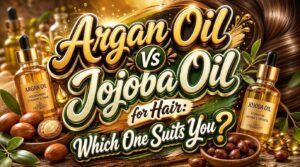
Picking the wrong hair oil doesn’t just waste money—it can leave fine hair plastered flat or dry ends still gasping for moisture. Argan oil and jojoba oil both sit at the top of the natural hair care world, yet they work in fundamentally different ways. Knowing which one matches your hair type turns a guessing game into a clear, confident choice.
Argan is a triglyceride-rich oil that seals the cuticle and repairs dryness, while jojoba is technically a liquid wax that mimics your scalp’s own sebum, making it one of the few oils your skin chemistry already recognizes. This difference changes everything about how each one performs.
Table Of Contents
Key Takeaways
- Argan oil is your go-to for dry, coarse, or damaged hair because its fatty acids seal the cuticle, lock in moisture, and reduce breakage over time.
- Jojoba oil isn’t really an oil — it’s a liquid wax that closely mirrors your scalp’s natural sebum, making it uniquely effective at balancing oily roots without adding weight.
- Your hair type is the deciding factor: dry ends call for argan, oily roots call for jojoba, and if you’ve got both problems, using each oil in its right zone solves them together.
- How you apply either oil matters as much as which one you pick — too much, in the wrong spot, turns a good oil into a greasy mess.
Argan Oil Vs Jojoba Oil Overview
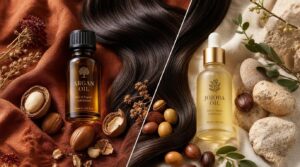
Both oils have earned their place in hair care, but they work in very different ways. Knowing what sets them apart helps you pick the right one for your hair — not just the popular one.
If you’re still unsure which is right for your hair type, this castor oil vs. coconut oil hair growth comparison breaks down the real differences so you can choose with confidence.
Digging into reviews of the best oils for moisturizing hair can make that choice a lot clearer, especially when you see how real results vary by hair type.
Here’s a quick breakdown of what to expect.
Key Differences for Hair Care
Both oils work differently because their molecular structure sets them apart from the start. This structural difference makes Argan oil ideal for dry, coarse hair and Jojoba oil suitable for oily scalp, fine hair.
Argan oil excels at frizz control, hair shine enhancement, and hair breakage prevention. Jojoba wins for sebum mimicry, making it ideal for scalp balance and lightweight hair conditioning.
| Feature | Argan Oil | Jojoba Oil |
|---|---|---|
| Molecular Structure | Triglyceride-based | Liquid wax ester |
| Best For | Dry, coarse hair | Oily scalp, fine hair |
| Thermal Protection | Strong | Moderate |
| Shelf Stability | Moderate | Very high |
| Nutrient Density | High vitamin E, fatty acids | Zinc, selenium, vitamin E |
You can also use AI‑powered hair analysis to customize your oil choice based on your hair type and porosity.
Texture, Absorption, and Weight
Beyond their chemical profiles, texture feel and oil viscosity shape how each oil actually behaves on your strands.
Argan oil offers a richer, deeply nourishing experience with a slower Film Drydown Speed, deeper Absorption Depth, and thicker Coating Thickness. Jojoba oil, in contrast, is lightweight and fast-absorbing, delivering a subtle Slip Feel and less Weight Per Drop.
| Property | Argan Oil | Jojoba Oil |
|---|---|---|
| Oil Absorption | Deep, conditioning | Quick, surface-level |
| Weight Per Drop | Heavier feel | Featherlight |
| Film Drydown Speed | Slower | Faster |
Best Use Cases for Each Oil
Knowing how each oil absorbs helps you utilize them effectively in the right moments.
| Use Case | Best Oil |
|---|---|
| Mid-length conditioning & frizz reduction | Argan oil |
| Nighttime seal for dry ends | Argan oil |
| Post-exercise refresh for oily roots | Jojoba oil |
| Chemical treatment recovery and beach hair care | Argan oil |
Jojoba oil suits scalp balance, while argan oil nourishes dry strands.
Quick Comparison for Buyers
Here’s a quick snapshot to help you decide. Comparing argan and jojoba oils for hair care comes down to your hair’s needs. Check ingredient certifications and price range before buying.
| Feature | Argan Oil | Jojoba Oil |
|---|---|---|
| Hair Conditioning | Deep, rich | Light, balancing |
| Best Hair Types | Dry, coarse, curly | Fine, oily-rooted |
| Shelf Life | Moderate | Long-lasting |
| Purity Verification | Cold-pressed label | Cold-pressed label |
| Packaging Influence | Dark glass preferred | Dark glass preferred |
What is Argan Oil?
Argan oil comes from a tree that grows almost nowhere else on Earth.
It’s packed with nutrients that do specific things for your hair — and understanding what’s inside it helps you use it the right way. Here’s what makes argan oil worth knowing about.
Source and Extraction Method
Pure argan oil begins its journey inside the kernels of Morocco’s Argania spinosa tree, a resilient species rooted in semi-arid coastal soil. Cold-pressed and unrefined, it preserves nutrients through a solvent-free extraction process.
- Moroccan kernel origin from hand-harvested fruit
- Stone mill process grinds kernels before pressing
- Cold press yield reaches up to 60%
- Organic, cold-pressed batches skip chemical solvents
Fatty Acids and Vitamin E Content
Argan oil packs a lot into every drop. Its oleic–linoleic ratio — roughly 46% oleic to 33% linoleic acid — gives it a strong essential fatty acid content that few plant oils can match.
For a deeper look at how fatty acid profiles translate to real styling results, hair clay formulas for men increasingly rely on oils like argan for their ability to nourish without weighing hair down.
This Vitamin E density, driven by alpha-tocopherol, shields those polyunsaturated fats from PUFA oxidation risk. More double bonds mean higher vulnerability, so the antioxidant richness of argan oil earns its reputation.
Why It Suits Dry Hair
Dry hair isn’t just rough — it’s structurally compromised. Lifted cuticles let moisture escape, leaving strands brittle and prone to breakage. That’s where argan oil earns its place:
- Cuticle Alignment — it seals lifted scales, restoring smoothness and shine
- Hydration Lock — acts as an external shield that slows moisture loss
- Reduced Friction — softens dry ends and improves flexibility for easier detangling
Common Argan Oil Hair Products
Knowing which product to reach for makes all the difference. Here’s a quick breakdown of common argan oil formats and what each one does:
| Product Type | Key Benefit |
|---|---|
| Silicone conditioners | Cuticle sealing, frizz control |
| Vitamin-E serums | Hair shine enhancement, deep nourishment |
| Amber packaging oils | Preserved potency, hair cuticle repair |
| UV-protective blends | Color-safe, heat-styled hair defense |
| Fragrance-free formulas | Gentle prewash hair oil blend option |
What is Jojoba Oil?
Jojoba oil isn’t actually an oil — it’s a liquid wax, and that distinction matters more than you’d think. It comes from the seeds of a desert shrub, and its structure is surprisingly close to what your scalp already produces on its own.
Jojoba oil is technically a liquid wax — and its structure mirrors your scalp’s own natural oils
Here’s what that means for your hair.
Why Jojoba is Technically a Wax
Jojoba oil isn’t actually an oil — it’s a liquid wax. Extracted from Simmondsia chinensis seeds, its unique ester composition sets it apart: long-chain fatty acids bonded to fatty alcohols, not the glycerol-based triglycerides found in most plant oils.
This non-triglyceride structure gives jojoba oil superior high oxidative stability, meaning it resists rancidity far longer. Its liquid wax nature also ensures a light feel on strands.
Similarity to Natural Scalp Sebum
Your scalp already makes its own protective coating — and jojoba matches it more closely than almost any other plant-derived ingredient. Its wax ester match with natural sebum means it mimics the same lipid class your scalp naturally produces.
This fatty acid alignment enhances the genuine sebum film coating without disrupting sebum regulation. Think of it as a triglyceride complement that works with your scalp, not against it.
Lightweight Feel on Hair
Jojoba’s sebum-matching quality directly influences how it feels on hair strands. Its lightweight and fast-absorbing nature allows it to spread as a thin film without feeling heavy. Unlike richer oils, it rinses clean, minimizing build-up and leaving no residue.
For fine hair, placement strategy matters—applying a single drop to mid-lengths enhances shine without compromising volume.
Common Jojoba Oil Hair Uses
That quick absorption makes it one of the most adaptable oils in a hair routine. Use it as a pre-shampoo scalp massage to loosen buildup and support dandruff prevention with jojoba oil. It works beautifully in a DIY hair mask, nighttime conditioning treatment, or mixed oil blends.
Travel-friendly and lightweight, it reduces frizz and keeps hair conditioning simple.
Benefits for Different Hair Types
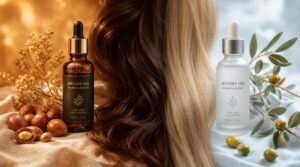
Not every oil works the same way for every head of hair. Your hair type is really the deciding factor here.
For fine or thin strands, lighter oils tend to coat without weighing hair down, while thicker, curlier textures often need the richer coverage found in a natural heat protectant for hair.
Here’s how argan and jojoba oil each perform across the most common hair types and concerns.
Fine or Thin Hair
Fine hair breaks more easily and loses volume fast — that’s just its nature.
Jojoba oil’s lightweight and fast-absorbing texture makes it ideal here. Unlike rich oils that drag strands down, jojoba nourishes hair cuticles’ health and enables lightweight styling without sacrificing root lift techniques or fine hair volume.
Think of it as hair conditioning that doesn’t cost you movement.
Oily Scalp and Greasy Roots
Greasy roots aren’t just a styling problem — they’re a scalp regulation issue. Jojoba oil’s sebum mimicking properties make it the smarter pick here. It supports balancing oil production without stripping moisture, signaling your sebaceous glands to ease overproduction naturally.
Apply it before washing to aid Product Buildup Prevention. Pair smart washing frequency with dry shampoo techniques and heat sweat control to keep roots fresher, longer.
Dry, Coarse, or Damaged Hair
Dry, coarse, or damaged hair stems from broken-down cuticles that fail to retain moisture. This core issue drives the argan oil vs. jojoba oil debate, where argan oil takes the lead.
Hair repair with argan oil directly addresses cuticle repair and porosity treatment, enhancing moisture retention and strengthening hair fibers deep within the shaft.
Consistent use on dry hair supports split end prevention and effectively reduces hair breakage, making it a targeted solution for long-term hair health.
Curly, Wavy, and Frizz-prone Hair
Curly and wavy hair loses moisture faster than straight hair — making curl hydration and frizz reduction non-negotiable. Argan oil’s cuticle-smoothing properties seal the hair shaft, improving humidity resistance and curl definition.
Here’s how to layer smartly:
- Apply argan oil to damp lengths for moisture lock
- Use jojoba oil at the scalp for balance
- Finish with product layering to hold curl shape
Color-treated or Heat-styled Hair
Color and heat are a tough combination. Both strip moisture and stress the hair cuticle.
Argan oil steps in with thermal shielding and fatty acids that support post-color conditioning and pigment retention.
Jojoba oil keeps scalp oils balanced, preventing buildup near roots.
Together, they cover the full picture: color fade prevention at the ends, comfort at the scalp — a smart salon blend technique.
Scalp Benefits Compared
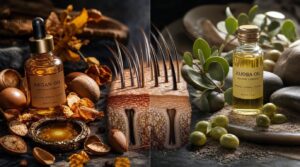
Your scalp is the foundation of healthy hair, so what you put on it actually matters.
Both jojoba and argan oil offer real benefits up there, but they work in very different ways. Here’s how they compare across the most common scalp concerns.
Jojoba Oil for Scalp Balance
Jojoba oil is one of the few natural options that actually speaks your scalp’s language. Its sebum-mimicking properties mean it blends with your scalp’s own oils rather than sitting on top. This promotes sebum regulation and oil balance, strengthens your moisture barrier, and delivers anti-inflammatory relief to irritated skin.
Its natural antimicrobial protection also helps maintain scalp pH balance, ensuring a healthier environment for your scalp.
Once your hair is thoroughly soaked, working through a gentle apple cider vinegar rinse for balanced scalp health can boost that antimicrobial effect from root to tip.
Argan Oil for Dry Scalp Comfort
When your scalp feels tight, flaky, or itchy, argan oil delivers real dry scalp relief. Its essential fatty acids—oleic and linoleic acid—provide a Barrier Lipid Boost that slows moisture loss and promotes skin comfort. Paired with vitamin E’s Oxidative Protection and Anti‑Inflammatory Soothing properties, it works from the surface inward.
Key moisturizing benefits include:
- Moisture Lock through emollient fatty acids that soften and hydrate dry skin
- Targeted Scalp Massage with 2–3 drops worked into affected areas before washing
- Natural antioxidant activity that reduces irritation linked to oxidative stress
Use it as a weekly scalp treatment for best results.
Dandruff and Buildup Considerations
Dandruff isn’t just about dryness — Malassezia, a fungus that feeds on scalp oils, is often the real culprit. Adding oil to an already oily, flake-prone scalp can worsen oil-induced flaking. Jojoba’s Sebum Mimicking Properties help balance moisture without overfeeding the fungus, while argan oil soothes dry, tight, flaky skin.
Proper scalp care involves addressing both fungal activity and hydration. Jojoba oil regulates excess sebum, making it ideal for oily scalps, whereas argan oil provides relief for dryness. Product residue removal is equally critical, as buildup can mimic dandruff flakes.
| Concern | Jojoba Oil | Argan Oil |
|---|---|---|
| Malassezia control | Regulates excess sebum | Less effective on oily scalp |
| Scalp cleansing frequency | Pre-wash, 2–3x weekly | Weekly dry scalp treatment |
| Preventing dryness and dandruff | Balances scalp health | Soothes tight, flaky skin |
Pre-shampoo Scalp Oiling Tips
Warm oil application spreads more evenly and absorbs faster, so rub a few drops between your palms first. Use a sectioning technique to reach the scalp directly—not just the surface hair.
Massage for two to three minutes, then allow a dwell time optimization window of 15–30 minutes.
When shampooing, follow emulsification tips: work shampoo into dry, oiled hair before adding water.
When to Avoid Oil on The Scalp
Oil isn’t always the answer. Skip scalp treatment entirely when these conditions apply:
- Excess sebum buildup or scalp acne risk — extra oil worsens clogged follicles
- Dandruff aggravation — lipid-rich environments feed yeast growth
- Open wounds or active infections — oil traps bacteria and delays healing
Long-duration residue can cause trouble, so rinse it within an hour. For dry scalp, patch-test first — potential precautions or allergies for natural oils are real, even with low-oil comedogenicity.
Shine, Frizz, and Breakage
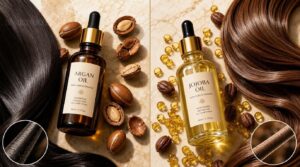
Shine, frizz, and breakage are often the first things you notice when your hair isn’t happy.
Both argan and jojoba oils address these concerns, but in different ways and for different hair needs. Here’s how each one performs where it counts most.
Argan Oil for Shine and Smoothness
Argan oil works by sealing the hair cuticle — that outer protective layer — so light bounces off evenly. This light refraction creates a glossy, polished look.
Its protective film locks in moisture and delivers antioxidant gloss that guards against dullness.
It adds shine to thicker or curlier hair without flattening volume, making it a reliable anti-frizz treatment.
Jojoba Oil for Softness Without Heaviness
Where argan delivers mirror-like gloss, jojoba works differently — it softens without settling heavily on strands. Think of it as microfilm conditioning: a light layer blend that smooths the cuticle without stiffening it.
This noncomedogenic oil adds shine without flattening volume, making it ideal for serum pairing or mixing one drop into your conditioner. It even softens dry or flaky patches along the hairline.
Split Ends and Breakage Support
Here’s the hard truth: neither oil can fuse a split end back together. Once your hair cuticle splits, trimming is the only real fix.
What argan and jojoba do offer is genuine friction management — argan seals the cuticle for moisture retention, while jojoba’s lightweight conditioning reduces daily breakage triggers. Used consistently, both oils can stretch your trim frequency noticeably.
Heat Styling and Environmental Stress
Every time you run a flat iron over your hair, you’re stacking heat styling damage on top of environmental stressors your strands have already absorbed outside. Argan oil’s antioxidant properties and vitamin E create a reliable thermal protection barrier, while its oxidation resistance ensures stability under high temperatures.
Watch out for these four compounding stressors:
- UV heat synergy — Sun exposure weakens the hair cuticle before your styling tool even touches it.
- Humidity heat interaction — Humid air causes frizz to rebound faster after styling, pushing you toward more heat passes.
- Pollution residue effects — Airborne particles settle on strands, increasing friction during tool contact.
- Styling temperature guidelines ignored — Skipping lower heat settings greatly multiplies cumulative fiber stress.
Hair cuticle health and oils are directly connected—a sealed cuticle resists moisture loss better under heat.
Which Oil Works Better for Frizz
Both oils help with frizzy hair, but they work differently. Argan oil excels at cuticle flattening and acts as a deeper anti-frizz treatment, sealing the hair cuticle for lasting smoothness. Jojoba oil offers a light-weight coating with superior residue control, making it ideal for finer or oil-prone hair.
| Frizz Factor | Argan Oil | Jojoba Oil |
|---|---|---|
| Seal vs absorb | Seals cuticle | Absorbs quickly |
| Humidity defense | Strong | Moderate |
| Hair Cuticle Health and Oils | Deep conditioning | Surface balance |
| Taming frizz | Coarse, dry hair | Fine, oily hair |
| Residue control | Medium | High |
How to Use Each Oil
Knowing which oil to use is only half the battle — how you apply it matters just as much.
A few small habits can make the difference between hair that looks nourished and hair that looks greasy. Here’s exactly how to get the most out of both oils.
Getting the starting amount right is half the battle, so check out this guide on how many ounces of oil you need for long hair before you begin.
Pre-wash Treatment Method
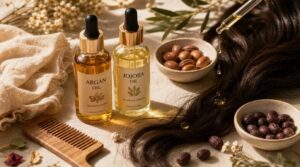
Pre-wash oiling works best when you keep it simple. Apply 2–3 drops through mid-lengths and ends — length targeting matters more than saturating roots. Scalp minimalism prevents buildup.
Let the oil sit for 15–30 minutes; the rest duration depends on how dry your hair feels. Rinse thoroughly, then shampoo.
That rinse boost helps remove oil without stripping moisture.
Leave-in Oil Application

Leave-in oil works best on damp hair, sealing in moisture before it fully dries. Start with a leave-in conditioner first, then use the warm-palm emulsifying technique with just 2–3 drops before touching the strands. Apply via finger-raking distribution for curls or smooth palms for straight hair.
Focus on end-only application to protect against dryness without weighing roots down — dosage is critical for fine hair.
How Many Drops to Use
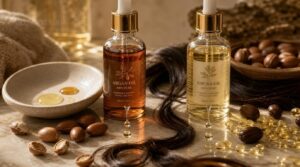
Start with 2–3 drops — that’s the right trial drop count for most people. Dropper calibration matters because viscosity impact means thicker argan oil delivers larger drops than lightweight jojoba.
Hair length factor and density adjustment also play a role: longer, coarser hair needs slightly more. Add drops gradually rather than all at once to avoid greasiness.
Best Application Areas
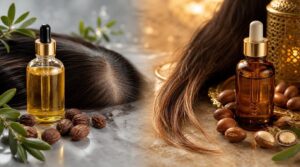
Where you put the oil matters as much as how much you use. For Root Lightening and scalp treatment with natural oils, jojoba wins — its lightweight feel won’t smother follicles.
Argan manages Midsection Hydration and Tip Repair Therapy beautifully. Think of it as zoning: jojoba from scalp down, argan on ends.
That’s smart Hair Conditioning Techniques with Argan Oil in practice.
How Often to Apply
Once you’ve nailed your application areas, frequency is the next thing to get right. For most people, a Weekly Treatment Frequency works well.
Apply argan oil on the ends once a week. Use jojoba on the scalp two to three times a week.
Your Pre‑Wash Interval should be 30–60 minutes.
Adjust your Leave‑In Schedule based on how your hair responds.
Consider Seasonal Application Timing—dry winters often call for more.
Mistakes That Cause Greasy Hair
Even the right oil can backfire with wrong habits. Excess oil use near the roots speeds up an oily or shiny look by midday. Wrong product placement worsens the issue—keep oils off the scalp unless pre-washing.
Skipping proper cleansing allows styling product buildup to accumulate quickly. Tight hairstyles trap heat and sweat, accelerating grease before noon.
Which Hair Oil Should You Choose?
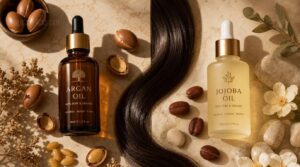
Choosing between argan oil and jojoba oil really comes down to what your hair actually needs.
Your hair type, scalp condition, and daily routine all point toward one clear answer. Here’s how to match the right oil to your specific concern.
For a balanced look, explore layers versus one-length haircuts to complement your hair’s natural texture.
Choose Argan Oil if Your Hair is Dry
Dry hair craves deep hydration — and argan oil delivers.
Its rich fatty acids support moisture retention and provide an elasticity boost, making brittle strands more resilient.
Think of it as a cuticle repair treatment that doubles as an antioxidant shield against heat and environmental damage.
The benefits of argan oil for hair hydration and shine are real: it’s richer and more deeply nourishing, leaving dry hair visibly smoother.
Choose Jojoba Oil if Roots Get Oily
Oily roots don’t need more oil — they need the right one. Jojoba’s sebum mimicking properties signal your scalp to ease up on natural oil production, restoring balance rather than adding weight.
Its lightweight oil texture absorbs fast, making micro-application — just 2 to 3 drops ideal for daily or seasonal adjustments.
Supporting follicle health, jojoba oil benefits for oily skin go far beyond surface control.
Use Both for Oily Roots and Dry Ends
Some hair doesn’t fit neatly into one category — oily roots with dry ends are common, and combining jojoba and argan oils solves both at once.
A layered oil schedule works well here: jojoba on the scalp for root-sparing balance, argan on mid-lengths through the ends.
Alternating oil days and seasonal tweaks keep this dual approach effective without buildup.
Quality Signs to Look For
Not all oils labeled "pure" actually are. Look for cold-pressed, unrefined, cosmetic-grade oils with full ingredient transparency — no fillers, no solvents. Batch traceability and a clear expiration date tell you the oil is fresh.
Third-party certification confirms ingredient purity independently. Strong oxidation resistance starts with honest labeling, so always check that the bottle says "cold-pressed" and lists a certificate of analysis.
Final Buying Recommendation by Hair Concern
Your hair concern should drive every purchase decision. For dry scalp solutions, opt for cold-pressed argan oil—it directly enhances hair elasticity and shine. For oily roots, jojoba’s sebum-mimicking chemistry makes it the smarter price-performance ratio pick.
- Look for allergen-free certifications and shelf-life guidance on every label
- Prioritize oil packaging indicators like dark amber glass for freshness
- Use both when choosing oils for different hair types and hair growth support
Frequently Asked Questions (FAQs)
Is jojoba oil malassezia safe?
Jojoba isn’t considered Malassezia-safe. Its lipid chain suitability falls in the C11–C24 range, raising Malassezia feeding risk.
This lipid chain range directly contributes to the risk of Malassezia feeding.
A patch test protocol and yeast‑safe alternatives like squalane are worth exploring first.
Who should not use jojoba oil?
Not everyone should use jojoba oil. Pregnant individuals, breastfeeding mothers, those with severe skin allergies, sensitive or reactive skin, a compromised scalp, or young children should either perform a patch test first or avoid it entirely.
Can argan or jojoba oil cause allergic reactions?
Yes, both can cause allergic reactions. Argan oil has triggered anaphylaxis in rare cases. Patch testing before full use is smart, especially if you have sensitive or reactive skin.
How long do argan and jojoba oils last?
Shelf life isn’t one-size-fits-all. Argan oil lasts 12–24 months unopened; jojoba stretches 2–3 years, thanks to stronger oil oxidation resistance. Always check your bottle’s date.
Are these oils safe during pregnancy?
Both oils are generally considered safe for topical use during pregnancy. Systemic absorption through the skin is minimal.
Always perform patch testing first, select products with ingredient purity, and consult your doctor if uncertain.
Do both oils work on hair extensions?
Both oils work on extensions — but placement matters. Keep oil on the mid-lengths and ends. Avoid bond areas to prevent slippage. Lightweight application keeps buildup low and extensions looking fresh.
Can either oil replace a hair serum?
Not quite. Hair serums create a surface film that oils can’t fully replicate. For frizz control and heat protection match, argan oil comes closest — but serum substitution potential remains limited.
Conclusion
Studies show nearly 60% of people choose the wrong hair oil simply because they don’t know their hair type. That single mistake quietly undoes every other effort in your routine.
When comparing argan oil versus jojoba oil hair benefits, the answer isn’t about which oil is better—it’s about which one matches what your hair actually needs. Dry ends need argan, while oily roots need jojoba.
Know your hair, and the right choice makes itself.
- https://nefertiti-eg.com/argan-oil-vs-jojoba-oil-for-face-skin-and-hair/?srsltid=AfmBOoq0EbU2PxrLncpFIU62EjVenZ0E_Hg7QXGxCdLSrNrY0Mn2gkVW
- https://traya.health/blogs/hair-health/jojoba-oil-vs-argan-oil?srsltid=AfmBOoq_LWdWmnha4ZU2TYNSQiK7sAnoiGQtL26mik04AM-GgG7OyHQz
- https://www.globalresourcesdirect.com/blog/jojoba-oil-vs-argan-oil/