This site is supported by our readers. We may earn a commission, at no cost to you, if you purchase through links. This content is for general informational and educational purposes only and is not a substitute for professional medical, dermatological, or nutritional advice.
Most people wake up to skin that feels tighter and hair that’s drier than when they went to bed—and blame it on genetics, age, or not drinking enough water.
The real culprit is transepidermal water loss, a process that accelerates during sleep because cellular renewal nearly doubles between 11 PM and 4 AM, increasing the skin’s permeability precisely when bedroom humidity can drop as low as 20%.
Your body is working hard overnight; your routine needs to match that effort. The right overnight moisture retention methods address this biology directly—through strategic layering, barrier-sealing ingredients, and a sleep environment calibrated to stop evaporation before it starts.
Table Of Contents
Key Takeaways
- Between 11 PM and 4 AM, your skin’s cellular renewal nearly doubles and its permeability rises, making transepidermal water loss the true driver of morning tightness—not genetics or poor hydration habits.
- Layering humectants (like hyaluronic acid and glycerin) on damp skin, then sealing with an occlusive such as petrolatum, can reduce overnight water loss by up to 99% by mimicking the skin’s natural barrier architecture.
- Bedroom air conditioned or heated below 40% relative humidity acts as a continuous dehydrator overnight, making humidifier calibrated to 40–60% one of the highest-leverage environmental interventions you can make.
- For hair, combining the LOC or LCO layering method with a silk bonnet or pillowcase addresses both cuticle-level moisture sealing and friction-driven damage simultaneously, preserving overnight product efficacy until morning.
Why Moisture Escapes Overnight

You wake up with tight, parched skin and limp hair—and it’s not just because you slept. Several specific mechanisms work against your skin and hair every single night, quietly draining moisture while you rest. Here’s what’s actually happening, and why it matters before you choose any solution.
The same daytime habits—heat styling, friction, and chemical exposure—compound the damage, so understanding how to retain moisture in hair throughout the day makes your nighttime routine actually stick.
Nighttime Water Loss
While you sleep, your skin doesn’t rest — it works. Between 11:00 PM and 4:00 AM, cellular renewal nearly doubles, and epidermal permeability rises, meaning your skin both regenerates and loses water more readily. Transepidermal water loss (TEWL) drives most of that overnight dehydration, as water vapor migrates outward through the stratum corneum when no occlusive layer is present to interrupt it.
Even a slight drop in hydration, referred to as mild dehydration during sleep, can raise heart rate and disrupt temperature regulation, further impacting skin recovery.
- Morning tightness isn’t random — it’s TEWL doing its quiet damage
- Without barrier support, even healthy skin leaks moisture all night
- Nighttime skin regeneration demands hydration to function properly
Dry Bedroom Air
Your bedroom air itself can be working against you. When doors stay closed overnight, indoor relative humidity often drops to 20–30%, turning your sleep environment into a slow dehydrator.
At that level, moisture evaporates from both skin and hair surfaces continuously, compounding the TEWL already occurring beneath the surface.
A bedroom humidifier targeting 40–60% humidity is your most direct countermeasure.
Heating and Air Conditioning
Heating and air conditioning systems are, in many ways, the silent culprits behind overnight moisture loss.
Central heating and AC strip indoor air of humidity as a mechanical byproduct—not a flaw, but an unavoidable consequence of how refrigerant cycles and forced-air systems function. The result is that same 20–30% relative humidity range, sustained for hours while you sleep.
Skin Barrier Disruption
Low indoor humidity compounds a problem that’s already unfolding beneath your skin’s surface.
When the lipid barrier is compromised—through over-cleansing, harsh actives, or accumulated stress—transepidermal water loss accelerates markedly.
Think of it as mortar crumbling between bricks: water escapes freely, and irritants enter just as easily, triggering inflammation that further delays barrier recovery overnight.
A crumbling skin barrier lets water escape and irritants enter, stalling overnight recovery
Hair Cuticle Friction
While skin loses moisture through barrier failure, your hair faces its own nightly threat: cuticle friction damage.
- Cuticle edges interlock when hair rubs tip-to-root, lifting scales and increasing surface roughness
- Repeated contact accelerates wear patterns, stripping the protective 18-methyleicosanoic acid layer
- Exposed, roughened cuticles lose moisture far faster overnight
Silk pillowcases and satin bonnets reduce this friction anisotropy markedly, keeping protective styling intact.
Pairing these fabrics with a solid overnight routine—like the steps outlined in this high porosity hair care guide—helps lock in moisture while you sleep.
Build a Night Skin Routine
Your skin does its most intensive repair work while you sleep, which makes your nighttime routine far more than a simple wind-down ritual. Getting the order and ingredients right can mean the difference between waking up plump and refreshed versus tight and dull. Here’s how to build each step with intention.
Gentle Double Cleansing

Think of cleansing as clearing the stage before the real overnight work begins.
Start with a lipid-based cleanser to dissolve sunscreen, sebum, and makeup through emulsification alone — no harsh scrubbing needed.
Follow immediately with a non-foaming, pH-balanced cream or water-based cleanser to lift remaining debris.
This double cleanse preserves your acid mantle, supporting moisture retention all night.
Apply on Damp Skin
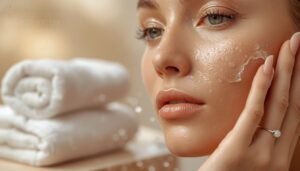
Once you’ve completed your double cleanse, don’t let that window close. Apply within minutes of rinsing — while your skin is still slightly damp, not dripping — to lock in surface moisture before it evaporates.
Gently pat with a towel rather than rubbing, preserving that thin film.
This timing alone can increase moisture retention by up to 300%.
Humectants Before Creams
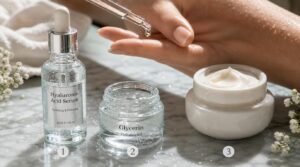
Order matters here. Humectants like hyaluronic acid serum, glycerin, and polyglutamic acid work by pulling water into the stratum corneum through molecular attraction — but only when applied first, on slightly damp skin.
Layering a cream over top too soon disrupts this process. Give each humectant step a moment to settle, binding moisture before your emollient follows.
Seal With Occlusives
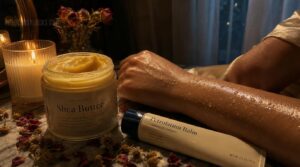
Once your humectants have settled, it’s time to seal everything in. Occlusive film formation is the final, non-negotiable step — petrolatum, dimethicone, and shea butter each create a hydrophobic layer that limits evaporation overnight.
Nighttime occlusion works precisely because it locks moisture already present into the skin, making your entire moisture-locking routine noticeably more effective.
Include Neck and Chest

Your face routine doesn’t end at the jawline. The neck and chest are often the first areas to show overnight dryness, yet they’re routinely skipped.
Extend your Neck Hydration Routine up to the collarbone, applying the same night cream and occlusives your face receives — because leaving that skin unprotected creates uneven texture by morning.
Use Moisture-Locking Ingredients
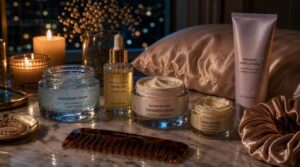
The ingredients in your routine do the heavy lifting while you sleep, so choosing the right ones matters more than most people realize. Each one works differently — some pull moisture in, others lock it down, and a few rebuild the barrier itself. Here are the five worth knowing.
Hyaluronic Acid
Few ingredients earn their place in a moisture-locking routine as decisively as hyaluronic acid. As a glycosaminoglycan, it binds water through hygroscopic molecular attraction, drawing fluid from the environment and deeper dermal layers simultaneously.
- Low molecular weight penetrates deeper skin layers
- High molecular weight forms a surface hydration film
- Crosslinking gels extend contact time overnight
- Skin receptor interaction via CD44 promotes barrier repair
Glycerin
Where hyaluronic acid pulls water from a distance, glycerin works close to the surface—anchoring moisture through its three hydroxyl groups, which actively interact with water molecules in the outer skin layers.
Applied before your night cream, it acts as a first-step hydration layer, drawing in moisture that your occlusive then seals firmly in place overnight.
Ceramides
While glycerin draws moisture in, ceramides decide how much of it actually stays. Think of them as the mortar between skin cells—lipids that form lamellar structures alongside cholesterol and fatty acids, keeping your barrier stable and intact overnight.
Without adequate ceramides, that framework breaks down, and water quietly escapes while you sleep.
Petrolatum
Where ceramides reinforce your barrier’s structure, petrolatum takes over as the final seal. Its hydrocarbon composition makes it practically insoluble in water, so it stays anchored on the surface rather than absorbing into—reducing transepidermal water loss by up to 99%.
Applied as the last step, this occlusive moisture seal locks everything underneath in place while you sleep.
Dimethicone
Think of dimethicone as petrolatum’s lighter, more adaptable cousin. This silicone barrier ingredient sits on the skin’s surface, forming an inert, breathable film that reduces moisture evaporation without the heaviness.
Non-comedogenic and temperature-stable, it’s ideal for those avoiding thick occlusives.
In hair care, it smooths the cuticle, controls hair frizz, and shields strands overnight.
Protect Hair While Sleeping

Your hair loses more moisture overnight than you might expect, mostly from friction and exposure to dry air while you sleep. The good news is that a few simple habits before bed can make a real difference by morning. Here’s what actually works.
LOC or LCO Method
The LOC method — Liquid, Oil, Cream — and its counterpart, LCO, are structured layering protocols designed to address exactly what happens to textured hair overnight: progressive moisture loss through an unsealed cuticle. You begin both methods with a liquid or leave-in conditioner, which delivers immediate hydration to the hair shaft before heavier products are applied.
Where the two methods diverge is in how oil and cream are ordered. In LOC, oil follows the liquid directly, creating a lipid-based occlusive layer that slows moisture evaporation; the cream then seals and defines on top. In LCO, the cream comes second to condition and define, while oil finishes as the outermost sealant layer. Neither order is universally better — your hair’s porosity and density determine which sequence retains moisture more effectively for you.
Lightweight Serum Application
Once your LOC or LCO layers are set, a lightweight hair oil serum deserves a place in your overnight treatment.
Dispense a pea-sized amount, warm it between your palms, then use a gentle pressing technique along mid-lengths and ends — never the scalp.
Applied at post-cleanse timing on slightly damp strands, the formula’s serum absorption rate improves noticeably, locking moisture in before you sleep.
Loose Braids or Twists
Finishing your serum step with loose braids or twists gives the moisture you’ve just layered somewhere to stay. When you section hair with low tension, roots stay comfortable and the scalp’s follicular environment remains undisturbed.
Keep sections medium to large, seal ends carefully, and apply product in thin, even layers — distributed uniformly so no strand wakes up drier than the rest.
Pineapple Method
The pineapple method gathers your curls loosely at the crown, creating that signature high mound that keeps curl clumps lifted away from the pillow surface overnight. Secure everything with a silk scrunchie — never a rough elastic — to eliminate the friction that shreds cuticles and strips moisture while you sleep.
A light leave-in applied before crown securing keeps strands flexible and hydrated until morning.
Silk Bonnet or Pillowcase
The choice between a silk bonnet and a silk pillowcase comes down to coverage.
A pillowcase protects where your hair contacts the surface; a bonnet wraps crown, nape, and temples entirely, virtually eliminating friction-driven cuticle lifting and moisture wicking from all angles.
Mulberry charmeuse, with its characteristic hair-glide surface, absorbs far less moisture than cotton, keeping your natural oils and overnight serums exactly where they belong.
Improve Your Sleep Environment
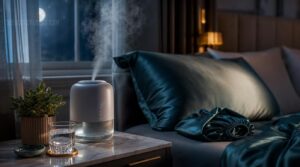
Your bedroom itself plays a bigger role in overnight moisture loss than most people realize. The air quality, temperature control, and even your bedding choices all quietly work against your skin and hair while you sleep. Here’s what you can adjust to make your environment work for you instead.
Maintain Bedroom Humidity
Few people realize how much dry bedroom air acts as environmental moisture theft, quietly pulling hydration from both skin and hair while you sleep. Central heating and air conditioning routinely drop indoor relative humidity to 20–30%, well below the 40–60% target range your skin barrier needs to minimize transepidermal water loss overnight.
A bedroom humidifier is your most direct intervention. Consider these five steps for effective humidity control:
- Choose your humidifier type — ultrasonic models produce a fine, quiet mist ideal for bedrooms, while evaporative units self-regulate naturally without over-saturating the air.
- Set a humidity setpoint — program your device to maintain 45–50% relative humidity, cycling automatically to hold that level through the night.
- Monitor with a hygrometer — a digital hygrometer confirms whether your target stays stable from bedtime to morning, revealing exactly when humidity dips occur.
- Prevent condensation — if you notice moisture forming on windows, reduce your setpoint slightly; visible condensation signals humidity has exceeded what your room temperature can comfortably hold.
- Manage airflow — position vents away from your bed and avoid running fans directly overhead, as moving air accelerates surface drying on both skin and hair.
For low humidity hair care especially, consistent airflow management transforms how well your overnight products actually perform.
Choose Breathable Bedding
Once your humidity levels are dialed in, what you sleep on and with becomes the next layer of control.
Breathable natural fibers — linen, cotton percale, and TENCEL lyocell — allow air to circulate and moisture to evaporate rather than pooling against your skin. Look for OEKO-TEX certified options to minimize chemical exposure and machine-wash new bedding before first use.
Avoid Cotton Friction
Breathable bedding helps, but the surface your face and hair rest against all night matters just as much.
Cotton pillowcases, despite feeling soft, have a fibrous texture that grips hair strands and tugs at facial skin with every movement.
Switching to a silk or satin pillowcase reduces that friction noticeably, helping your skin and hair retain overnight moisture.
If frizz is your main struggle, this guide on how to get rid of frizzy hair covers the fixes that actually work.
Hydrate Before Bedtime
What you drink—and when—shapes how your skin wakes up.
Pre-sleep water intake of around 4–6 ounces is enough to support overnight hydration without triggering disruptive bathroom trips. Space your evening hydration timing earlier, tapering fluids toward bedtime so your body absorbs them steadily rather than processing a sudden surge at midnight.
Limit Alcohol and Caffeine
Both caffeine and alcohol act as diuretics, pulling fluid from your system precisely when your skin and scalp need it most. Caffeine delays sleep onset by blocking adenosine, while alcohol fragments the second half of your night, reducing the restorative deep sleep your barrier depends on.
- Establish an evening cutoff routine: stop caffeine by early afternoon and avoid alcohol within six hours of bedtime.
- Choose sleep-friendly beverages like herbal teas or plain water as your default after dinner.
- A pre-bed water sip of 4–6 ounces helps offset the dehydrating residue both substances leave behind.
Frequently Asked Questions (FAQs)
Can diet affect how skin retains moisture overnight?
Yes, diet genuinely influences how well your skin holds moisture overnight.
Omega-3 fatty acids, ceramide-supporting nutrients, and prebiotic dietary fiber all reinforce barrier lipids, while water-rich foods and balanced electrolytes support overnight fluid retention from within.
Does sleep position impact facial hydration levels?
Your sleep position directly affects facial hydration levels. Side and stomach sleeping increases pillow contact friction, compresses the skin barrier, and disrupts overnight fluid distribution, leaving certain zones measurably drier by morning.
How does age change overnight moisture retention needs?
As you age, your skin loses the trifecta it once relied on: sebum, hyaluronic acid, and natural moisturizing factors all decline, leaving your aging skin barrier far less equipped to retain water overnight.
Are there hormonal factors that worsen nighttime dryness?
Absolutely. Estrogen decline directly weakens the skin barrier by reducing ceramide production, increasing overnight water loss. Lower progesterone and testosterone compound this, leaving skin noticeably drier and more irritated by morning.
Does exercise timing influence how skin hydrates during sleep?
Yes — exercise timing matters. A late strenuous workout can delay sleep onset, compress your skin’s barrier recovery window, and leave sweat-disrupted stratum corneum cells in a more dehydrated state before you even lie down.
Conclusion
What happens to skin and hair tonight depends entirely on what you do in the next hour. Cellular repair is already queued, humidity is already dropping, and the window for real overnight moisture retention methods is narrowing.
Hyaluronic acid, ceramides, sealed occlusives, a silk pillowcase—each one is a small, deliberate defense against biology working against you.
Build the routine once and your body does the rest while you sleep.