This site is supported by our readers. We may earn a commission, at no cost to you, if you purchase through links. This content is for general informational and educational purposes only and is not a substitute for professional medical, dermatological, or nutritional advice.

Most guys grow a beard to look sharper. Then they let it fill in evenly, round the bottom off, and wonder why their face looks wider than before.
Beard shaping for a round face runs on one principle: more length at the chin, tighter on the sides. That sounds simple. But the details are where it gets specific. Guard sizes, cheek line placement, neckline drop. Those are what separate a beard that slims your face from one that pads it.
Below, you’ll get every measurement and technique that changes how your face reads in the mirror.
Table Of Contents
- Key Takeaways
- How to Identify a Round Face
- How to Shape a Beard for a Round Face
- Best Beard Styles for Round Faces
- How to Maintain a Face-Slimming Beard
- Beard Shaping Mistakes to Avoid
- Frequently Asked Questions (FAQs)
- Can beard growth supplements help round faces?
- How long does beard shaping take daily?
- Which beard colors complement round face shapes?
- Do beard straighteners work for round faces?
- When should round faces consider beard transplants?
- Can patchy cheeks actually benefit a round face?
- How does face shape change as beard grows?
- Which beard styles work for professional environments?
- Should first-time growers commit to long beards?
- Does beard color affect how round faces look?
- Conclusion
Key Takeaways
- More length at the chin and tighter sides is the one principle that makes a beard slim a round face instead of widening it.
- Your cheek line placement is the most common mistake — keep it low and straight, running from the base of your ear to the corner of your mouth, never high near the cheekbones.
- Guard variation matters more than length: use a 3mm guard near the sideburns, step up to 6mm lower, and leave the chin at 10mm or longer to pull the eye downward.
- Maintenance locks in the shape — trim every 2 to 4 weeks, comb chin hair straight down while damp, and use beard oil on the sides to keep them flat without adding bulk.
How to Identify a Round Face

Before you pick a beard shape, you need to know what you’re actually working with. A round face has specific traits — and if you misread them, you’ll end up shaping in the wrong direction. Here’s how to check yours in three steps.
Once you’ve nailed down your face shape, browsing beard styles curated specifically for round faces can help you spot exactly which cuts and lines will work in your favor.
Measure Facial Width and Length
Two numbers tell you everything: your face length and width. Pull your hair back, stand in natural head position (eyes level, looking straight ahead), and run a flexible tape measure from your hairline straight down to your chin tip. That’s your vertical length. Then measure cheekbone to cheekbone at the widest span. Take each reading twice and average the results.
For a round face, you’ll notice your face length and width measurements come out nearly equal, which is the defining ratio that sets it apart from oval or oblong shapes.
Check Jawline and Chin Angles
The jawline angle tells you a lot. For a round face, the jaw-neck separation is soft, meaning the jaw blends into the neck without a sharp corner.
Shoot a side-profile photo at eye level in natural light. If your chin lacks forward projection and your jawline curves without a defined angle at the back corner, that confirms the round shape.
Use The Ten-Percent Test
That profile photo confirms the shape, but numbers make it official. The Ten-Percent Test turns guesswork into a measurement you can trust.
- Measure facial length: hairline center to chin.
- Measure facial width: cheekbone to cheekbone.
- Divide width by length, multiply by 100.
- Score 90 or above: round face confirmed.
- Below 90: oval, oblong, or another shape.
How to Shape a Beard for a Round Face
Shaping a beard for a round face comes down to one principle: add length where it counts and remove it where it doesn’t. Done right, five steps will get you there without guesswork. Here’s exactly how to do it.
Grow Enough Length to Shape

Grow enough length to shape before picking up any trimmer. Most styles need at least 1 inch first.
| Beard Style | Minimum Length |
|---|---|
| Shadow fade | 0.5–1 inch |
| Extended goatee | 1–2 inches |
| Ducktail | 3–4 inches |
Beard length vs width balance drives a vertical beard look. A beard with high cheek line needs chin length for the cheek taper technique to even work.
For Black men navigating these proportions, exploring beard styles tailored to different face shapes can sharpen your instincts around cheek line, fade placement, and chin length.
Taper Cheeks With Guards 1–2
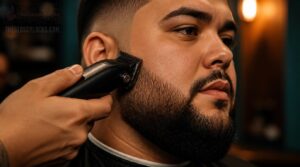
Once you’ve got the length, the cheek taper technique does the heavy lifting. Set your trimmer to a guard 1 (3mm) near the sideburns and work toward the jaw, feathering the clipper outward at the end of each stroke. That outward flick prevents harsh lines. A beard trimmer with adjustable guards makes swapping between those lengths quick and precise, so your taper stays consistent from session to session.
Switch to a guard 2 (6mm) as you move lower. This guard length gradient — tighter up top, slightly fuller below — pulls the eye downward instead of outward.
Leave More Length at Chin

Drop the guard on your chin or switch to a guard 3 (10mm).
Leaving more length at the chin is what drives vertical facial elongation on a round face. Target 2 to 4 inches if your growth allows. That extra length shifts the eye downward and builds chin prominence, which is the whole point of beard shaping for face slimming.
Lower and Define Cheek Lines
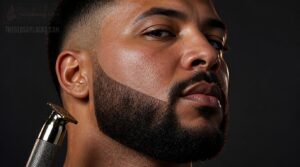
The cheek line is where most round-faced men go wrong. Keep it lower and straighter, running from the base of your ear to the corner of your mouth. That angle does the real cheek contouring work, cutting natural curves so the face reads longer.
A high line widens everything. Use a T-liner for beard line precision, one pass per side.
Blend Sideburns and Set Neckline
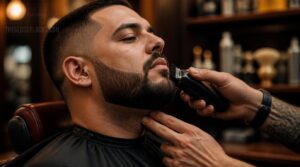
Sideburns set the frame. Match their width to your ear, then fade sideburns using a 0.5 or 1 guard down toward the jaw.
For neckline definition, go natural — two fingers above your Adam’s apple. A tapered finish beats a blocked edge every time.
Key checkpoints:
- Taper, don’t box, the neckline
- Fade sideburns into surrounding hair
- Keep width ear-level or narrower
Best Beard Styles for Round Faces

Not every beard style works the same way on a round face — shape matters more than length. The right cut creates angles where your face doesn’t have them, pulling attention downward and adding the illusion of length. Here are the five styles that do that best.
Shadow Fade Beard
The shadow fade beard is one of the strongest tools your face shape analysis can point to. Hair tapers gradually from your chin to your cheekbones, keeping the shortest buzz near your ears.
That progression creates jawline definition through beard tapering alone, pulling the eye down and inward. No harsh lines. Just a clean, graduated shadow that slims your profile.
Extended Goatee and Anchor Beard
Two styles that work directly off face shape analysis: the extended goatee and the anchor beard.
The extended goatee stretches your chin section downward, adding length where your face needs it most. Your mustache connects seamlessly into the goatee, drawing the eye straight down.
The anchor beard adds pointed chin definition with a thin jawline strip and clean-shaven cheeks for contrast.
Ducktail and Pointed Full Beards
Both styles push the pointed chin concept further than the anchor does. The ducktail beard splits at the chin into two points, carving a forked shape that pulls the eye down. A tapered full beard with a pointed tip runs one clean centerline instead.
Either way, you need sharp cheek lines and real vertical length to slim a round face.
Low Boxed and Narrow Beards
Where pointed styles pull the eye downward through a tip, a low boxed beard takes a different route. Keep it between 5 and 10mm, drop the cheek lines low, and tighten the sides.
The rectangular frame does the slimming work on its own. This narrow beard style corrects facial symmetry by compressing width, not just adding chin length.
Square Beard With Sharp Corners
The square beard is built on perpendicular corners and sharp cheek lines, not on tapers. That geometry shifts visual weight distribution toward the jaw and corrects facial symmetry through angular definition.
Three things make it work:
- Start the shaping line at your ear and drop straight down.
- Finish the chin flat, not rounded.
- Square your sideburns into the jaw corners.
How to Maintain a Face-Slimming Beard
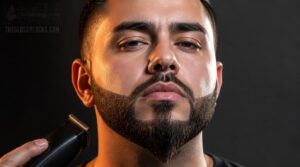
Getting the shape right is only half the job — keeping it sharp is what actually makes it work. A face-slimming beard loses its effect fast if the cheek lines grow out or the chin loses its point. Here’s what your maintenance routine needs to include.
Follow a Consistent Trimming Schedule
Your beard maintenance routine needs a schedule, not just good intentions. Short beards need trimming every 2-4 weeks. Medium lengths, every 4-6 weeks.
Part of any solid beard care routine is knowing your trimmer guard numbers for each session. A consistent beard line reset schedule keeps your chin long and your cheeks tapered, the foundation of a professional trimmed beard.
Comb Chin Hair Straight Down
A simple comb can do real work for facial symmetry correction. After washing, run a wide-tooth comb straight down through your chin hair while it’s still slightly damp. That downward pull trains the strands over time, reinforcing vertical length where you need it most.
Don’t overdo it. One pass, then leave it alone. Constant touching makes hair go limp.
Choose Beard Oil or Balm
Why does your beard look wider on some days? Often it’s your product choice. Beard oil application, 2 to 4 drops on damp hair, softens strands and keeps hair lying flat without bulk. Use balm for hold only at the chin to strengthen jawline enhancement: A lightweight beard oil for daily use works best here, since heavier formulas can add unwanted volume to the sides.
- Oil first for moisture and softness
- Balm at chin for length
- Skip balm on cheeks
Use Adjustable and Detail Trimmers
Two tools, two different jobs. Your adjustable trimmer takes care of bulk length first. Use guards 1 to 2 on cheeks to keep avoiding horizontal width.
Then switch to a detail trimmer for sharp cheek lines and the chin outline. For a short boxed beard or square beard, that clean precision edge is what drives effective beard shaping for a round face.
Ask Barbers for Precise Tapers
When your hand isn’t steady enough for precision, your barber is. Tell them exactly what you need: "taper cheeks shorter" using guards 1 to 2, leave chin length intact. Bring a reference photo. Ask them to check symmetry from multiple angles.
Visit every 2 to 3 weeks — a tapered full beard loses its face-slimming effect fast.
Beard Shaping Mistakes to Avoid
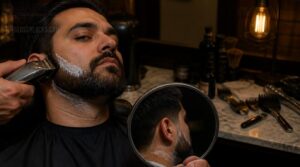
Getting the shape right takes effort, but the wrong habits can quietly undo all of it. Most round-faced guys don’t fail because of bad tools — they fail because of specific, fixable mistakes. Here are the ones that do the most damage.
Keeping Every Area Equal Length
Using one guard everywhere is the fastest way to lose facial shape. Uniform length adds width across your cheeks and removes chin length. A short boxed beard or square beard needs variation to work. Equal length works against that:
- Face reads wider, not longer
- Jawline definition disappears
- Chin loses downward weight
- Cheeks gain bulk
- Sculpted beard with sharp edges becomes impossible
Drawing Cheek Lines Too High
A high cheek line is the fastest way to widen your face. Drawing it too close to your cheekbones removes the natural taper that slims facial proportions.
The beard looks disconnected from your sideburns and sits on your jawline like a chin strap. For beard shaping on a round face, keep straight cheek lines low and follow your natural growth.
Rounding The Beard Bottom
A rounded beard bottom works against you. It widens the chin line and kills the elongating effect you’ve been building everywhere else.
Keep the bottom tight and tapered, letting the chin sit as the fullest point, not a curved shelf. Styles like the ducktail and short boxed beard succeed precisely because their bases aren’t soft.
Wearing Full Curved Chinstraps
A chinstrap beard sounds logical. It follows the jaw. But a full curved chinstrap mirrors your natural jawline, and on a round face, that curve already exists. You’re tracing the problem, not fixing it.
Real jawline enhancement comes from angular lines and defined edges, not soft arcs. Facial contouring requires contrast and structure. Sharp cuts deliver that. Curves never will.
Angular lines and sharp edges define the jaw — curves only trace the problem
Letting Sideburns Add Bulk
Curves aren’t the only problem. Wide, long sideburns add horizontal bulk right where a round face is already widest. That wipes out the elongation your chin length creates.
Keep sideburns trimmed to ear width and tapered toward the bottom. No wider. Trim every 3 to 5 days. Tight sides let the beard’s length at the chin do the actual work.
Frequently Asked Questions (FAQs)
Can beard growth supplements help round faces?
Think of beard supplements like a Victorian cure-all: promising, but limited. No pill changes your genetics. If you’re genuinely deficient in nutrients, they may support slow or patchy growth. Expect 2-6 months to see anything.
How long does beard shaping take daily?
Once your shape is locked in, daily maintenance runs 3 to 5 minutes. Budget 10 to 15 minutes early on while you’re still setting outlines and learning which guard lengths work for your beard.
Which beard colors complement round face shapes?
A shadow makes a sculpture look carved, not round. Dark beard shades like black, charcoal, or deep brown work the same way, sharpening facial proportions and reinforcing the jawline definition your beard fade naturally builds.
Do beard straighteners work for round faces?
Beard straighteners heat the hair shaft, which changes how each strand sits and behaves. For a round face, the controlled lay reduces side bulk and keeps cheek hair from pushing noticeably outward and adding width.
When should round faces consider beard transplants?
Like burning the last bridge, beard transplants come into play when you’ve exhausted every other option. If patchy growth around your jawline prevents the length and definition your face needs, transplantation is worth exploring.
Can patchy cheeks actually benefit a round face?
Yes, patchy cheeks can help. Gaps reduce outward bulk at the widest part of your face, keeping emphasis low, near the chin, where vertical length does the slimming work.
How does face shape change as beard grows?
Your face shape shifts each time the beard fills into a new area. Volume at the cheeks reads as width, while length at the chin reads as height. The silhouette never stays still for long.
Which beard styles work for professional environments?
Short boxed beards and corporate beard standards keep you polished at the office. A trimmed goatee works too. Both read professional while still letting you own the look.
Should first-time growers commit to long beards?
A young man’s first beard is your honest look at what you can actually grow. Don’t commit to length before that picture is clear. Long beards demand months, and one bad trim sets you back.
Does beard color affect how round faces look?
Beard color absolutely shapes perception. A darker beard against light skin sharpens your jawline edges. A patchy or faded beard blurs them. Contrast controls definition more than most men realize.
Conclusion
Most guys won’t notice the mistake until the trimmer is already back on the shelf. That’s the real problem with beard shaping for a round face: wrong moves don’t announce themselves until after.
Keep the chin long. Taper the cheeks tight. Lower the cheek line. Set a clean, well-defined neckline. Each of those adjustments by itself seems minor. Together, they shift how your entire face reads in the mirror. That’s exactly where the difference lives.