This site is supported by our readers. We may earn a commission, at no cost to you, if you purchase through links. This content is for general informational and educational purposes only and is not a substitute for professional medical, dermatological, or nutritional advice.

Your skin’s cell turnover slows to 60 days as you age, nearly double the 28-day cycle you had in your twenties. That means dead skin cells pile up longer, leaving your complexion looking dull and your serums sitting on the surface instead of absorbing where they count.
The right facial exfoliators for mature skin don’t strip or scratch. They dissolve that buildup gently, smooth texture, and let everything else in your routine actually work. Some even support your skin barrier while they exfoliate.
Here’s what to use, what to skip, and why each pick made the list.
Table Of Contents
- Key Takeaways
- Top 7 Facial Exfoliators for Mature Skin
- How Mature Skin Benefits From Exfoliation
- Chemical Versus Physical Exfoliators for Mature Skin
- How to Choose a Gentle Exfoliator
- How to Exfoliate Mature Skin Safely
- Frequently Asked Questions (FAQs)
- What is the best face exfoliant for mature skin?
- What is a good facial exfoliator for mature skin?
- Should a 60 year old woman exfoliate her face?
- What is the best way to exfoliate elderly skin?
- Can I use retinol alongside an exfoliator?
- Should I apply SPF after exfoliating?
- How soon will I see visible results?
- Can I exfoliate if I have rosacea?
- Is professional exfoliation better than at-home options?
- Conclusion
Key Takeaways
- Mature skin’s cell turnover slows to 60 days — nearly double the youthful 28-day cycle — causing dead cells to pile up and block serums from absorbing properly, which makes regular exfoliation essential, not optional.
- Chemical exfoliants like mandelic and lactic acid are safer for mature skin than physical scrubs, because they dissolve dead cells without friction that can cause microtears in thinner, aging skin.
- Barrier-supporting ingredients — ceramides, niacinamide, and hyaluronic acid — should accompany any exfoliant you choose, since mature skin needs protection during and after the exfoliation process to prevent irritation and dryness.
- Start exfoliating just once a week, always follow with moisturizer, and wear SPF every morning, because exfoliated skin absorbs more UV damage and consistency over weeks — not days — is what delivers lasting results.
Top 7 Facial Exfoliators for Mature Skin
These seven products were chosen with mature skin’s needs in mind, not just general effectiveness. Each one balances exfoliation with barrier support, so you’re getting results without unnecessary irritation. Whether you prefer a cleanser, serum, or treatment pad, there’s an option here that fits your routine.
For more on building a routine that works with sensitive skin rather than against it, calming skincare routines for reactive skin offer guidance on pairing these kinds of products effectively.
1. LOreal Revitalift Bright Reveal Cleanser
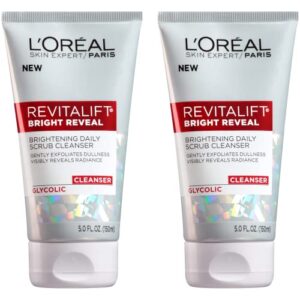
Cleanser format makes exfoliation simple to add to your daily routine. L’Oreal’s Revitalift Bright Reveal pairs glycolic acid with micro-pearls to loosen dead skin cells and smooth surface texture. Vitamin C derivatives and mica add visible brightness after rinsing, so you’re not just cleansing, you’re also improving your skin tone. It’s dermatologist tested and suitable for both morning and nightly use.
If you have sensitive skin, start with weekly use and watch carefully for stinging or redness before building up.
| Best For | People looking to brighten their complexion and simplify exfoliation with a daily cleanser that does double duty. |
|---|---|
| Active Ingredient | Glycolic Acid |
| Product Format | Daily scrub cleanser |
| Skin Suitability | All skin types |
| Product Size | 5 fl oz (2-pack) |
| Irritation Risk | Possible burning |
| Secondary Benefit | Improves tone and radiance |
| Additional Features |
|
- Combines glycolic acid and micro-pearls for effective exfoliation in one simple step
- Suitable for both morning and evening use, making it easy to fit into any routine
- Dermatologist tested, with added brightness from vitamin C derivatives and mica
- May cause burning or stinging, especially for those with sensitive skin
- Customer experiences vary, so it may not work for everyone
- Can be hard to find in stores and may require ordering online
2. The Ordinary Mandelic Acid 10% Serum
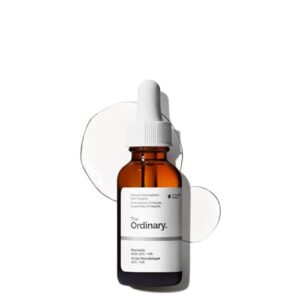
If glycolic acid feels too aggressive for your skin, mandelic acid is worth trying. The Ordinary’s 10% serum delivers gentle chemical exfoliation through a larger molecule that penetrates more slowly, reducing irritation risk. It also contains hyaluronic acid for hydration and Tasmanian Pepperberry extract to calm your skin during exfoliation.
Use it two to three nights weekly, follow with moisturizer, and apply SPF the next morning. Some users notice a slightly oily texture, but results build steadily over several days.
| Best For | People with sensitive skin who want effective chemical exfoliation without the irritation that stronger acids like glycolic acid can cause. |
|---|---|
| Active Ingredient | 10% Mandelic Acid |
| Product Format | Liquid serum |
| Skin Suitability | Sensitive skin |
| Product Size | 1 fl oz (30 ml) |
| Irritation Risk | Mild stinging possible |
| Secondary Benefit | Fades dark spots; reduces acne |
| Additional Features |
|
- Mandelic acid’s larger molecule penetrates slowly, making it gentler and less likely to cause irritation than other chemical exfoliants.
- Hyaluronic acid and Tasmanian Pepperberry extract work together to keep skin hydrated and calm during exfoliation.
- Helps fade dark spots, improve skin texture, and reduce acne breakouts with consistent use.
- Sunscreen is required the morning after each application, adding a step to your routine.
- Some users find the texture slightly oily, and mild stinging is possible.
- Results aren’t immediate — it can take several days of regular use before visible improvements appear.
3. CeraVe Glycolic Acid Nightly Serum
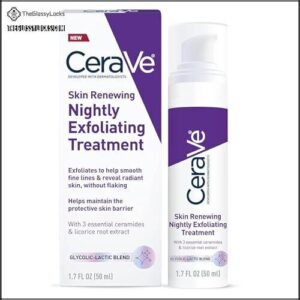
If your skin tolerates mandelic acid well, CeraVe’s nightly serum is a practical next step. It contains a 5% glycolic and lactic acid mix that resurfaces more actively, with ceramides protecting your barrier and locking in moisture. Hyaluronic acid and licorice root round out the formula.
Start every other night to build tolerance, then increase frequency as your skin adjusts. Skip it over active breakouts or raw skin. Always apply SPF the next morning, since glycolic raises your sun sensitivity.
| Best For | Those with dry, oily, or sensitive skin who are ready to graduate from gentler acids and want a ceramide-cushioned formula that resurfaces while protecting the skin barrier. |
|---|---|
| Active Ingredient | Glycolic + Lactic Acids (5%) |
| Product Format | Leave-on treatment |
| Skin Suitability | Dry, sensitive, oily, acne-prone |
| Product Size | 1.7 oz (50 ml) |
| Irritation Risk | Burning on active acne |
| Secondary Benefit | Targets fine lines and dark spots |
| Additional Features |
|
- The 5% glycolic and lactic acid blend resurfaces effectively while ceramides actively repair and reinforce your moisture barrier
- Hyaluronic acid and licorice root add hydration and brightening benefits, making it more than a one-note exfoliant
- Non-comedogenic and fragrance-free, so it works across a wide range of skin types without unnecessary irritants
- Can cause burning or irritation on active breakouts or broken skin, requiring you to spot-avoid problem areas
- Daily SPF becomes non-negotiable since glycolic acid increases sun sensitivity
- Results on exfoliation can be inconsistent, with some users finding the formula less impactful than expected
4. Sunday Riley Good Genes Serum
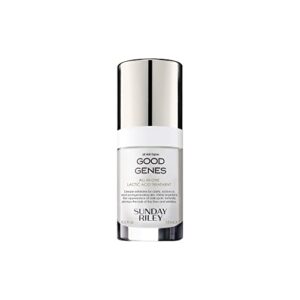
Good Genes is a step up in potency. It combines lactic acid with botanicals like lemongrass, aloe, and licorice in a leave-on chemical exfoliant targeting dark spots, uneven tone, and fine lines. If your skin’s sensitive, use it as a rinse-off mask and wash it off after 15 minutes.
For broader exfoliation beyond the face, proper body exfoliation techniques can help you get the same even-toned results from acids like lactic acid head to toe.
At $50 for 0.5 ounces, it’s concentrated. The lightweight serum layers without pilling under your moisturizer or SPF. Sunscreen the next morning isn’t optional, since lactic acid raises your sun sensitivity.
| Best For | Anyone with dull, uneven skin tone or dark spots who wants a potent chemical exfoliant that works for most skin types, including sensitive skin with the right application method. |
|---|---|
| Active Ingredient | Lactic Acid |
| Product Format | Leave-on serum / rinse-off mask |
| Skin Suitability | All skin types |
| Product Size | 0.5 fl oz (15 ml) |
| Irritation Risk | Burning or stinging possible |
| Secondary Benefit | Targets dark spots and fine lines |
| Additional Features |
|
- Combines lactic acid with skin-soothing botanicals (aloe, arnica, licorice) for exfoliation that doesn’t feel completely stripped
- Flexible use — apply as a leave-on serum for normal skin or a 15-minute rinse-off mask for sensitive skin
- Lightweight formula layers cleanly under moisturizer, retinol, or makeup without pilling
- $50 for just 0.5 oz is steep, and how long it lasts varies wildly — some users get a few weeks, others several months
- Irritation is hit or miss; some people feel a pleasant tingle, others report burning or stinging
- Lactic acid increases sun sensitivity, so daily SPF becomes non-negotiable while using it
5. Dr Dennis Gross Alpha Beta Peel
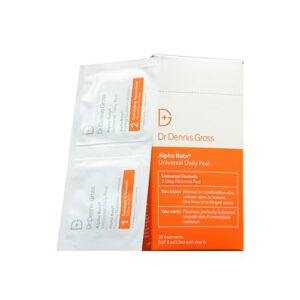
A two-step pad system, the Dr. Dennis Gross Alpha Beta Peel combines 5 alpha and beta acids in Step 1 with 12 antioxidants in Step 2. That pairing exfoliates and actively replenishes in a single routine.
If you’re new to it, apply every other day until your skin fully adjusts. It’s dermatologist-formulated, vegan, and free of parabens and sulfates. Avoid layering it with retinoids or alcohol-based products on the same night. At $79.90 for 30 pads, it’s a solid investment.
| Best For | People with normal or combination skin who want a straightforward daily exfoliation routine that smooths texture, brightens, and targets fine lines without a complicated regimen. |
|---|---|
| Active Ingredient | 5 Alpha Beta Acids |
| Product Format | Two-step treatment pads |
| Skin Suitability | Normal or combination |
| Product Size | 30 pads |
| Irritation Risk | Stinging for sensitive skin |
| Secondary Benefit | Firms skin; refines pores |
| Additional Features |
|
- Combines exfoliation and antioxidant replenishment in one two-step routine, so you’re not layering multiple products
- Dermatologist-formulated with a clean ingredient profile — vegan, paraben-free, and sulfate-free
- Works on multiple concerns at once: pore appearance, fine lines, dullness, and skin firmness
- At $79.90 for 30 pads, the per-use cost adds up quickly for a daily routine
- Can cause stinging or irritation, especially for sensitive skin types
- Cannot be used alongside alcohol-based products or retinoids, which limits how you can build the rest of your routine
6. Kate Somerville ExfoliKate Travel Cleanser
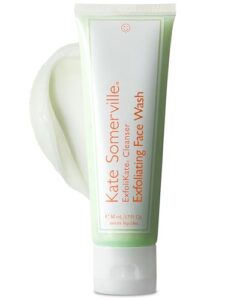
It’s small enough to fit in your carry-on, but this 1.7-ounce travel cleanser still delivers real results. The formula combines Glycolic Acid, Lactic Acid, and a trio of fruit enzymes from papaya, pineapple, and pumpkin to work on texture and brightness simultaneously.
If you’re navigating sensitive skin or prone to ingrowns, understanding how exfoliation prevents ingrown hairs can help you get the most out of this kind of multi-acid formula.
Massage it for 30 seconds on damp skin, then rinse well. It’s free of parabens, SLS, and mineral oil, so it’s cleaner for sensitive types. Don’t leave it on longer than directed since the active ingredients can burn.
| Best For | Travelers and anyone with sensitive or combination skin who wants an effective daily exfoliating cleanser in a carry-on-friendly size. |
|---|---|
| Active Ingredient | Glycolic + Lactic + Enzymes |
| Product Format | Daily foaming cleanser |
| Skin Suitability | All skin types |
| Product Size | 1.7 fl oz (50 ml) |
| Irritation Risk | Burning if overused |
| Secondary Benefit | Purifies pores; removes makeup |
| Additional Features |
|
- Combines chemical exfoliants (Glycolic and Lactic Acid) with fruit enzymes for smoother, brighter skin in just 30 seconds
- Free from parabens, SLS, SLES, phthalates, and mineral oil — a cleaner formula suitable for sensitive skin
- Compact 1.7 oz size fits easily in a travel bag without sacrificing real exfoliating power
- Active ingredients can cause burning if left on longer than recommended, so rinsing promptly is a must
- At least one user experienced significant eyelid irritation and sensitivity that lasted several weeks
- Higher price point than most cleansers, with some customers questioning whether the results justify the cost
7. Tatcha Rice Polish Classic Enzyme Powder
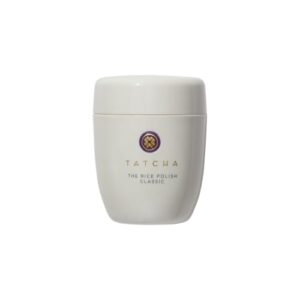
Picture a soft cloud of powder hitting water and blooming into a silky, creamy foam. That’s the experience here.
You activate papain enzyme and Japanese rice bran with just a half teaspoon, giving your skin both chemical and gentle physical exfoliation in one pass.
At $69 for 2.12 oz, it’s a real investment, but the formula goes a long way because you need so little.
Silk proteins and the Hadasei-3 complex actively condition and support your barrier as you polish.
| Best For | Anyone with sensitive skin who wants a gentle daily exfoliant that doubles as a skin-conditioning treatment and doesn’t mind spending more for a little-goes-a-long-way formula. |
|---|---|
| Active Ingredient | Japanese Rice Bran Enzyme |
| Product Format | Water-activated powder |
| Skin Suitability | Sensitive skin |
| Product Size | 2.12 oz |
| Irritation Risk | Low; non-harsh |
| Secondary Benefit | Smooth, polished finish |
| Additional Features |
|
- The water-activated powder blooms into a creamy foam that delivers both enzyme and physical exfoliation in one step, leaving skin noticeably smoother.
- A small half-teaspoon dose per use means the 2.12 oz jar lasts well beyond what the price tag might suggest.
- Silk proteins and the Hadasei-3 complex condition and support the skin barrier while you exfoliate, so it doesn’t strip or irritate.
- At $69, it’s a significant splurge, and not every user finds the results justify the cost.
- Some customers report that the powder formula can be tricky to rinse away completely.
- Despite being marketed for sensitive skin, the experience isn’t universally gentle — results vary by skin type.
How Mature Skin Benefits From Exfoliation
Exfoliating mature skin does more than remove dead cells — it helps with processes that slow down as your skin ages. Done consistently and gently, it delivers five measurable benefits your skin can actually use. Here’s what to expect.
Supports Cell Turnover
Mature skin’s cellular turnover slows dramatically, taking up to 60 days instead of 28. That means dead cells pile up faster than your skin sheds them.
Regular exfoliation shortens that cycle, nudging skin cell regeneration back toward a younger pace. Studies show AHAs can accelerate renewal within 14–28 days, so consistent exfoliation frequency** is what actually moves the needle.
Smooths Rough Texture
That sandpaper feeling on your skin? It’s corneocyte buildup. As mature skin slows cell turnover, dead cells accumulate on the surface.
Regular exfoliation breaks those intercellular bonds, clearing the debris and revealing smoother keratinocytes underneath. The right face exfoliators for mature skin, especially AHAs like glycolic or lactic acid, can visibly smooth rough texture within just two to four weeks.
Brightens Dull Skin
You can’t brighten dull looking skin without first addressing cellular turnover. In mature skin, that process naturally slows down, so dead cells accumulate on the surface and block skin radiance.
Regular exfoliation with gentle acids clears them away and reveals fresher, brighter cells underneath. Pair your exfoliant with a niacinamide serum to brighten your complexion and keep your results going.
Evens Skin Tone
Exfoliation doesn’t just reveal fresher cells. It also changes how pigment appears. When dead skin accumulates, hyperpigmentation looks darker and patchier, making your complexion look uneven.
Gentle acids like mandelic and lactic are your best tools for skin tone evening. They encourage faster turnover without disrupting the barrier. With consistent use, dark spots fade and your skin tone evens out.
A well-formulated mandelic and lactic acid serum can make this routine even more targeted, combining both acids for a more balanced, skin-brightening effect.
Enhances Product Absorption
Dead cells don’t just affect your tone. They also block serums and moisturizers from fully sinking in.
Face exfoliators for mature skin clear that buildup. Glycolic and lactic acids can improve product absorption by up to three times, so your actives reach deeper layers more effectively.
Protect your skin barrier between sessions. That’s what keeps moisturizer absorption working without irritation.
Chemical Versus Physical Exfoliators for Mature Skin
Now that you know what exfoliation does for mature skin, the method matters. Not all exfoliators for mature skin work the same way.
Physical exfoliators use friction to remove dead cells. For mature skin, that friction is a problem. Skin thins with age, and abrasion can cause micro-tears, weaken your barrier, and trigger irritation.
Chemical exfoliators dissolve the bonds holding dead cells in place without rubbing. That’s why nonabrasive exfoliation suits mature skin better. Here’s the key difference:
- Chemical exfoliators work at a cellular level, not the surface
- A physical exfoliator can’t target tone or texture the same way
- Chemical options often include barrier-supporting ingredients alongside the active
For most mature skin, chemical exfoliators are the safer, more effective pick.
How to Choose a Gentle Exfoliator
Not every exfoliator is built for mature skin, so the label alone won’t tell you what you need to know. A few key factors guide the right choice and keep your skin barrier intact. Here’s what to look for before you buy.
Choose Gentler Acids
Think of mature skin like fine fabric, it needs a gentle touch. Mandelic acid and lactic acid are your best starting points, and they’ll deliver gentle exfoliation without the sting glycolic often brings.
A polyhydroxy acid like gluconolactone goes even further, actively supporting skin barrier repair while it works. These options respect your skin instead of pushing it too hard.
Check Acid Strength
How strong is too strong? That’s the right question for exfoliant safety. Chemical exfoliators like glycolic acid work best at 5–10% for nightly use on mature skin.
Going higher raises your irritation risk fast. Check the percentage and pH before you buy. Lower pH deepens penetration. For better skin sensitivity management, salicylic acid stays surface-level, making it the gentler choice.
Prioritize Barrier Support
For mature skin, gentle exfoliation can still damage your barrier without the right support. Look for products with ceramides, panthenol, or niacinamide alongside any acid. These ingredients restore lipids, improve skin hydration, and reduce irritation risk. Combining all three in one formula is easier than it sounds — a ceramide panthenol niacinamide moisturizer delivers that full barrier-rebuilding trio without the guesswork.
Always follow up with a ceramide-rich moisturizer afterward. It’ll keep skin barrier function intact. Choose fragrance-free formulas, since fragrance is a common barrier disruptor.
Avoid Abrasive Scrubs
Scrubs feel effective, but a physical exfoliator with gritty particles can cause microtears in mature skin, raising your risk of barrier damage and dryness.
- Switch to chemical exfoliators like mandelic acid; they’re gentler and won’t scrub.
- If you want texture, choose fine jojoba particles over sugar or salt.
- Reserve gentle exfoliation for chemical options to better protect your skin’s barrier.
Start With Weekly Use
Picture a new exercise routine: you don’t start by running five miles. You build up. The same logic applies to face exfoliators for mature skin.
Begin with once-weekly use. Your sensitive skin needs time to adjust, and your skin barrier needs room to stay intact. Gentle exfoliation one night a week is enough to see real results without overdoing it.
Monitor Irritation Signs
Your skin will tell you when it’s had enough. Watch for persistent redness or stinging that lingers for hours after exfoliating. Tightness, flaking, or new breakouts that line up with your exfoliant use are clear signs of skin irritation. If discomfort increases with each application rather than settling, stop and give your barrier time to fully recover before trying again.
When exfoliation causes more discomfort with each use, your skin is asking you to stop
How to Exfoliate Mature Skin Safely

Getting your exfoliation routine right doesn’t have to be complicated. A few deliberate habits keep your skin barrier protected while you see real results.
- Start once weekly and only increase if your skin tolerates it well. If you’re unsure where to begin, this guide to chemical body exfoliant benefits breaks down how these ingredients smooth rough skin without irritating it.
- Apply your gentle exfoliator to clean, dry skin and rinse thoroughly.
- Never layer multiple exfoliating acids in the same routine.
- Moisturize right after each session to support barrier recovery.
- Wear sunscreen daily, since exfoliated skin absorbs more UV damage.
If you notice burning, persistent redness, or sudden sensitivity, it’s time to scale back immediately. Mature skin responds better to patience than to intensity. Give each product a few weeks before drawing any conclusions. That’s exactly how you build lasting, real results without losing progress.
Frequently Asked Questions (FAQs)
What is the best face exfoliant for mature skin?
For mature skin, mandelic acid is often your best option. It’s gentler than glycolic acid, penetrates less deeply, and causes less stinging. Pair it with ceramides or hyaluronic acid to keep your skin barrier strong.
What is a good facial exfoliator for mature skin?
Think of your face as a window clouded with layers of buildup. Gentle chemical exfoliants clear it without damage. For aging skin, The Ordinary Mandelic Acid 10% is a top esthetician-picked option to try first.
Should a 60 year old woman exfoliate her face?
Yes, but gently. After 50, cell turnover slows, so dead skin builds up faster. A gentle exfoliator for mature skin, used weekly, helps brighten and smooth without disrupting your barrier.
What is the best way to exfoliate elderly skin?
The best approach for elderly skin is gentle chemical exfoliation. Start with a mild acid serum once weekly, moisturize right after, and always skip abrasive scrubs. They’re simply too harsh for your already thinning barrier.
Can I use retinol alongside an exfoliator?
Two lanes running at full speed invite a crash.
You can use retinol and an exfoliator, but alternate the nights to protect your skin barrier and don’t compound exfoliant sensitivity on mature or aging skin.
Should I apply SPF after exfoliating?
Exfoliation makes your skin more sensitive to UV and everyday irritants, so postexfoliation sun protection isn’t a step you can skip. Apply your sunscreen every morning as your final step, including after a nighttime session.
How soon will I see visible results?
Think of it like slowly peeling back the layers of frosted glass. Surface smoothness shows up within days, but deeper visible results like skin texture improvement and skin brightening don’t arrive for several consistent weeks.
Can I exfoliate if I have rosacea?
Yes, but rosacea-prone skin needs extra care. Skip glycolic acid and anything abrasive; both can irritate sensitive skin and trigger flares.
A fragrance-free, nonabrasive PHA is a gentler option. Use it once weekly at most.
When in remission, AHAs with rosacea-prone skin may be tolerated cautiously, but always prioritize barrier support and stop use if stinging or flushing occurs.
Is professional exfoliation better than at-home options?
Neither is universally better. Professional exfoliation penetrates deeper into the skin, treating stubborn hyperpigmentation, scarring, and deep wrinkles that at-home options simply can’t reach. Your best results for mature skin come from using them both.
Conclusion
Think of exfoliation as clearing the path so everything else can actually land. When dead cells pile up for 60 days instead of 28, even your best serums sit at the door, waiting. The right facial exfoliators for mature skin change that.
Pick one that fits your sensitivity, use it consistently, and give your skin two to three weeks to respond. That buildup clears. Your routine starts working the way it should.