This site is supported by our readers. We may earn a commission, at no cost to you, if you purchase through links. This content is for general informational and educational purposes only and is not a substitute for professional medical, dermatological, or nutritional advice.
Most people grab a box of hair dye, match it roughly to their current color, and hope for the best—then spend weeks wondering why the result looks nothing like the swatch.
The gap between what you expected and what you got almost always comes down to one thing: misreading the chart.
Hair dye color charts aren’t just pretty color swatches arranged in a row.
They encode level numbers, tone codes, developer volumes, and gray-coverage designations that each shape your final result.
Once you understand how to read them, picking your perfect shade stops feeling like a gamble.
Table Of Contents
- Key Takeaways
- Hair Dye Color Chart Basics
- Decode Hair Shade Numbers
- Pick Shades for Your Undertone
- Use Charts for Safer Coloring
- Top 6 Haircare Products
- Frequently Asked Questions (FAQs)
- What hair color goes best with rosacea?
- How do I figure out what color to dye my hair?
- What hair color makes you look younger over 50?
- Is 3n darker than 4n?
- Should you go darker or lighter with hair color as you age?
- How long do hair dye colors last?
- Can you mix different hair dye shades?
- What developer strength should I use?
- How often can I dye my hair?
- Do color charts work for all hair types?
- Conclusion
Key Takeaways
- Hair dye charts encode level numbers (1–10), tone codes, and developer volumes that directly determine your final color result, so reading them correctly removes the guesswork from shade selection.
- Your skin undertone is the real guide to choosing a flattering shade — warm undertones balance with cooler ash tones, while cool undertones pair better with warm golds and coppers.
- Understanding underlying pigments at each level lets you predict and neutralize brassiness before it appears, using violet toners for yellow at levels 9–10 and blue toners for orange at levels 6–8.
- Hair porosity, gray percentage, and developer volume all shift how color deposits on your hair, so matching these factors to chart guidance is just as important as picking the right shade.
Hair Dye Color Chart Basics
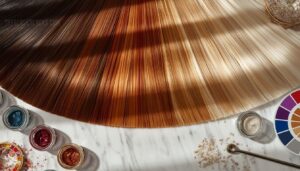
Every hair dye chart starts with the same building blocks, and once you understand them, picking a shade gets a whole lot easier.
Pairing those basics with a solid hair color numbers and codes guide makes reading any chart feel intuitive rather than overwhelming.
The system relies on a few key elements working together — levels, tones, underlying pigments, and special codes that tell you exactly what you’re getting. Here’s each part of that system actually means.
Hair Color Levels From 1 to 10
Every hair color level chart uses a simple 1–10 scale — level 1 being jet black, level 10 being the palest blonde.
Think of it as a brightness dial.
Each step represents one measurable depth change, so level transitions are easy to track once you know the system.
| Level Range | What It Looks Like |
|---|---|
| 1–3 | Black to dark brown |
| 4–6 | Medium to dark blonde |
| 7–10 | Blonde to lightest blonde |
How Tone Changes The Final Shade
Level sets the depth, but tone decides the mood. A level 7 ash blonde looks smoky and muted thanks to its Ash Cooling Effect, while a level 7 gold blonde delivers a warm, sunlit finish through its Gold Warmth Boost.
Your hair color chart maps this clearly:
| Tone | What It Does |
|---|---|
| Ash | Reduces warmth, adds cool undertone |
| Violet | Cancels yellow via Violet Neutralization |
| Gold | Brightens with warm undertone |
| Red/Copper | Adds Red Copper Vibrancy and richness |
For a modern look, consider the Mushroom brown trend which blends ashy brown, purple, and gray pigments. Tone Strength Balance matters too — stronger tones shift results more dramatically than soft neutrals.
Underlying Pigments at Each Level
Tone shapes the finish, but understanding underlying pigments is what makes your shade selection process reliable. Think of it as Pigment Layering Mechanics — every level hides warm tones beneath the surface.
| Level | Underlying Pigment | Key Shift |
|---|---|---|
| 1–4 | Red Pigment Emergence | Deep red, then red-orange |
| 5–6 | Orange Base Shift | Orange to orange-gold |
| 7–8 | Yellow Gold Shift | Gold to bright yellow |
| 9–10 | Pale Yellow Reveal | Soft pale yellow |
Your hair color chart reflects this — Understanding hair color levels and tones helps you anticipate warmth before it appears, making tone neutralization far more predictable.
Double-tone Codes and What They Mean
When you see a code like 6.77, that’s a double tone at work. The first digit sets your level; the doubled second digit means that tone is dominant — roughly 70% of the final shade. This shade precision helps with fade compensation and developer selection.
| Double Tone Code | What It Delivers |
|---|---|
| 6.77 | Dark blonde, intense violet |
| 7.33 | Medium blonde, rich gold |
| 5.66 | Light brown, vivid red |
| 8.11 | Light blonde, deep ash |
| 4.55 | Medium brown, mahogany |
Gray-coverage Shades Like N and NN
If your hair is more than 50% gray, the letter N on a hair color chart isn’t always enough. That’s where NN — Extra Natural Coverage — steps in.
Here’s a quick N vs NN Opacity breakdown:
| Shade | Best For |
|---|---|
| 6N | Under 50% gray |
| 6NN | 50–100% gray |
| NN + reflect | Gray blend ratios |
| 20 vol developer | Full gray coverage |
| N + fashion tone | Lighter gray neutralization |
NN’s heavier Pigment Load Comparison delivers denser, more opaque results where the standard N turns translucent.
Decode Hair Shade Numbers
Those numbers and letters on a box of dye aren’t random — they’re actually a pretty logical system once you know the key.
The letter-number combo even helps you predict how a shade will look on you — especially useful when you’re figuring out which blonde tones suit your skin undertones.
Every code tells you exactly how light or dark your hair will go and what tone you’ll end up with.
Here’s what each part of that code actually means.
Level-first Numbering Systems Explained
Every number on a hair color chart tells a story — if you know how to read it. The level-first hierarchy puts depth before tone, so the first number always anchors your result on the color level guide.
- Level 5 = light brown; level 10 = palest blonde
- Zero-based natural series (like 6.0) signals a neutral, balanced base
- Repeated number intensity, like 7.44, amplifies one reflectance without shifting depth
That tone and level relationship shapes everything.
Letter Codes for Ash, Gold, Red, and Violet
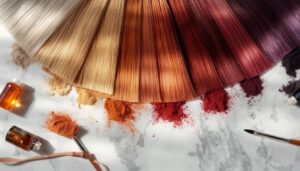
Letters do the heavy lifting once you’ve nailed your level. On most hair color charts, A signals ash tones, G marks gold, R indicates red hair color, and V stands for violet — but Brand Code Variations mean one line’s A might be another’s C or M.
Cross-Brand Comparisons matter here, so always check the swatch.
Pigment Composition Details, Tone Intensity Levels, and Shade Naming Conventions shift the result more than the letter alone.
Dot and Slash Notation on Box Dyes
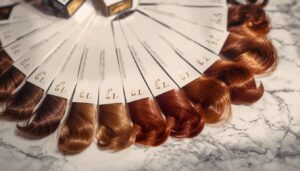
The dot or slash in a shade code — like 6.1 or 6/1 — is pure Separator Significance. It splits depth from tone, nothing more.
Reading Sequence always goes left to right: level first, then tone. Brand Notation Variations mean some boxes use dots, others slashes, but both follow the same Chart Placement Rules.
color chart decoding makes shade selection straightforward every time.
European Vs American Chart Differences
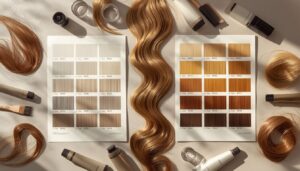
European and American charts look similar at first glance, but tone numbering conventions differ considerably. European systems use numbers for tone — 7.1 means level 7 ash — while American charts use letters like 7A.
Gray coverage labeling also splits: Europeans write 6.00, Americans write 6NN.
Reflect order variance affects warmth, and high lift extensions appear more consistently on salon boards than retail boxes.
Color chart interpretation always requires checking the brand key first.
Pick Shades for Your Undertone
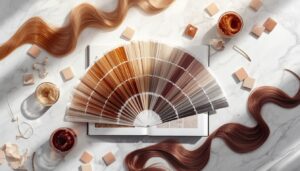
Choosing the right hair color isn’t just about what looks pretty on the box — it’s about what actually works with your skin.
Your undertone is the real deciding factor, and once you know it, the chart practically reads itself.
Here’s how to match your shade to your skin, whether you’re warm, cool, or somewhere in between.
Warm Undertones and Cooler Hair Colors
Here’s something that surprises a lot of people: if you have warm undertones, cooler hair colors actually work in your favor.
Your skin’s golden, peachy cast already brings the heat — so a cooler shade on the hair color chart creates beautiful balance.
For skin tone matching, try these options:
- Ash blonde
- Cool beige blonde
- Ash brown
- Burgundy with violet base
Cool Undertones and Warmer Hair Colors
Cool undertones work the opposite way. If your wrist veins look blue or purple — that’s your vein test guidance — your skin already carries a pink or rosy cast.
Silver jewelry contrast becomes obvious here too: silver sits naturally, gold feels off.
A warm blonde between levels 7 and 9 adds beige blonde balance, while caramel brown warmth softens ash undertones beautifully.
Copper red softening at levels 6 or 7 keeps things flattering without overwhelming cool skin.
Neutral Skin and Natural Shade Choices
Neutral skin is the lucky middle ground. Your veins look blue-green rather than clearly one or the other, and both gold and silver jewelry sit comfortably.
Neutral skin also opens up a wide palette for clothing and makeup, from warm earth tones to cool jewel shades, as explored in this guide to best colors for olive and neutral skin tones.
That flexibility carries into your hair color chart choices too. Natural depth shades — think Beige Mushroom or 5N through 6N — give soft contrast without pulling your complexion warm or cool.
skin tone considerations for hair color choice are genuinely wide open.
Best Blonde Shades for Each Undertone
Blonde isn’t one-size-fits-all — your skin tone is the deciding factor on your blonde hair color chart.
- Warm undertones: Honey blonde (levels 7–8) adds gold reflectivity that echoes your natural warmth.
- Cool undertones: Ash blonde (8A) uses blue-violet pigment to complement pink skin.
- Neutral undertones: Beige blonde balances both, sitting softly between ash and gold.
- Olive undertones: Soft pearl platinum avoids sallow contrast better than silver-gray shades.
Best Brown and Red Shades for Each Undertone
Browns and reds follow the same undertone logic.
For cool skin tones, ash brown (4A or 5.1) or mushroom brown keep depth without orange interference — solid Cool Brown Picks.
Warm undertones thrive with chestnut or copper red—your best Warm Red Choices.
Neutral Tone Matching works beautifully with rose brown or soft auburn, sitting right between both worlds.
Use Charts for Safer Coloring
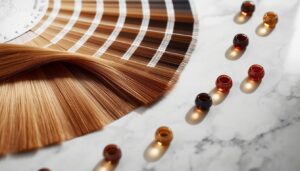
Color charts aren’t just for picking pretty shades — they’re one of the best tools you have for protecting your hair through the coloring process. Knowing how to read them correctly can save you from common mistakes like over-lifting, uneven results, or stubborn brassiness.
what the chart can tell you before you ever open a box.
Matching Chart Swatches to Your Current Hair
Getting a swatch match right starts with where and when you look. Check your hair in bright indirect daylight — warm indoor bulbs shift neutral shades, golden, and throw off your read entirely.
| Matching Factor | What to Check | Why It Matters |
|---|---|---|
| Lighting Conditions | Indirect daylight only | Indoor bulbs add yellow cast |
| Hair Moisture | Fully dry strands | Wet hair reads one level darker |
| Sectional Matching | Midlength zone | Least influenced by roots or fading |
| Gray Distribution | Zone by zone | Temple gray can look one level lighter |
| Strand Test Timing | 24 hours post-rinse | Oxidation shifts tone after rinsing |
Your hair color chart interpretation also depends on reading the right section — midlengths give you the most honest base color. Use this color matching guide alongside a strand test for confident, accurate results.
Choosing The Right Lift Level
Once you know your starting level, choosing the right developer becomes straightforward. Use this Lift Volume Guidance table to match developer strength to your target shade.
| Starting Level | Developer Strength | Processing Time Tips |
|---|---|---|
| Level 4–5 | 30–40 volume | 35–45 minutes |
| Level 6–7 | 20–30 volume | 25–35 minutes |
| Level 8–9 | 10–20 volume | 20–30 minutes |
Hair porosity and Heat Influence affect lift speed — always run a Strand Test Method first.
Neutralizing Yellow, Orange, and Brassiness
Brassiness follows a pattern you can work with once you understand the color wheel. Yellow tones at levels 9–10 need a Violet Toner, while orange warmth at levels 6–8 works well with Blue Toner. This is pigment neutralization in action — depositing the opposite shade, not lightening.
Brassiness is predictable: neutralize yellow with violet, orange with blue — deposit the opposite, never lighten
| Unwanted Tone | Correct With |
|---|---|
| Pale yellow | Violet toner or purple toning shampoo |
| Orange/copper | Blue toner or ash tone formula |
| Mixed brass | Blue-violet toner |
| Sun fading warmth | Color-depositing gloss |
| Hard water buildup | Chelating wash first, then tone |
Brass Prevention means staying consistent — sulfate-free cleansers, UV protection, and avoiding excessive heat all slow the fading between color corrections.
How Porosity Changes Dye Results
Your hair’s porosity level’s impact on dye results is bigger than most people realize. High-porosity strands drink in color fast — often landing 1–2 shades deeper than the chart swatch.
Uneven strand porosity creates a porosity tone shift from root to end, affecting color retention speed considerably.
Porosity equalizing sprays help balance absorption before application.
| Hair Type | What Happens |
|---|---|
| High porosity | Absorbs dye faster, reads darker |
| Low porosity | Resists color, may finish lighter |
| Porous ends | Fade quicker than roots |
| Mixed porosity | Uneven result, darker ends |
| Bleached hair | Grabs cool tones strongly |
Safe Bleach Use for At-home Coloring
Bleach at home isn’t as intimidating as it sounds — if you follow the right steps. Always start with a Patch Test Procedure at least 48 hours before. Your Developer Volume Selection matters: stick to 20-vol for minimal lift, 30-vol for two levels. Use a Sectioning Technique from back to front for even coverage.
| Step | Why It Matters |
|---|---|
| Patch test first | Catches allergic reactions early |
| Choose correct developer | Controls lift and damage |
| Section methodically | Prevents uneven lift |
| Watch processing time | Avoids breakage and patchiness |
| Condition immediately after | Restores moisture post-bleach |
Post-Bleach Conditioning isn’t optional — it’s essential.
Covering Gray Hair With Chart Guidance
Gray hair doesn’t follow the same rules as pigmented hair — it processes cooler, reflects more light, and resists tone. Your gray hair color chart should guide both Developer Strength and Mix Ratio choices.
Patch Test remains non‑negotiable before any gray hair coverage attempt.
| Gray % | Recommended Approach |
|---|---|
| Under 25% | Demi-permanent blending |
| 25–50% | Permanent with natural base |
| 50–75% | Add warm tone support |
| 75–100% | Neutral/NN formula, 20‑vol |
| All levels | Adjust Gray Root Timing every 4–6 weeks |
Top 6 Haircare Products
Getting your color right is only half the job — keeping it looking fresh is where the real work begins. The products you use after coloring can make or break your results, whether fighting brassiness, dryness, or breakage.
Here are six haircare picks worth adding to your routine.
1. Purple conditioner for blonde hair
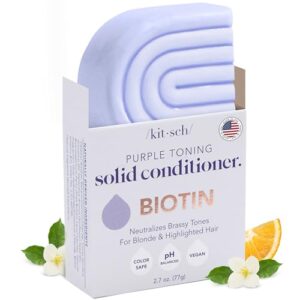
Keeping blonde hair cool between salon visits is easier than you think. This purple conditioner bar deposits violet pigments that neutralize yellow and brassy tones — exactly what your hair needs after lifting.
Enriched with biotin, it strengthens strands and boosts shine without silicones, sulfates, or parabens.
Whether you’re lightening or deepening your color, our guide to hair lightening versus hair coloring helps you choose the right approach for your starting shade.
Just paint it onto wet mid-lengths and ends, wait 1–3 minutes, then rinse.
One bar replaces two liquid bottles, making it a smart, travel-friendly pick for color-treated hair.
| Best For | Blondes, highlighted, or gray-haired folks who want to ditch brassiness between salon visits without a cabinet full of plastic bottles. |
|---|---|
| Product Type | Purple Conditioner Bar |
| Formula Safety | Sulfate-free, paraben-free, silicone-free |
| Hair Type | Blonde, highlighted, gray |
| Key Ingredient | Violet pigments, biotin |
| Price | Not specified |
| Primary Benefit | Tones brassiness |
| Additional Features |
|
- Tones yellow and brassy hues fast — most people notice a difference after just one use.
- Packed with biotin, so it’s not just pretty hair — it’s stronger, shinier hair too.
- Solid bar means easy travel and less plastic waste, and it replaces two full liquid bottles.
- Long or thick hair might burn through it faster, which can make the price feel less worth it.
- It crumbles as it gets smaller, so you’ll want a little container or bag to keep the pieces together.
- Needs to stay dry between uses — leave it sitting in water and it’ll dissolve way too fast.
2. Clarifying Shampoo For Oily Hair
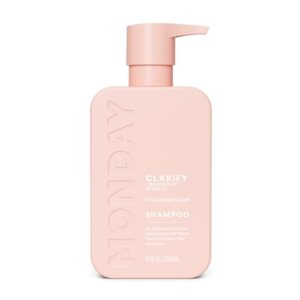
Once blonde is toned and bright, buildup is its quiet enemy. This clarifying shampoo cuts through excess oil, dry shampoo residue, and styling product without sulfates or parabens.
Grapefruit extract and vitamin E give it a fresh, clean feel, while coconut oil keeps the cleanse from going too harsh.
Use it every 3–4 weeks — not every wash — especially if your hair is color-treated.
At $9.40 for 12 fl oz, it earns its spot in your routine.
| Best For | Anyone with oily, color-treated, or buildup-prone hair who wants a gentle reset without harsh chemicals. |
|---|---|
| Product Type | Clarifying Shampoo |
| Formula Safety | Sulfate-free, paraben-free |
| Hair Type | Oily, color-treated |
| Key Ingredient | Grapefruit extract, vitamin E |
| Price | $9.40 |
| Primary Benefit | Removes buildup |
| Additional Features |
|
- Sulfate- and paraben-free, so it cleans deep without stripping your color or drying things out too much
- Grapefruit extract and vitamin E leave hair smelling fresh and feeling genuinely clean
- Cruelty-free and recyclable packaging — easy to feel good about buying it
- Use it too often and your scalp will let you know — dryness and itching are real if you overdo it
- The pump can be frustratingly stiff, and you often have to take the cap off just to get enough product
- Heavy-duty styling products like strong gels might need a second wash to fully clear out
3. Redken Moisture Restore Hair Treatment
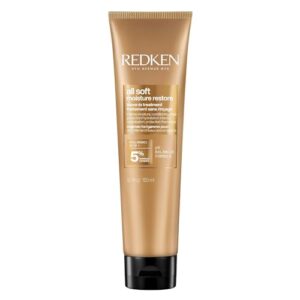
After clarifying, your hair needs something back. That’s where the Redken All Soft Leave-In Treatment earns its place.
Formulated with hyaluronic acid and argan oil, it pulls moisture into the hair shaft and seals the cuticle — so dryness doesn’t creep back by midday. It protects up to 450°F, which matters if you’re heat‑styling.
Understanding why conditioner is essential after every wash makes ingredients like hyaluronic acid and argan oil feel less like a bonus and more like a necessity.
At $34 for 5.61 oz, it’s a targeted investment. Fine-to-medium hair responds especially well — softer, smoother, without any heaviness.
| Best For | Anyone with dry, fine-to-medium hair who heat-styles regularly and wants lightweight hydration without the grease. |
|---|---|
| Product Type | Leave-In Treatment |
| Formula Safety | Not specified |
| Hair Type | Dry, fine-to-medium |
| Key Ingredient | Hyaluronic acid, argan oil |
| Price | $34.00 |
| Primary Benefit | Moisture & heat protection |
| Additional Features |
|
- Hyaluronic acid and argan oil actually replace what clarifying strips away — moisture comes back fast.
- 450°F heat protection means you’re covered whether you’re blow-drying or flat-ironing. Even with that protection, heat styling can still stress fragile strands, so it helps to know how hair growth recovers after breakage and what slows it down.
- Plays well as a daily leave-in — no buildup, no heaviness, just softer hair.
- $34 for 5.61 oz is a bit steep, especially if you’ve got long or thick hair burning through it faster.
- Results can feel underwhelming on coarse or very thick strands — it’s really built for finer textures.
- The small bottle means you’ll be reordering more often than you’d expect.
4. Hyaluron Plump Hydrating Hair Shampoo
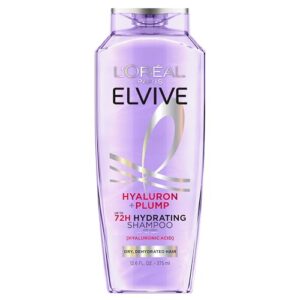
If moisture is your main concern, the L’Oréal Elvive Hyaluron + Plump Shampoo keeps things simple and effective.
Its 2% Hyaluronic Care Complex coats each strand, locking in hydration for up to 72 hours — so your hair stays soft well past wash day.
At $5.57 for 12.6 oz, it’s easy to work into your routine.
Dry, wavy, or color-treated hair responds especially well, and the paraben-free formula won’t strip what your last treatment just put back.
| Best For | Anyone with dry, dehydrated, wavy, or curly hair who wants an affordable, no-fuss shampoo that keeps moisture locked in between washes. |
|---|---|
| Product Type | Hydrating Shampoo |
| Formula Safety | Paraben-free |
| Hair Type | Dry, wavy, color-treated |
| Key Ingredient | 2% Hyaluronic Care Complex |
| Price | $5.57 |
| Primary Benefit | 72-hour hydration |
| Additional Features |
|
- Delivers up to 72 hours of hydration, leaving hair noticeably softer and less frizzy after just one wash
- Paraben-free and lightweight — it hydrates without weighing hair down or stripping previous treatments
- Great value at $5.57 for 12.6 oz, making it easy to commit to as a daily or regular shampoo
- Fine or thin hair may feel a bit heavy or over-nourished after use
- The fragrance can come across as strong or generic to those with scent sensitivities
- Hard water can reduce its effectiveness, especially for scalp concerns like itchiness or dandruff
5. Vegan Hair Strength Recovery Shampoo
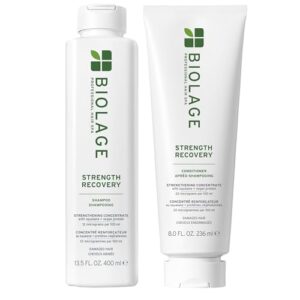
Rebuilding damaged hair starts with what you wash it with.
Vegan Hair Strength Recovery Shampoo pairs olive squalane with a plant-based protein complex — two ingredients that work together to lock in moisture and reinforce the hair shaft from the inside out.
If your hair is bleached, curly, or post-partum stressed, this one’s worth trying.
It claims three times stronger hair after just one wash, and at $52 for the shampoo-conditioner set, it’s a serious but well-rounded investment.
| Best For | Anyone with damaged, bleached, curly, or post-partum hair who wants a vegan, cruelty-free routine that actually rebuilds strength without harsh chemicals. |
|---|---|
| Product Type | Strengthening Shampoo & Conditioner Set |
| Formula Safety | Vegan, cruelty-free |
| Hair Type | Damaged, bleached, curly |
| Key Ingredient | Olive squalane, plant protein |
| Price | $52.00 |
| Primary Benefit | 3x stronger hair |
| Additional Features |
|
- Noticeably stronger, softer hair after just one wash — the 3× moisture claim holds up for most damaged hair types.
- Clean, cruelty-free formula that works well for curly, chemically treated, or heat-styled hair without weighing it down.
- The shampoo-conditioner duo covers both cleansing and deep repair in one simple routine.
- At $52 a set, it’s a harder sell if you’re on a tight budget or wash your hair frequently.
- The rich conditioner can feel too heavy for very fine or oily hair, especially with daily use.
- The scent is mild — great for sensitive folks, but a letdown if you love a bold, lasting fragrance.
6. strengthening shampoo for damaged hair
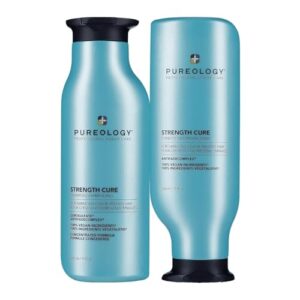
When hair is brittle, over-processed, or breaking at the ends, you need a shampoo that actually rebuilds — not just coats. This sulfate-free duo uses anti-breakage technology and a vegan conditioner that seals split ends while restoring up to 99% of your hair’s original strength.
It detangles, protects color vibrancy, and adds real shine.
At $76 for the set, it’s a premium pick, but a little goes a long way — making it more cost-effective than it looks on the shelf.
| Best For | Anyone with damaged, color-treated, or brittle hair who wants a serious repair treatment and doesn’t mind spending a little more to get real results. |
|---|---|
| Product Type | Repair Shampoo & Conditioner Duo |
| Formula Safety | Sulfate-free, vegan |
| Hair Type | Damaged, color-treated |
| Key Ingredient | Anti-breakage vegan complex |
| Price | $76.00 |
| Primary Benefit | 99% strength restoration |
| Additional Features |
|
- Restores up to 99% of hair’s original strength — real rebuilding, not just surface coating
- Color-safe and sulfate-free, so it won’t strip your color or dry out your hair
- A little goes a long way, so that $76 price tag stretches further than you’d expect
- $76 is a hard sell if you’re watching your budget
- Some people find it loses its punch over time and need to rotate it with other products
- Don’t expect overnight results — it takes a few weeks of consistent use to really see the difference
Frequently Asked Questions (FAQs)
What hair color goes best with rosacea?
Ironically, the boldest colors often offer the least favors here.
Cool ash browns and beige blondes, around levels 5 through 7, calm rosacea visually by avoiding red and warm orange, which reflect near your face.
How do I figure out what color to dye my hair?
Start with your skin undertone and current hair level. Warm undertones suit golden or copper shades; cool undertones work better with ash or violet.
From there, the chart does the rest.
What hair color makes you look younger over 50?
Softer shades around levels 6 to 8 tend to be the sweet spot. They brighten your face without harsh contrast, making warm blondes, honey browns, and soft auburns your most flattering options.
Is 3n darker than 4n?
Yes, 3N is darker than 4N. Think of it like floors in a building — the lower you go, the deeper the shade.
Level 3 lands in dark brown territory, while level 4 sits at medium brown.
Should you go darker or lighter with hair color as you age?
Lighter shades tend to be more forgiving as you age — they soften regrowth lines, blend grays more naturally, and brighten your complexion without the harsh contrast darker colors can create.
How long do hair dye colors last?
That depends on the formula you choose. Permanent color grows out but fades in tone after 4–6 weeks. Demi-permanent lasts about 20–28 washes, while semi-permanent taps out in as few as 4 shampoos.
Can you mix different hair dye shades?
Mixing different hair dye shades is possible, but stick to the same type and brand. Blending a Level 6 with a Level 8 usually lands around a Level 7 result.
What developer strength should I use?
For most at-home color jobs, 20 volume is your safest bet — it covers gray and lifts 1–2 levels without overdoing it. Go lower for toning, higher only if you need serious lift.
How often can I dye my hair?
For permanent color, wait at least 6 to 8 weeks between full applications. Root touch-ups can happen every 4 to 6 weeks, and demi-permanent glosses refresh safely every 4 weeks.
If your roots keep coming out lighter than the rest of your hair, this guide to dyeing roots darker walks you through fixing the mismatch.
Do color charts work for all hair types?
Color charts work for most hair types — but not perfectly.
Natural hair responds predictably, while chemically treated, bleached, or highly porous hair may shift two shades darker or warmer than the swatch suggests.
Conclusion
Hair dye color charts are maps, and you’re no longer reading them blind. Every number tells you how light or dark, every letter tells you which direction the tone pulls, and every swatch gives you a preview of what chemistry will actually deliver.
You now know how to match your undertone, neutralize unwanted warmth, and choose developer strength with intention. That box on the shelf isn’t a gamble anymore — it’s a decision you’re fully equipped to make.