This site is supported by our readers. We may earn a commission, at no cost to you, if you purchase through links. This content is for general informational and educational purposes only and is not a substitute for professional medical, dermatological, or nutritional advice.

You grab one box, slather it on, and halfway through your ponytail you’re staring at an empty tube with your roots still blonde. Sound familiar? It happens more than you’d think, because most people guess at how much hair dye you need instead of calculating it.
Length matters, but so does density, texture, and even how porous your strands are. A single box works fine for a pixie cut and leaves someone with waist-length hair stranded.
Get the math right upfront, and you’ll never ration color like it’s the last slice of pizza again.
Table Of Contents
- Key Takeaways
- What Determines How Much Hair Dye You Need?
- How Much Hair Dye Do I Need?
- Dye Amounts for Different Coloring Services
- How Much Developer Should You Mix?
- How to Measure and Apply Enough Dye
- Frequently Asked Questions (FAQs)
- How do I calculate how much hair dye I need?
- Is 4 oz of hair dye enough for long hair?
- How many boxes of dye do you need to dye your hair?
- Does hair dye expire?
- Can I use hair dye more than once?
- What are the best techniques for applying hair dye?
- Is it possible to lighten hair without damaging it?
- What are the risks of using hair dye?
- Can you recolor dyed hair without damaging it further?
- Whats the ideal dye consistency for even coverage?
- Conclusion
Key Takeaways
- Your hair length is the biggest factor in how much dye you need, ranging from half a box for short hair to two-to-five boxes for long hair.
- Texture, porosity, and density all shift the amount up or down, so coarse, thick, or curly hair needs extra product beyond what length alone suggests.
- Most permanent dyes mix at a 1:1 ratio with developer, but stubborn grays or major lightening call for 1:1.5 or 1:2 ratios instead.
- Using a digital scale and sectioning your hair into four quadrants helps you measure accurately and apply color evenly, so you avoid running out or leaving patchy spots.
What Determines How Much Hair Dye You Need?

Grabbing a random box off the shelf is how you end up short on color halfway through your head. The right amount depends on more than just length, though that’s a big piece of it. Here’s what actually decides the number you need.
Hair Length and Density
Length is the boss factor, plain and simple: more hair means more surface area, means more dye. Short hair (above the shoulders) sips product; long hair, past mid-back, can guzzle 2-5 boxes. Your scalp holds roughly 80,000-120,000 hairs, so density compounds length.
If you’re unsure where your strand count falls, this guide on how to check your hair density can help you estimate dye needs more accurately.
More hair means more surface area, and more surface area always means more dye
Layered cuts and seasonal shedding can shift how much you actually need, too.
Texture, Porosity, and Condition
Density sets the baseline, but hair porosity decides how fast color actually soaks in. Low porosity resists; high porosity drinks it up, then fades fast. Coarse texture needs 0.5-2oz more than fine strands. Damaged or bleached hair? Add extra product.
A quick strand test (porosity testing) plus conditioning before dye saves you a processing nightmare.
Hair texture characteristics vary by region and influence how products interact with strands. Hair texture characteristics
Dye Type and Coverage Goal
Porosity tells you how fast color soaks in, but dye type and your coverage goal decide how much you need in the first place.
- Permanent hair dye for full coverage
- Semipermanent dye for gentler, temporary color
- Gray coverage needs extra pigment lift
- Vivid fashion colors demand heavier saturation
Root touchup? Less product. Full coverage or bold vivids? Load up.
Box Versus Tube Sizes
Boxes and tubes aren’t really about hair dye packaging dimensions, but about matching product to your hair length.
Tubes offer better shipping efficiency and lower material costs for gloss or toner; boxes suit full color applications.
Skip the guesswork, use a hair dye calculator to confirm boxes of hair dye or tubes needed before mixing ratio decisions.
Layered or Uneven Hair
A few choppy layers throw off your whole hair dye amount calculator. Shorter top layers eat product fast, so weigh in extra for uneven color risk.
- Layered volume benefits mean more surface, more dye
- Face framing layers need touch-up precision
- Texture enhancement techniques demand even saturation
- Layer maintenance frequency affects regrowth mixing ratio
How Much Hair Dye Do I Need?
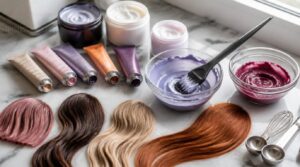
So let’s get down to real numbers. Your hair length is the biggest clue to how much dye you’ll need, but texture and thickness still tip the scale. Here’s the breakdown by length, so you can grab the right amount before you start mixing.
And once you’ve measured out your dye, this guide to mixing 20 volume developer ratios makes sure you get the color-to-developer balance just right.
Short Hair: Half to One Box
Chin-length or shorter? Half a box usually does it, especially if you’re staying close to your natural shade.
Going bold or lightened before? Use the full box. Section into four quadrants, saturate roots to ends, and store leftover dye sealed for quick touch-ups within two weeks.
Medium Hair: One to Two Boxes
Most shoulder-to-mid-back hair needs one box, but coarse or layered cuts often demand two box coverage for full saturation.
- Coarse strand needs run higher
- Layered cut solution: two boxes harmonize length differences
- Semi-permanent medium formulas may stretch one box
- Thick medium hair thickness eats product fast
When unsure, a hair dye amount calculator settles the mixing ratio debate before you start.
Long Hair: Two to Five Boxes
Past mid-back, one box won’t cut it. Long hair often needs two to five boxes, depending on density and length.
Run the Two-Box Test first: apply two, check saturation, add more if patches show. A hair dye amount calculator helps with Quantity Estimation and Density Adjustment, preventing product waste while ensuring full hair dye coverage from root to end.
Extra for Thick or Curly Hair
Curls eat product like a sponge eats water. Every twist and coil hides extra surface area, so thick hair needs more than length alone suggests.
Curl pattern impact means dye pools in bends instead of spreading evenly. Budget one extra box, keep your mixing ratio consistent, and treat overages as insurance, not waste.
Quick Ounce and Gram Guide
Numbers stick better than guesswork. One ounce equals 28.35 grams, so two boxes land around 56 to 114 grams of color, depending on brand.
A full head usually needs 60 to 120 grams of dye. Grab a digital scale for weight accuracy, keep a conversion chart nearby, and match grams of color to milliliters of developer for smart product budgeting.
Dye Amounts for Different Coloring Services

Not every coloring session needs the same amount of product, and that’s where things get interesting. A full color, a root touch-up, and a set of highlights all pull from very different amounts, even on the same head of hair. Here’s how each service breaks down.
Full-Head Color Amounts
Going full-head means every strand starts fresh, so you need enough to saturate roots to ends evenly.
- Short hair: 2–4 ounces
- Medium hair: 4–8 ounces
- Long hair: 8+ ounces
- Dense or coarse hair: add extra grams of color
A hair dye calculator removes the guesswork, especially for budget dye purchasing decisions.
Root Touch-Up Amounts
Touch-ups only need regrowth covered, so 1–2 ounces usually does it.
| Regrowth | Amount |
|---|---|
| Short roots | 1 oz |
| Longer roots | Up to 2 oz |
Match your dye-to-developer ratio to gray coverage needs, keep touch-up frequency around 4–6 weeks, and use a hair dye calculator to prevent product waste.
Highlights and Balayage Amounts
Highlights and balayage don’t follow full-color math since you’re only lifting sections, not the whole head.
- Partial highlights: 1–2 oz
- Full highlights: ~70% of full-color amount
- Balayage: varies by placement, hand-painted
- Foil technique: more product per foil
- Ombre gradient: heavier at ends
A hair dye measurement calculator saves guesswork here.
Toner and Gloss Amounts
Toner and gloss play by their own rules, way lighter than full color.
Toner amounts scale with hair length and how much correction the undertone needs. Purple, blue, or green formulas run 60% of a full-color amount, mixed with developer and processed briefly. Gloss? Often developer-free, ammonia-free too, just sealing shine over your existing shade. Run it through a Hair Dye Amount Calculator so you’re not eyeballing that Total mixture.
Color Correction Product Needs
Nothing eats product like fixing a mistake. Color correction demands Corrector Shade Selection to kill brassiness or ash, plus Base Formula Compatibility so it blends, not clashes.
Check Porosity Adjustment Guidelines first — damaged ends grab color differently than your crown. Run a Bond Builder Pre-Treatment, then follow Saturation Verification Steps.
A hair dye amount calculator, weighing hair length and type, keeps your dye-to-developer ratio honest.
How Much Developer Should You Mix?
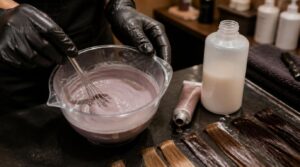
Dye is only half the equation, developer is the other, and getting that ratio wrong can throw off your whole result. It’s not a one-size-fits-all number, either, since your goal color and gray coverage both play a part. Here’s how to nail the mix every time.
Follow Brand Mixing Instructions
Every brand mixes differently, so guessing is how color disasters happen. Read the product label first, follow the exact steps, and only use the recommended container.
Never eyeball your dye-to-developer ratio.
- Read label fully
- Follow mixing steps precisely
- Discard mixed product after use
Always do a safety patch test 48 hours ahead, no exceptions.
Common 1:1 Mixing Ratio
Most permanent dyes rely on a simple 1:1 ratio—equal parts color and developer. Standard 20-volume developer suits most gray coverage.
Ratio precision matters: too little developer means patchy saturation, too much thins color and hurts stability. A hair dye calculator helps once you know your length and hair type, so every mix stays accurate and consistent.
When 1:1.5 Ratios Apply
Stubborn grays or resistant strands? Bump to a 1:1.5 ratio for deeper saturation. This shift slightly extends processing time and works best between 20–25°C for consistency.
Coarse or dense hair often needs this adjustment, too. Measure carefully—accuracy keeps color even.
Whatever your hair length or type, this ratio bridges the gap between basic coverage and stubborn resistance without overwhelming your strands.
When 1:2 Ratios Apply
Going three-plus shades lighter? That’s when you need a 1:2 dye-to-developer ratio, opening the cuticle wide enough for major lift. Think high-lift blonding.
Higher developer volume (30–40) pairs with this ratio, so mixing precision really matters here. Use a hair dye calculator to avoid guesswork, and always check your brand’s application timing for safety.
Calculate Total Mixed Product
Math beats guesswork every time. Use the Total Volume Formula: divide your desired total by the ratio parts, then multiply per-part by color and developer portions.
- Pick total volume (say, 120ml)
- Add ratio parts (1:2 = 3 parts)
- Divide for volume per part (40ml)
- Multiply by ratio for each portion
Subtract additives first. Round to 0.1ml, and a hair dye calculator simplifies scaling for longer hair.
How to Measure and Apply Enough Dye
Knowing your numbers is one thing, but getting the dye onto your hair correctly is what actually makes the color work. A little strategy here saves you from patchy spots and product waste. Let’s walk through the steps that get you an even, salon-quality result every time.
Use a Hair Dye Calculator

Guessing wastes product and money, so let a hair dye calculator do the math for you. Plug in your hair length, thickness, and desired service, and it’ll estimate color plus the right dye-to-developer ratio.
Bonus features like cost estimates and saved calculations make repeat touch-ups painless. Just double-check porosity adjustments before mixing.
Measure With a Digital Scale
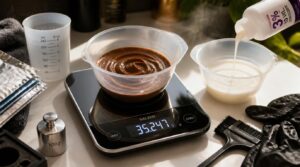
A calculator gives you the estimate, but a digital scale confirms it. Weigh your dye and developer separately, tare the container first, and match the display to your calculated grams for true dye measurement accuracy.
Look for 0.1g resolution and quick scale calibration with a known weight. Bonus points for unit conversion and data logging to repeat winning formulas.
Section Hair Into Four Quadrants

Your scale’s calibrated, so now put that product where it counts. The Four Quadrant Method splits hair at the Crown Top Intersection, creating symmetry through quadrants instead of guesswork.
- Clip front-left and front-right sections
- Clip back-left and back-right sections
- Work root to end in each zone
Clipping quadrant sections stops overlap and gives you even distribution, no matter your hair type or length.
Check for Complete Saturation
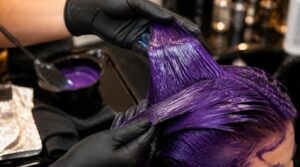
Every strand should glisten, not just look damp. Run a quick strand test on each quadrant — no translucent patches, no dry spots at the ends. That’s complete saturation: color reaching root to tip evenly.
Watch processing time closely, and check again before rinsing. This step catches problems while you can still fix them.
If You Run Out Midway
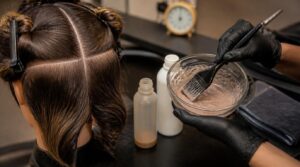
Running dry with two quadrants left? Don’t panic. Stop, weigh what’s left, and mix a small fresh batch at the same dye-to-developer ratio.
Grab the closest shade match, apply to roots first, and time it precisely. If tones look off, a toner glaze fixes it after rinsing. Store leftover dye properly, away from heat, for your next touch-up.
Frequently Asked Questions (FAQs)
How do I calculate how much hair dye I need?
Picture Sarah, box in hand, guessing at "medium-ish" hair. Instead, factor in hair length, hair type, and developer volume together, then run those numbers through a quick DIY dye calculator for a precise, waste-free dye-to-developer ratio.
Is 4 oz of hair dye enough for long hair?
Short answer: no.
Four ounces suits shoulder-length hair, but long hair needs more volume to saturate every strand—think two to five boxes. Skimping risks patchy color and product waste, so run the numbers through a hair dye calculator first.
How many boxes of dye do you need to dye your hair?
Think one box for short hair, one to two for medium, and two to three for long or thick strands. Hair length and type drive the count—buy an extra box if you’re unsure, it’s cheap insurance.
Does hair dye expire?
Yes, that bottle isn’t a time capsule. Unopened dye lasts about three years, but once opened, use it within weeks. Watch for separation, sour smell, or dull color—all signs of expiration and developer degradation.
Can I use hair dye more than once?
Once mixed, dye starts oxidizing immediately, so don’t save leftovers. For repeat color, wait per reuse timing guidelines—6-8 weeks for permanent, 2-4 for demi. A hair dye calculator prevents waste on your next full application.
What are the best techniques for applying hair dye?
Section into four quadrants, clip each up, and work root to ends with smooth brush strokes. Time your processing, check saturation strand by strand, then rinse and follow with color-safe conditioner.
Is it possible to lighten hair without damaging it?
Lightening without wrecking your hair is like dimming a lamp instead of smashing the bulb. Use ammonia free dyes, low developer volume, bond building products, and gradual lightening between sessions to protect hair type and porosity.
What are the risks of using hair dye?
Dye carries real risks: allergic reactions, scalp irritation, and breathing trouble from fumes. Frequent permanent color use raises cancer concerns too. A patch test 48 hours ahead, good ventilation, and spacing out sessions protect your skin and your strands.
Can you recolor dyed hair without damaging it further?
Recoloring is like repainting over old paint—prep matters more than color. Use a color remover first, match dye to porosity, choose a low ammonia formula, and finish with deep conditioning to protect against hair damage.
Whats the ideal dye consistency for even coverage?
Aim for a smooth, yogurt-like consistency — thick enough to cling, loose enough to penetrate. Follow your dye-to-developer ratio exactly, stir until streak-free, then work section by section for full coverage regardless of hair length or thickness.
Conclusion
Here’s a truth every stylist learns fast: guessing at product is how good color turns into a patchy nightmare. Once you know your length, texture, and mix ratio, how much hair dye you need stops being a mystery and becomes simple math.
Weigh it, section it, mix it right, and you’re no longer at the mercy of a half-empty tube. That’s not just convenience. That’s real control over your color, box after box.