This site is supported by our readers. We may earn a commission, at no cost to you, if you purchase through links. This content is for general informational and educational purposes only and is not a substitute for professional medical, dermatological, or nutritional advice.

Imagine this: you eyeball the bleach and developer, mix it like pancake batter, and slap it on your hair hoping for the best. Twenty minutes later you’ve got orange patches and a bathroom that smells like a science lab gone wrong. Sound familiar?
Here’s the truth most box kits won’t tell you. How to mix developer and bleach isn’t guesswork, it’s a formula with real ratios, real timing, and real consequences if you skip steps.
Get the ratio wrong and you’ll either fry your strands or barely lighten a shade. Get it right, and you’re in control of the lift, the texture, and the outcome. Ready to mix like you know what you’re doing?
Table Of Contents
- Key Takeaways
- Choose The Right Developer Before Mixing
- How to Mix Developer and Bleach: Start With 1:2
- Adjust Bleach-to-Developer Ratios by Hair Type
- Apply and Process The Bleach Evenly
- Fix Bleach Mixing Mistakes and Prevent Damage
- Frequently Asked Questions (FAQs)
- How long should I leave the developer and bleach mixture on my hair?
- What are the possible side effects of using developer and bleach?
- Can I mix developer and bleach without a bowl or brush?
- Is there a difference between permanent and semi-permanent developer and bleach?
- Is developer and bleach suitable for all hair types?
- Can you reuse leftover bleach and developer mixture?
- How do you fix bleach thats too thick?
- What happens if bleach sits too long before applying?
- Can you mix different bleach brands with any developer?
- How do you know when bleach mixture is expired?
- Conclusion
Key Takeaways
- The standard bleach-to-developer ratio is 1:2, but you’ll want to tweak it slightly depending on your hair type and technique (like 1:1.5 for balayage or 1:2.5 for fine, fragile hair).
- Always run a strand test two weeks ahead and a patch test 48 hours before mixing, since these confirm the right developer strength and rule out allergic reactions.
- Mix bleach in a nonmetal bowl, measure both products precisely, and use the mixture within minutes, since it starts losing strength and can cause patchy results the longer it sits.
- Apply bleach to your mid-lengths and ends first, then your roots last, and always avoid overlapping onto already-lightened hair to prevent breakage and uneven color.
Choose The Right Developer Before Mixing

Before you crack open that bottle of developer, slow down for a second. Picking the wrong strength can mean fried ends or barely-there results, and neither one feels good. Here’s exactly what to check before you mix anything.
Assess Hair Condition and History
Detective work, not guesswork, that’s your first move before any bleach touches hair.
Start by checking what it actually costs to bleach your hair, since salon pricing and product needs can shift your whole plan.
- Brittle strands that snap like dry spaghetti
- Dull color with zero shine
- Fraying, see-through ends
- Uneven texture from root to tip
Run a hair porosity check, a damage assessment, and check past chemical exposure. Test elasticity and scalp sensitivity too. A thorough examination of hair and scalp can also help you spot root conditions that affect how hair reacts to bleach. Skip this, and you’re gambling with breakage.
Perform Strand and Allergy Tests
Once you know your hair’s condition, run a strand test two weeks out. Clip a quarter-inch section, foil it, process 30 minutes.
Also do a patch test behind your ear, 48 hours, every single time. Watch for redness or itching.
Rinse, blow-dry, check color in daylight. This confirms your developer volume choice.
Choose The Right Developer Volume
Now that your strand test passed, pick your volume. Think of it like choosing gears on a bike.
5 volume refreshes color with barely any lift. 10 volume gives fine hair 1-2 levels, gently. 20 volume balances 2-3 levels for most home jobs. 30 volume pushes 3-5 levels but risks breakage on damaged strands.
Match strength to your hair’s actual condition, not your wish list.
Avoid 40 Volume at Home
Now, about 40 volume: leave it alone.
It sounds tempting for stubborn hair, but it brings real scalp burn risks and heat that fries your cuticle fast.
- Burns skin if timing slips
- Causes patchy, unpredictable lift
- Dries hair through excess heat
- Needs professional supervision to use safely
Save it for a salon chair, not your bathroom sink.
Follow Brand-Specific Product Directions
Before you touch that box, read the label like it owes you money.
Checking developer volume and processing time against your desired tone helps you choose correctly—this comparison of Wella T14 vs T18 results breaks down which shade suits your starting level.
Read the label like it owes you money before you touch that box
Every brand tweaks its own bleach-to-developer ratio, so their instructions beat any general rule here.
| Brand Says | You Do |
|---|---|
| Specific ratio | Measure exact |
| Timing chart | Set a timer |
Check expiration dates, use their recommended tools, and always patch and strand test first.
How to Mix Developer and Bleach: Start With 1:2
Once you’ve picked your developer, mixing it right matters just as much. A basic 1:2 ratio, that’s one part bleach powder to two parts developer, works for most everyday bleaching jobs. Here’s exactly how to get that mix smooth, safe, and ready to use.
Use Nonmetal Bowls and Tools

Metal bowls are a no-go, full stop. They can react with your bleach mixture and throw off your lift.
Stick to a plastic or glass mixing bowl, or ceramic. Any nonmetallic bowl keeps things stable and easy to clean.
Use silicone spatulas too. They resist stains and won’t corrode, keeping your tools reliable for every mix.
Measure Both Products Accurately
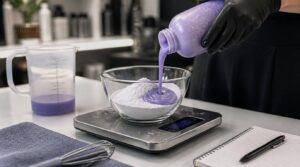
Eyeballing it is a rookie move. Grab a digital scale and get precise to the nearest 0.1 gram, then double check with your measuring tote to confirm volume before combining anything.
Work on a clean, room-temperature surface, and jot down your batch details for next time. This is your bleach-to-developer ratio, after all, and mixed bleach loses strength fast once it sits.
Add Developer to Powder Gradually
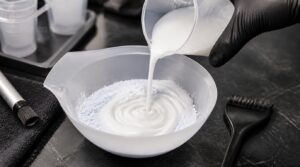
Powder goes in your plastic bowl first, always. Then comes the slow developer addition, poured a little at a time, not dumped like a milkshake.
This controlled pour method keeps your bleach mixture consistency predictable. Rushing means lumps. Use your measuring tool for each splash, blending between pours until your bleach-to-developer ratio comes together evenly.
Mix Until Smooth and Creamy
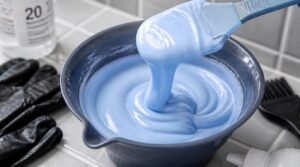
Grab a silicone spatula and scrape the bowl’s sides every 30 seconds or so.
You’re chasing thick yogurt texture, no lumps, no dry streaks hiding at the bottom. Too runny? Add a touch more powder. Too thick? Splash in developer. Lift your spatula: the mix should ribbon slowly, not drip or sit stiff.
Use The Mixture Immediately
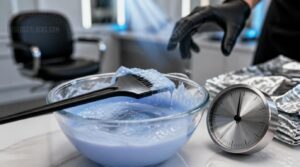
Once mixed, the clock’s ticking. Bleach loses strength fast, so apply the mixture promptly, before it thins out and stops lifting evenly.
- Apply within minutes to maintain potency
- Prevent patchiness from uneven processing
- Avoid bacterial growth in leftover product
- Toss any extra, don’t save it for later
A fresh bleach consistency means predictable results. Waiting around just wastes your developer and bleach ratio.
Adjust Bleach-to-Developer Ratios by Hair Type

That basic 1:2 ratio is a great starting point, but hair isn’t one-size-fits-all. Your hair type, texture, and even the technique you’re using can change what mix works best. Here’s how to adjust the ratio depending on what you’re working with.
1:1.5 Ratio for Balayage
Balayage calls for a thicker touch. Mix one part bleach powder to one and a half parts developer, pair it with 20 volume developer for gentle lift, and aim for a gummy, not runny, texture. That consistency sits on your tint brush without dripping, giving you control for freehand strokes on mid-lengths and ends.
1:2 Ratio for Most Uses
Balayage needs that gummy hold, but most of your everyday bleaching calls for the standard 1:2 ratio. One part bleach powder to two parts developer gives you a medium lift that suits most hair types without overworking the strand.
This ratio keeps things predictable:
- Even lightening across sections
- Lower breakage risk
- Reliable timing with your strand test
Mix accurately, work quickly, and don’t let it sit.
Ratios for Fine, Dry Hair
Fine, dry hair is fragile, so back off the strength. Go with a 1:2 ratio, sometimes even 1:2.5, to keep things gentle and conditioning-focused.
Use a low-volume developer and dry, unwashed hair to limit stress on the shaft. Shorter processing times matter here too. Slow and steady beats a rushed, damaging lift.
Ratios for Coarse, Resistant Hair
Now flip to the opposite problem: hair that laughs off lightener like it’s got somewhere better to be. Coarse strands need more muscle, so start with a 1:2 bleach-to-developer ratio using 20 volume.
Stalled lift? Bump to 1:2.5, never higher volume. Check strands often, protect the scalp, and keep 30 volume reserved for stubborn, healthy virgin hair only.
When Brand Directions Override
Every ratio here is a starting point, not gospel. If your brand’s manual specifies an exact bleach-to-developer ratio or developer volume, that direction wins, full stop.
Approval workflows and a change management log keep these overrides consistent and safe. Always confirm with a patch and strand test first, since mixed bleach loses strength fast once opened.
Apply and Process The Bleach Evenly

Mixing the bleach right is only half the job. How you apply it decides whether you get even, salon-worthy color or a patchy mess you have to explain to everyone. Here’s exactly how to section, saturate, and time things so every strand gets treated fairly.
Section Dry, Unwashed Hair
Skip the shampoo before bleach day. Scalp oils act like a natural raincoat, buffering peroxide contact.
Comb dry hair to prevent tangles, then section your hair into four even quadrants using 1 to 2 centimeter subsections. Clip each one snugly. Consistent width means consistent lift, no random patchy surprises later.
Apply to Lengths Before Roots
Start where the color’s already faded: your mid-lengths and ends. This is the Lengths First Technique, and it’s not optional if you want even color.
Save the roots for last. Scalp heat speeds up processing there, so this Root Timing Delay prevents hot roots while lengths catch up with your bleach mixture.
If your timing is off and you end up with patchy results, these uneven bleached hair fixes can help you correct hot roots and resistant mid-lengths without starting over.
Fully Saturate Thin Sections
Dry patches ruin lift, plain and simple. When you section your hair, keep each piece the same width so your bleach mixture reaches every strand evenly.
Work the developer and bleach mix in fully, side to side, checking for missed spots. Fully saturate thin sections before moving on, and watch your saturation time so nothing sits too long unevenly.
Avoid Overlapping Lightened Hair
Reprocessing already-lightened hair is how you end up with crunchy, see-through ends. Use non-overlap zone marking with a crayon, then foil off treated strands so new bleach can’t sneak in. Check often, patchy results usually mean overlap crept in somewhere.
- Mark boundaries before starting
- Foil-isolate lightened sections
- Recheck for accidental crossover
Monitor Lift and Processing Time
Set a timer the second bleach touches hair. Check every 5 minutes, watching for pale yellow, your target lift color.
Uneven patches along mid-shaft mean trouble brewing. Most lift windows run 15 to 45 minutes, and going 5 minutes over invites breakage. When you hit target, rinse immediately, don’t wait around like it’s optional.
Fix Bleach Mixing Mistakes and Prevent Damage
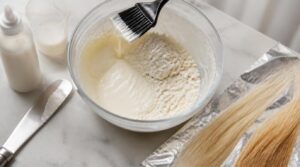
Even careful mixers hit a lumpy patch or a runny batch now and then. The good news is most bleach mishaps are fixable if you catch them early. Here’s how to troubleshoot your mix and keep your hair safe along the way.
Break Up Hidden Powder Pockets
When your mix looks smooth but hides tiny clumps against the bowl’s edge, that’s a hidden powder pocket, and it’ll streak your color unevenly.
Fix it by scraping the sides constantly while adding developer slowly, not all at once. Rotate your spatula direction too.
Too lumpy still? Discard and remix fresh.
Never let old, settled bleach powder ride along for the process.
Adjust Overly Thick Mixtures
Powder pockets aren’t the only clump problem. Sometimes your whole bowl turns into stiff paste, more like spackle than yogurt.
Loosen it gradually:
- Add developer in tiny splashes, not glugs
- Warm the bowl slightly, cold thickens everything
- Fold gently with a silicone spatula
- Test flow, it should recompose in a second
Working time shrinks fast once it’s mixed.
Thicken Runny Mixtures Carefully
Runny mix, opposite problem. Add bleach powder in small pinches, not spoonfuls, using clear measuring spoons for precise dosing.
Whisk with a nonmetal tool between pinches. Warm liquids stay thinner, so cooler mixes thicken faster. Check flow often, aiming past that 1:2 ratio toward yogurt, not soup.
Recognize Overprocessing Warning Signs
Consistency isn’t the only warning system you’ve got. Your hair itself talks back.
Watch for gummy texture, snapping strands when combing, and uneven color grab. Do the elasticity test: stretch a wet strand. No bounce back? Stop.
Scalp burning or itching? Also stop. These signs mean damage now, not later.
Rinse, Condition, and Repair Hair
Once you’ve stopped the process, get that bleach out fast. Rinse thoroughly with cool water until it runs clear.
Follow with a bond repair treatment like Olaplex, then a deep conditioner for protein rebuilding. Finish with a light serum for moisture sealing.
Skip a step and you’re basically inviting split ends to the party.
Frequently Asked Questions (FAQs)
How long should I leave the developer and bleach mixture on my hair?
Think of it as a countdown to golden hour, not a timer you ignore. Give it 20 to 45 minutes, checking every 10 after the first Developer volume, hair porosity, and scalp heat all speed things up.
What are the possible side effects of using developer and bleach?
Bleach and developer can bring skin irritation, eye burns, and even respiratory issues from fumes. Watch for allergic reactions, hair breakage, scalp sensitivity, or chemical burns, especially with wrong ratios, overprocessing, or skipped bond protectants.
Can I mix developer and bleach without a bowl or brush?
Picture bleach seeping through bare fingers like spilled paint, messy and unpredictable.
Skip the plastic or glass mixing bowl and tint brush, and you’re gambling with skin contact, patchy color, and wasted powdered bleach.
Grab a nonmetal spatula instead, use it immediately, never metal.
Is there a difference between permanent and semi-permanent developer and bleach?
Yes and no. Developer volume stays the same peroxide either way, but permanent formulas lift and deposit color in the cortex, while semi-permanent versions just coat the cuticle, fade faster, and skip deep lightening altogether.
Is developer and bleach suitable for all hair types?
Porous hair grabs, damaged hair breaks, coarse hair resists. High porosity means faster, uneven lift and real breakage risk, while coarse strands tolerate lifting better.
Watch scalp sensitivity, previous dye jobs, and pick developer volume accordingly.
Can you reuse leftover bleach and developer mixture?
Nope, once mixed, that bleach mixture starts oxidizing fast. Chemical degradation kills its lifting power within minutes, plus contamination risks climb.
Skip the shortcuts, mix fresh every single time, and check your brand’s storage guidelines before opening a new bottle.
How do you fix bleach thats too thick?
When your bleach mixture feels more like stiff clay than a spreadable paste, don’t panic. Add developer a splash at a time using the water thinning technique as your guide, testing consistency until it turns smooth and creamy.
What happens if bleach sits too long before applying?
Waiting too long invites oxidation effects and real potency loss, plus separation issues as powder settles. You’ll notice a stronger chlorine scent too, warning signs of uneven lift and unnecessary strand damage once finally applied.
Can you mix different bleach brands with any developer?
Not really, no. Mixing brands is risky since pH and peroxide levels vary. Stick with same-brand developer and bleach, test compatibility first, and keep your bleach-to-developer ratio at 1:2 for predictable results.
How do you know when bleach mixture is expired?
Clumpy, curdled, or watery, foul-smelling, or dull instead of creamy: that’s your mixture going bad. Once mixed, bleach activation starts fast, so use it within minutes for safe, predictable lift.
Conclusion
Your grandmother’s rotary-phone patience is exactly what this job rewards. Once you know how to mix developer and bleach, you stop gambling and start creating. The ratio isn’t a suggestion, it’s your steering wheel. Measure twice, mix once, and watch powder turn into cream instead of chaos.
Every strand tells you something if you actually listen. Trust the numbers, respect the timer, and your next bleach job won’t just lighten hair. It’ll finally show your hands know the craft.