This site is supported by our readers. We may earn a commission, at no cost to you, if you purchase through links. This content is for general informational and educational purposes only and is not a substitute for professional medical, dermatological, or nutritional advice.
That tuft of hair sprouting from your ear didn’t show up by accident — it grew thicker because rising DHT sensitivity caused nearby follicles to miniaturize and shift from fine vellus strands into coarse terminal hair, a process tied directly to aging and hormone changes in men. Reaching for tweezers or pointed scissors feels like the obvious fix, but those tools risk follicle inflammation, ingrown hairs, or worse, a punctured ear canal.
So is it safe to trim ear hair? Yes, when you target only the visible strands curling past the rim and keep every tool well clear of the canal itself. Get the technique and tools right, and grooming becomes routine rather than risky.
Table Of Contents
- Key Takeaways
- Yes, Ear Hair Trimming is Safe
- Why Ear Hair Grows
- Why Ear Hair Exists
- Safest Ear Hair Trimming Tools
- How to Trim Ear Hair Safely
- What Not to Put in Ears
- Trimming Versus Plucking Ear Hair
- Is Waxing Ear Hair Safe?
- Permanent Ear Hair Removal Options
- When Ear Trimming Needs Medical Care
- Frequently Asked Questions (FAQs)
- Is it okay to remove ear hair?
- Is permanent ear hair removal safe?
- How to remove ear hair permanently?
- Should you use a ear hair removal trimmer or tweezing?
- How often should you trim ear hair?
- Does ear hair trimming hurt or sting?
- Can children safely have their ear hair trimmed?
- Are depilatory creams safe for ear hair?
- Does ear hair growth speed up after trimming?
- Conclusion
Key Takeaways
- Trimming visible outer ear hair is safe, but inserting any tool into the canal risks puncturing the eardrum or thin canal skin and disrupting the protective wax barrier.
- Rounded electric trimmers and blunt-tip scissors are far safer than pointed scissors or tweezers, which can puncture skin, cause ingrown hairs, or trigger folliculitis.
- Ear hair grows coarser with age mainly due to rising DHT sensitivity in follicles, a hormonal shift that converts fine vellus hair into thicker terminal hair.
- For lasting results, electrolysis destroys follicles permanently regardless of hair color, while laser removal works best on dark hair and requires multiple sessions.
Yes, Ear Hair Trimming is Safe
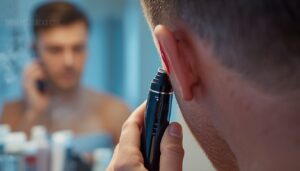
Trimming ear hair is safe when you respect the anatomy you’re working with, and the canal doesn’t leave much room for error. Most problems happen when people skip the basics and rush the process with the wrong tools or technique. Here’s what actually keeps the procedure safe from start to finish.
A good trimmer designed for sweat-prone, active use keeps the tip rounded and stable, so you avoid jabbing the canal during quick grooming sessions.
Trim Visible Outer Hairs
Picture the hairs you can actually see curling outward past your ear’s rim — that’s your target area, full stop. Anything along those visible contours is fair game; the canal isn’t.
Safe grooming visibility tips:
- Trim only what’s visible
- Use an electric rotary or foil trimmer
- Mind surface skin sensitivity
- Keep strokes light
- Stop at the outer ear’s edge
Professional non-shedding dog coats often require specific techniques to maintain their health and appearance.
Avoid Deep Canal Trimming
The ear canal isn’t self-grooming territory — it’s self-cleaning. Inserting any trimmer tip past the opening risks nicking thin canal skin, disrupting the protective wax barrier, and triggering swelling or bleeding that’s hard to control in such tight quarters.
Stick to what your eyes can verify. If you can’t see a hair without poking blindly, leave it alone and let your auditory health stay undisturbed.
Use Proper Grooming Tools
A pointed scissor in tight quarters is asking for trouble. Choose tools with rounded guards and enclosed cutting heads instead.
- A reassuring grip that won’t slip mid-trim
- Confidence knowing blunt tips can’t pierce skin
- Peace of mind from a freshly sanitized blade
Wipe blades with alcohol, replace worn heads regularly, and let the tool’s curved shape match your ear’s contour.
Keep Ears Clean and Dry
Clean tools won’t help if you trim into a damp canal. Moisture trapped after bathing creates a breeding ground for bacteria and fungi, raising your risk of otitis externa, or swimmer’s ear.
Tilt your head and pat the outer ear dry post-shower. Wipe visible debris with a washcloth — never inside the canal — and consider earplugs while swimming to prevent dampness altogether.
Why Ear Hair Grows
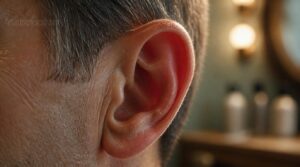
Ear hair doesn’t just appear out of nowhere — there are real biological reasons it becomes more noticeable as you get older. A few key factors work together to drive this change, from shifting hormone levels to traits written into your DNA. Here’s what’s actually behind it.
Aging and Hormone Changes
Hormones don’t age gracefully — they shift, decline, and reorganize in ways that quietly reshape your body, including your ears.
As testosterone availability decreases and sex hormone binding globulin rises, more androgen remains bound and less reaches target tissues. Growth hormone pulsatility also fades. These overlapping endocrine changes, including declining DHEA and altered cortisol rhythms, collectively heighten hair follicle sensitivity with age.
DHT Sensitivity in Men
Sensitivity, not quantity, is what makes DHT so influential in men’s hair patterns. When androgen receptors in follicles respond aggressively to dihydrotestosterone — produced locally via 5-alpha reductase activity — those follicles gradually miniaturize, generating progressively finer terminal hair over time.
That’s why two men with identical testosterone levels can have entirely different outcomes: one grows dense ear hair, the other doesn’t.
Genetics and Hair Patterns
Polygenic trait inheritance means ear hair patterns don’t follow a single predictable rule — multiple genes govern follicle cycling, hair density, and how strongly your follicles respond to hormonal signaling pathways. Variants in genes like EDAR influence inherited hair thickness across ancestries differently.
Which means two brothers can inherit entirely different ear hair outcomes from the same parents.
Vellus Versus Terminal Hair
Two hair types share your ears: vellus hair, fine and shallow-rooted, lacks a medulla and cycles quickly; terminal or tragi hair anchors deeper, contains a medulla, and grows about 1 centimeter monthly — making it far more visible.
- Vellus follicles sit higher in the skin
- Terminal hair produces one hair per pilosebaceous unit
- DHT converts vellus into terminal hair over time
Why Ear Hair Exists
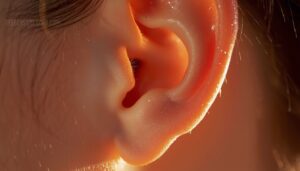
That hair on your outer ear isn’t just sitting there for no reason. It’s doing real work, acting as a built-in defense system for one of your body’s most sensitive openings. Here’s what it’s actually protecting you from.
Traps Dust and Debris
Picture each strand acting as a tiny net, intercepting airborne dust before it ever reaches your skin. Your outer ear sits in a microclimate where airflow shifts near the entrance, and hair dampens that movement so particles settle on strands rather than skin.
Natural oils make things stick, which is why this protective bristle layer matters so much for everyday hygiene and long-term ear health.
Supports Earwax Protection
Earwax isn’t a flaw — it’s a functional secretion, and the hairs lining your outer ear canal help keep it where it belongs instead of migrating deeper.
This same principle drives hearing aid wax guards: disposable filters and nanocoating that repel residue protect the receiver from buildup, preventing sound blockage just as your own hair helps preserve natural earwax protection and grooming safety.
Helps Block Germs
That same hair also acts as a physical filter, catching airborne bacteria before they reach deeper structures. Less surface contamination at the entrance means lower odds of microbes establishing themselves where the skin’s defenses are thinnest.
Combined with earwax, this creates a balanced microbial environment — disrupt it through over-trimming, and you raise your risk of irritation or bacterial infection taking hold.
Protects Sensitive Ear Skin
Beyond filtering germs, this hair maintains skin barrier integrity at the ear opening, where tissue is thinner and more reactive than skin elsewhere on your body.
Trimming smart protects against:
- Microabrasions from rough contact
- Skin irritation near the canal
- Redness from friction
- Disrupted gentle contact control
- Compromised dermatological safety overall
Safest Ear Hair Trimming Tools

The right tool matters more than the technique itself, since even careful hands can’t compensate for a poorly designed device.
Your safest options share one thing in common: they’re built to remove hair without ever putting sharp edges near delicate canal tissue. Here’s what belongs in your grooming kit, and why each piece earns its spot.
Rounded Electric Ear Trimmers
Rotary head efficiency is what sets rounded electric trimmers apart for ear hair removal. The R-shaped tip keeps a safe distance from canal skin, reducing irritation risk.
| Feature | Function |
|---|---|
| Dual edge blades | Less pulling |
| Guard hole design | Pulls hair in |
| High RPM (6000-8000) | Faster, smoother cuts |
| Waterproof rating | Easy rinse-clean |
| Rounded tip | Skin protection |
For aesthetic grooming at home, it’s hard to beat.
Foil or Rotary Guards
The guard itself does most of the safety work. Foil screens use a thin, perforated metal sheet that lets hair in while keeping blades off your skin; rotary guards encircle moving blades entirely.
Both rely on smooth, corrosion-resistant metal to reduce skin contact friction and support easy cleaning—critical for hygiene, since trimmer heads collect debris with every use.
Blunt-tip Grooming Scissors
When electric trimmers aren’t available, blunt-tip grooming scissors offer a reliable alternative. Their rounded ends reduce the risk of accidental punctures near sensitive ear skin, and compact sizes around 4.5 inches improve reach in tight spaces.
Look for 440C stainless steel blades and an adjustable tension screw — both support cleaner cuts and easier maintenance between uses.
Clean Mirror and Lighting
A well-lit mirror isn’t optional — it’s your primary safety tool. Position your task light to shine directly onto the mirror’s surface, minimizing shadows so you can see exactly where your trimmer is relative to the canal opening.
Inspect from an angle rather than straight-on; this reveals smudges or residue that distort your view, compromising precision when it matters most.
Alcohol for Sanitizing Blades
Wipe blades with 60–90% isopropyl alcohol before each session — this concentration denatures microbial proteins effectively without evaporating too quickly to work. Clear debris first, because alcohol can’t reach germs buried under hair or oil residue.
Let the blade air-dry fully; storing it damp traps contamination. Keep alcohol away from heat sources, since it’s flammable.
How to Trim Ear Hair Safely
Trimming ear hair safely comes down to a few deliberate habits that protect your skin and your hearing. The technique matters just as much as the tool you choose, so slowing down and following each step carefully makes a real difference. Here’s exactly how to do it right.
Wash Hands First

Before you touch your ears or any grooming tool, wash your hands thoroughly. Proper scrubbing technique means lathering with soap for at least 20 seconds, covering the backs of your hands, between fingers, and under nails — areas where bacteria quietly accumulate.
Preventing cross-contamination this way ensures you’re not introducing pathogens directly into a sensitive ear canal before hair removal begins.
Sanitize Tools Before Use

A clean blade isn’t a sanitized one — debris has to come off first, since leftover hair and oils block disinfectant from reaching bacteria. Wipe with alcohol, keeping surfaces wet for the full contact time listed on the label; rushing this step leaves microbes behind.
Never mix sanitizing chemicals, as combinations can react dangerously. Let tools air dry completely before they ever near your ear canal.
Trim Only Visible Hair
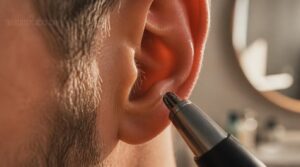
Where’s the boundary line? Anything growing along the rim and outer canal opening counts as fair game; anything past that point doesn’t.
Visible hair limits exist because the canal skin is thinner and more sensitive, and it relies on undisturbed hair to trap debris. Trimming only what you can see preserves that barrier while still controlling the bushy look — without risking deeper, unnecessary contact.
Move Slowly and Gently

Speed is where most ear hair injuries actually start. A controlled trimming motion—slow, deliberate, unhurried—keeps the blade tracking only where your eyes can follow it.
Rushing invites tool slippage and skin nicks, especially on skin this sensitive. If you feel resistance, stop; forcing through buildup tears follicles instead of trimming them. Steady hands, not speed, prevent irritation and the infections that follow careless hygiene practices.
Ask for Help if Needed

Even with steady hands, visibility challenges limit what you can safely manage alone. A second set of eyes—a partner or grooming buddy—improves angle and lighting beyond any mirror setup.
This isn’t about convenience:
- Better depth perception
- Reduced slip risk
- Safety supervision during trimming
- Spotting irritation early
- Confidence for beginners
If complications persist, professional consultation with dermatological care or medical-grade technology beats guessing.
What Not to Put in Ears
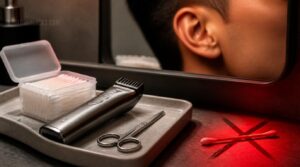
Knowing what to use is only half the equation; knowing what to keep away from your ear canal matters just as much. Certain tools and habits, even ones that feel routine, can turn a quick grooming task into an injury. Here’s what you should never bring near your ears.
Pointed Scissors
Pointed scissors belong nowhere near your ear canal. Their tapered tip concentrates cutting force at a single point, so accidental skin contact behaves like a puncture wound rather than a clean snip.
Tight quarters and poor visibility make blade tip precision nearly impossible to maintain, raising tool control challenges that lead to microscopic tissue damage, bleeding, and infection risk.
Sharp Tweezers
Tweezers earn their reputation for pointed tip precision when pulling splinters, not when used inside your ear canal. That same narrow geometry, often paired with serrated grip edges and stainless steel durability for splinter work, becomes dangerous in confined spaces.
Plucking with tweezers causes ingrown hairs and folliculitis. For skin irritation prevention, skip tweezers entirely when removing ear hair.
Deep Trimmer Tips
Pushing a trimmer past the canal opening risks eardrum puncture, even with rounded safety guards. Depth control matters here: shallow strokes that stay at the visible entrance protect the canal lining, while deeper passes don’t.
Good mirror visibility helps you judge that boundary accurately. If you can’t see where hair ends and canal begins, stop trimming rather than guessing—your eardrum isn’t worth the risk.
Cotton Swabs Too Deep
Why grab a swab for ear hair when it’s the wrong tool entirely? Cotton swabs compact wax deeper into the ear canal, causing deep wax plugging against sensitive skin.
This creates real dangers:
- Wax impaction requiring professional removal
- Canal skin abrasion from friction
- Eardrum puncture hazards with deeper insertion
- Sudden vertigo from swabbing
- Medical complications from trapped debris
Unclean Grooming Tools
Would you trust a blade you haven’t cleaned in months near your ear canal? Blade residue buildup mixes skin oils with hair fragments, while guard debris accumulation breeds bacteria in damp crevices.
Add hinge friction risks from corroded scissors, and you’re inviting cross-contamination dangers and skin sensitivity flare-ups. Sanitize with alcohol, dry tools fully, and prevent tool corrosion—or risk medical complications requiring dermatology or professional removal.
Trimming Versus Plucking Ear Hair

Once you’ve got the right tools in hand, the next question is technique, and that’s where trimming and plucking really part ways. Both methods remove hair, but your skin doesn’t experience them the same way at all. Here’s what sets them apart, and why it matters more than you’d think.
Trimming Causes Less Irritation
Why does trimming feel like the gentler option? Because it only targets hair above the skin, leaving the follicle untouched. This minimizes mechanical contact with the canal lining, reducing skin friction that triggers redness.
Gentle grooming passes with a guarded trimmer avoid micro-injuries altogether. Since the root stays put, you’re not disrupting follicles, just managing a cosmetic issue without provoking skin sensitivity or irritation.
Plucking Can Inflame Follicles
Yanking a hair from its root doesn’t just remove it—it wounds the follicle. The extraction tears bulb structures, triggers microscopic skin wounds, and causes localized hemorrhage and edema.
Plucking a hair doesn’t just remove it—it wounds the follicle, tearing tissue and triggering hidden bleeding and swelling
This sets off an inflammatory cascade:
- Tissue swelling around the follicle opening
- Increased skin reactivity
- Bacterial entry pathways through damaged openings
- Early folliculitis-like irritation
Repeated plucking keeps follicles stuck in this inflamed, vulnerable state.
Ingrown Hair Risk
Here’s where curl matters: if your ear hair grows in a tight curl pattern, plucking it leaves a sharpened edge that can re-enter the skin instead of growing straight out.
The follicle, already irritated from extraction, becomes blocked by debris, friction builds, and you scratch the resulting itch—creating an entry point for infection.
Folliculitis Warning Signs
Once that follicle gets irritated, your skin doesn’t stay quiet about it. Watch for these signs:
- Red pimple clusters around the outer ear
- Pus-filled blisters that crust after rupturing
- Itching or burning sensations near the canal opening
- Tender, inflamed bumps sensitive to touch
Hot tub exposure can trigger flare-ups too, since bacteria thrive in that warm, moist environment against compromised skin.
Best Choice for Beginners
Given those infection risks, the answer for beginners is clear: pick a guarded electric trimmer or blunt-tip scissors over tweezers every time. Electric trimmers remove ear hair evenly without yanking follicles, and rounded guards keep blades away from skin.
Sanitize your gear before each use, trim only visible hair, then follow basic aftercare. It’s the safest, most beginner-friendly approach in modern male grooming routines.
Is Waxing Ear Hair Safe?

Waxing might sound like a quick fix for ear hair, but it carries risks that trimming simply doesn’t. Where you apply it, and how it’s done, makes all the difference between a clean result and a painful mistake. Here’s what you need to know before you let anyone near your ears with hot wax.
Outer Ear Waxing Only
Pulling wax across the outer ear’s visible surface removes hair safely because this skin tolerates brief heat and tension better than canal tissue does. Temperature control matters here—wax applied too hot risks burns even externally. Stick to:
- Skin you can see and touch directly
- Wax cooled to a tolerable temperature
- Quick removal to limit residue buildup
This approach reflects current male grooming trends favoring cosmetic procedures with manageable risk.
Avoid Ear Canal Wax
The canal itself is off-limits. Its skin is thinner than the outer ear’s, with far less tolerance for heat or tension, and disrupting it interferes with natural wax migration—the process that moves cerumen outward and keeps the canal clean.
Applying wax there can compact debris, strip the cerumen barrier, and raise your risk of swimmer’s ear. From an otolaryngology standpoint, this area should stay untouched.
Burn and Tear Risks
Heated wax against thin outer-ear skin creates two distinct dangers: thermal burns if the temperature isn’t controlled, and tearing if the hardened wax adheres too firmly during removal.
Skin anatomy here is more fragile than facial skin, with less padding to absorb friction. A botched pull doesn’t just hurt; it can abrade the surface, leaving microtears that invite infection, including swimmer’s ear.
Professional Waxing Precautions
Trained estheticians screen skin before ever touching wax to it. A thorough intake covers medication disclosure, recent retinoid use, sunburn, and any visible irritation around the outer ear.
Pre-wax exfoliation removes dead cells; post-wax, heat and friction stay off-limits for 24 hours.
- Confirm skin barrier integrity
- Review retinoid timing (48-hour minimum)
- Skip lesions, cuts, or active breakouts
Aftercare matters as much as technique itself.
Regrowth Thickness Myth
Will waxing make your ear hair grow back thicker? No. The hair shaft simply regrows with a blunt regrowth tip instead of a tapered end, creating a temporary illusion. Follicle diameter biology stays fixed by genetics and androgens, not grooming method.
Regrowth timing cycles vary, so patchy or synchronized growth can look denser than it is. Trimming versus thickness misconceptions persist for the same reason: appearance, not actual hair density, changes.
Permanent Ear Hair Removal Options

If trimming feels like a never-ending chore, permanent removal might be worth a serious look. Your options here work at the follicle level, not just the surface, which is why results last so much longer. Here’s what you need to know about each one before you book an appointment.
Laser Hair Removal Basics
Laser hair removal works through selective photothermolysis: melanin in the hair shaft absorbs concentrated light, converting it to heat that damages the follicle while sparing surrounding skin.
This medical-grade technology uses specific wavelengths matched to your hair and skin tone, with pulse energy calibrated for safe, effective treatment.
Because follicles cycle through growth phases, you’ll need six to eight sessions, timed to catch hair regrowth inhibition at its peak.
Electrolysis for Permanent Results
Want the only FDA-approved permanent method? Electrolysis delivers electrical current through a fine probe inserted directly into each follicle, destroying the growth cells responsible for regrowth.
Unlike laser, it doesn’t rely on pigment targeting, which means it works regardless of hair color. You’ll need multiple sessions, since follicles cycle through different growth phases, but properly treated hairs won’t return once destroyed.
Dark Hair Laser Advantage
Pigment is what makes laser hair removal so effective on dark, coarse ear hairs. The follicle’s melanin absorbs concentrated light, converting it to heat that disables growth cells, while contrasting light skin tones limit collateral damage.
This pigment targeting efficiency depends on catching follicles in the anagen phase, requiring multiple sessions for permanent hair reduction and noticeably reduced shaving frequency over time.
Grey Hair Electrolysis Option
Grey or white ear hairs lack the melanin laser depends on, but electrolysis works regardless of pigment. A fine probe targets each follicle individually, delivering galvanic or thermolysis current for direct follicle destruction.
Because grey hairs cycle through growth phases, expect:
- Multiple sessions to catch regrowth
- Lasting confidence in stubborn areas
- Relief from ineffective laser attempts
Dermatologist or ENT Care
Whichever method you choose, who performs it matters as much as the technology itself.
A dermatologist focuses on skin and hair-bearing tissue, while an ENT evaluates the ear canal and hearing-related concerns, including inflammation, drainage, or hearing impairment risk.
If you’ve had swimmer’s ear or canal sensitivity, see an ENT first; for outer-ear skin issues alone, a dermatologist’s diagnostic tools are usually sufficient.
When Ear Trimming Needs Medical Care

Even careful trimming can sometimes go wrong, and your body will usually tell you when something’s off. Knowing which signs cross the line from minor irritation to a real problem keeps you from waiting too long to act. Here’s what should send you to a doctor instead of back to the mirror.
Pain After Trimming
How much soreness is too much? A little tenderness from skin friction irritation or mild tool abrasion usually fades within a day or two.
But pain that worsens, feels deep within the ear canal, or signals follicle inflammation beyond the surface deserves attention — that’s your body flagging trauma, not just routine soreness from temporary hair removal methods.
Bleeding or Pus
Soreness is one thing—drainage is another conversation entirely. Any blood from the ear canal warrants attention, especially if it persists.
Pus tells its own story: milky or yellow suggests standard bacterial infection signs, green points to specific pathogens, and unpleasant drainage odors paired with thick, purulent fluid texture often mean swimmer’s ear has set in. Don’t wait it out.
Sudden Muffled Hearing
Why would your hearing suddenly drop after a routine trim? It shouldn’t—and if it does, don’t assume earwax or a blocked ear canal is to blame.
This could signal sudden sensorineural hearing loss, an inner ear or auditory nerve emergency unrelated to trimming itself. It demands evaluation within 24-48 hours, since prompt treatment improves recovery odds. Rule out acoustic trauma too, especially if loud equipment was nearby during your grooming session.
Ringing in The Ear
Does your trim leave behind a phantom hiss or hum that wasn’t there before? That’s tinnitus, and it deserves attention.
Most cases are subjective, heard only by you, but pulsatile, heartbeat-timed sounds suggest objective tinnitus from nearby blood flow. Causes range from trapped earwax to cochlear hair cell damage from noise exposure.
Persistent ringing after grooming warrants an ENT evaluation, not guesswork.
Swelling or Redness
Why does the skin around your ear feel hot and puffy after trimming? You’re seeing two of inflammation’s cardinal signs at work—redness from increased blood flow and swelling from fluid buildup in irritated tissue.
Minor irritation usually stays localized, fading within days (acute, not chronic). But spreading redness, worsening swelling, or signs mimicking swimmer’s ear need evaluation. Keep ears dry afterward, and watch for changes regardless of skin tone or hair density.
Frequently Asked Questions (FAQs)
Is it okay to remove ear hair?
Lending an ear to this question isn’t hair-brained at all. Removing visible outer hair is acceptable grooming, but pulling strands risks damaging the canal’s sensitive lining—stick to gentle trimming methods that respect your ear’s natural protective function.
Is permanent ear hair removal safe?
Yes, when performed correctly. Laser hair removal and electrolysis achieve permanent follicle destruction, but safety depends on provider expertise, proper skin type matching, and laser safety protocols.
Electrolysis works on all hair colors, while laser favors dark hair against lighter skin.
How to remove ear hair permanently?
Does permanent really mean permanent?
Only electrolysis destroys follicles outright, working on any hair color. Laser hair removal offers long-term reduction, working best on dark hair, and needs multiple sessions—both require a qualified provider matched to your skin type and growth cycle.
Should you use a ear hair removal trimmer or tweezing?
Trimmers win for surface cutting of the hair shaft, sparing the root and minimizing follicle irritation. Tweezing pulls hair from its root, raising trauma risk. Stick with trimmers for routine grooming; save tweezing for stray hairs only, with sanitized tools.
How often should you trim ear hair?
Most people reach for their trimmer every one to two weeks, guided by visible regrowth rather than a fixed calendar. Faster hormonal cycles or coarser hair shafts shorten that window; slower growth stretches it.
Let visible hair, not the date, drive your maintenance schedule.
Does ear hair trimming hurt or sting?
No pain, no gain doesn’t apply here: light, gentle passes on outer hair cause minimal sensation.
But rushing or pressing too hard risks stinging from skin irritation, especially near sensitive canal tissue—slow, steady strokes keep trimming comfortable every session.
Can children safely have their ear hair trimmed?
Yes, with a guarded electric trimmer sized for small hands, limited strictly to visible outer hair.
Always supervise closely, watch for flinching or discomfort, and stop immediately—children’s ear canals are especially delicate before puberty’s hormonal changes drive thicker growth.
Are depilatory creams safe for ear hair?
Generally not recommended near the ear canal. Chemical burn risk is real if cream migrates inward, and canal skin tolerates irritation poorly. Patch-test first, apply only to visible outer hairs, and stop immediately if stinging develops.
Does ear hair growth speed up after trimming?
Picture stubble poking through like grass after mowing — it just looks faster. Trimming doesn’t speed follicle growth; hormonal drivers and genetics control that. You’re only noticing stubble visibility timing, not an actual change in your hair growth cycles or follicle output.
Conclusion
Think of that outer rim as a doorway, not a hallway leading inward—your job is the threshold, never the corridor beyond it.
So, is it safe to trim ear hair? Absolutely, when you respect that boundary and use rounded, blunt-tip tools instead of anything sharp or probing. Wash your hands, sanitize your blades, and move slowly under good light. Your ears don’t need aggressive intervention; they need steady, careful attention.
Master that distinction, and you’ll groom confidently for life: no nicks, no infections, just clean, controlled results every single time.