This site is supported by our readers. We may earn a commission, at no cost to you, if you purchase through links. This content is for general informational and educational purposes only and is not a substitute for professional medical, dermatological, or nutritional advice.
Most store-bought masks hide a dirty secret: the fragrance and preservatives that make them smell like a spa are the same ingredients that leave your cheeks stinging for hours. As a formulation chemist, I’ve watched too many "gentle" labels fall apart the moment you read the ingredient list past line three.
The good news? Your kitchen already holds better options. Colloidal oatmeal, plain yogurt, and honey each carry real chemistry behind them, from soothing antioxidants to moisture that actually stays put.
Below, you’ll find a non irritating face mask recipe with exact measurements, plus patch testing steps that keep your skin barrier happy instead of sorry.
Table Of Contents
- Key Takeaways
- Best Non-Irritating Face Mask Recipe
- More Gentle Face Mask Recipes
- Best Face Mask Ingredients for Sensitive Skin
- Patch Testing and Application Safety
- Frequency, Storage, and Skin Barrier Care
- Frequently Asked Questions (FAQs)
- What is the best face mask for very sensitive skin?
- What is a good 3-ingredients face mask for glowing skin?
- What ingredients should not be in a face mask?
- Can pregnant women safely use these masks?
- How long do homemade masks stay fresh?
- What causes sudden skin sensitivity changes?
- Are these masks safe for children?
- Can masks help with acne scars?
- Can I use these masks if Im pregnant?
- Are DIY face masks safe for childrens skin?
- Conclusion
Key Takeaways
- The oatmeal yogurt mask (2 tbsp plain yogurt, 1½ tbsp ground oats, 1 tsp honey) is the gentlest all-purpose recipe for sensitive skin, but it must be mixed fresh in single-use batches and used immediately.
- Always patch test a dime-sized dab on your inner arm for 24–48 hours before applying any mask to your face, and rinse immediately if you feel stinging, burning, or spreading redness.
- Keep wear time to 10–15 minutes, mask only once or twice weekly, rinse with lukewarm water, and apply fragrance-free moisturizer within three minutes to protect your skin barrier.
- Avoid fragrance, essential oils, denatured alcohol, sulfates, and formaldehyde-releasing preservatives—kitchen staples like colloidal oatmeal, honey, aloe, and green tea offer real soothing chemistry with far less risk.
Best Non-Irritating Face Mask Recipe
If you want one recipe to start with, the oatmeal yogurt mask is your best bet. It’s the gentlest combination I know of, and it works for almost every sensitive skin type. Here’s exactly how to make it, from ingredients to rinse-off.
If your skin leans dry or breakout-prone, you can tweak this base with honey or aloe — the yogurt face mask guide breaks down which add-in suits each concern.
Oatmeal Yogurt Mask Ingredients

Just three ingredients make this gentle non irritating face mask recipe, and your sensitive skin will thank you.
You’ll need:
- 2 tbsp plain yogurt (unsweetened, with live probiotics)
- 1 1/2 tbsp ground oats
- 1 tsp honey (optional, but lovely)
Grind rolled oats in a blender first, so they spread smoothly. Skip flavored yogurts entirely; sugar and fruit extracts belong in breakfast, not homemade face masks. Because the live probiotics in yogurt help reduce breakouts and support faster healing, this mask delivers real probiotic skin goodness but must be mixed in single-use batches and used immediately, as it cannot be stored safely.
Mixing The Mask
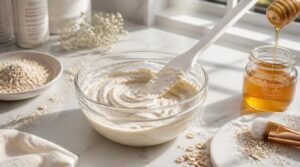
Grab a clean glass or ceramic bowl and add your ground oats first, then the yogurt. Fold gently with a silicone spatula for 30 to 60 seconds, since vigorous whisking can damage the delicate probiotics.
Stir in the honey last, at room temperature, until you see no streaks and the mixture looks perfectly smooth and uniform.
Adjusting The Texture
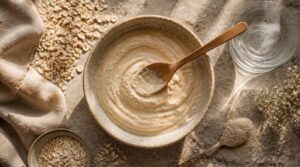
Once mixed, check the texture. It should look like smooth, spreadable pancake batter, not a stiff dough.
Too thick? Add lukewarm water, one teaspoon at a time, folding gently between additions. Over-thinning happens fast, so patience wins here. Too runny? Sprinkle in a pinch more ground oats and rest the mask for 2 minutes to let it thicken.
Why this matters: a properly textured mask stays put for the full 10 to 15 minute wear time without dripping or flaking.
Applying The Mask

Your batter is ready, so let’s apply it. First, patch test on your inner wrist and wait 20 minutes. Then follow these steps:
- Wash hands for 20 seconds
- Apply thin layer with fingertips
- Start at cheeks, move outward
- Avoid eyes and lips
- Set a 10-15 minute timer
Never sleep in it; overuse weakens your barrier. Rinse with lukewarm water only.
Rinsing and Moisturizing

Rinsing correctly matters as much as mixing. Use lukewarm water only, and gently splash away the oatmeal and plain yogurt with your fingertips. Skip washcloths; scrubbing irritates skin.
Then pat, don’t rub, with a clean towel. Apply moisturizer within three minutes to lock in hydration and support skin barrier recovery. Your skin will thank you.
More Gentle Face Mask Recipes
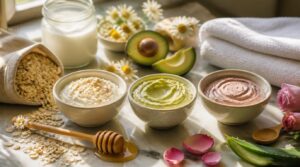
Once you’ve mastered the oatmeal yogurt mask, you’ll want a few more options in your skincare toolkit. Different skin days call for different masks, and variety keeps your routine interesting. Here are three more gentle recipes you can mix up in minutes, plus smart swaps for common sensitivities.
For a deeper dive into hydration boosters like honey and aloe, this dry skin home remedy guide pairs beautifully with the mask recipes below.
Cucumber Aloe Cooling Mask
Did you know cucumbers are about 96% water? That’s why this cucumber and aloe vera mask feels like a cool drink for your skin.
Puree half a cucumber, strain the puree, then whisk 2 tablespoons of it with 2 tablespoons of aloe vera gel. Chill for 10 minutes, apply in circles, rinse after 10 to 15 minutes.
Your skin gets soothing hydration, fast.
Avocado Honey Nourishing Mask
The humble avocado isn’t just for toast. Its healthy fats make a rich, soothing mask that thirsty skin loves.
Mash 2 to 3 tablespoons of ripe avocado (about half) until no chunks remain, then stir in 1 teaspoon of raw honey. Optional: add 1 teaspoon of plain yogurt for gentle exfoliation.
Spread on clean skin, avoiding eyes, and rinse after 20 minutes with warm water.
Green Tea Chamomile Mask
Need a soothing mask that calms redness fast? Green tea and chamomile are natural anti-inflammatory ingredients, perfect for reactive skin.
Steep 1 tablespoon of green tea (or matcha) with 50 milliliters of chamomile tea, then cool. Mix with honey into a paste, apply evenly, and rinse after 10 to 15 minutes with lukewarm water. Pat dry, then moisturize.
Ingredient Substitutions for Sensitivities
Found your perfect recipe but one ingredient makes you flinch? Don’t toss it, swap it. Smart substitutions keep the benefits while removing the troublemakers.
For lemon juice, use green tea or cucumber juice. Swap honey for maple syrup or agave if you’re vegan. Replace dairy yogurt with coconut yogurt for the same gentle exfoliation.
Skip essential oils entirely and choose fragrance-free skincare options like hydrosols. Always patch test new swaps first.
Best Face Mask Ingredients for Sensitive Skin
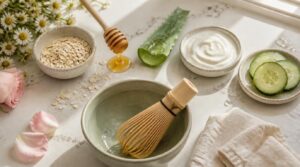
Not all "natural" ingredients are gentle, so choosing wisely matters when your skin flares up easily. The good news is that a handful of kitchen staples have real science behind their soothing power. Here are the five ingredients I trust most for sensitive skin masks, and why each one earns its spot.
Colloidal Oatmeal for Redness
Why does oatmeal calm angry skin so well? Colloidal oatmeal is your best friend here. It’s finely ground oats, about 65 to 85 percent polysaccharides, plus proteins and avenanthramides, which are natural antioxidants.
Together they form a protective layer that soothes redness and helps your skin barrier. It’s gentle enough for even reactive skin.
Aloe and Cucumber Hydration
Soothing redness is one job. Replenishing moisture is another, and that’s where aloe vera gel and cucumber shine together.
Aloe is hydrating with mild antimicrobial and anti-inflammatory activity, while cucumber is about 96 percent water, plus vitamin C and silica.
This duo makes a hydrating face mask that feels cool and won’t sting sensitive skin.
Honey for Moisture Retention
Aloe and cucumber add water. Honey helps your skin keep it.
Honey works as a humectant, grabbing moisture and holding it against your skin. Its natural sugars attract water, so it pairs beautifully in an avocado and honey mask.
- Start with clean, slightly damp skin
- Spread a thin layer
- Wait 15 to 20 minutes
- Rinse with lukewarm water
- Moisturize right away
Humectants love moisture that’s already there, so don’t apply honey to bone-dry skin.
Sticky? Yes. Worth it? Absolutely, for soft, calm skin.
Yogurt for Gentle Exfoliation
Honey holds moisture, and yogurt quietly clears away the old.
Plain yogurt delivers gentle exfoliation through lactic acid, a mild acid at roughly 0.9%. Its pH sits near 4.5, soft enough for sensitive skin. Apply a thin layer, wait 15 minutes, rinse warm. You’ll get soothing irritated skin benefits, too, thanks to these natural ingredients.
Green Tea and Chamomile
Yogurt exfoliates; green tea and chamomile calm what’s left behind.
These antiinflammatory ingredients are perfect for soothing irritated skin. Brew them right, then chill:
- Steep 1 tsp green tea, 170°F
- Add 1 tsp chamomile
- Wait 3–4 minutes
- Cool completely
- Use as mask liquid
Their antioxidants make homemade face masks genuinely soothing.
Patch Testing and Application Safety

Even the gentlest recipe can misbehave if you skip the safety basics, so this section covers exactly how to protect your skin. Think of it as your pre-flight checklist before any mask touches your face. Here’s what you need to know, step by step.
How to Patch Test
Think of a patch test as your skin’s dress rehearsal before the big show. For any DIY homemade face mask, apply a dime-sized dab to your inner elbow or behind your ear, wait 24 to 48 hours, and watch for redness or itching.
| Step | What To Do | Timing |
|---|---|---|
| 1 | Mix mask fresh | 5 min |
| 2 | Apply to inner arm | 1 min |
| 3 | Leave uncovered | 24 hrs |
| 4 | Check for reaction | 48 hrs |
| 5 | Confirm clear skin | 72 hrs |
Sensitive skin can be sneaky, so never skip this.
Ingredients Sensitive Skin Should Avoid
The ingredient label is your best friend here, even more than the recipe itself. For sensitive skin, a few common additives can undo all your gentle work.
Skip these in store-bought add-ins:
- Fragrance and essential oils, a top trigger for allergic contact dermatitis
- Denatured alcohol, which stings and dries reactive skin
- Sulfates like sodium lauryl sulfate, common in cleansers
- DMDM hydantoin, a preservative often flagged for sensitive users
Watch out for "unscented" labels too. They can still contain masking agents that irritate. Look for truly fragrance-free and paraben-free products instead, especially if you’re managing eczema relief or rosacea treatment goals.
Long ingredient lists? Treat them like a crowded room. More ingredients mean more chances one will misbehave. Less is more for your barrier.
When it comes to skincare ingredients, less is more—longer lists just give your barrier more chances to misbehave
Preparing Clean Tools
Before your mask touches your face, your tools need a spa day too. Wash bowls and spatulas with hot soapy water, rinse thoroughly, then air-dry on a clean towel. Skip reusing sponges, which harbor bacteria like a busy subway.
For storage, choose airtight containers, ideally BPA-free plastic or glass. Rinse with lukewarm water before use. Clean tools mean fewer breakouts, guaranteed.
Safe Mask Wear Time
How long should your mask sit? Ten to fifteen minutes is the sweet spot for sensitive skin. Beyond that, water evaporates and ingredients can tingle or sting.
Never let a clay or yogurt mask dry fully like cracked desert earth. Overuse risks include redness and barrier stress, so set a timer. Rinse with lukewarm water, and always patch test first.
Signs to Remove Immediately
Your skin talks to you during a mask, so listen closely. Stinging, burning, or rapid itching means rinse now, not in five minutes. Also remove immediately if you notice:
- Spreading redness beyond the mask edges
- Hives, welts, or sudden swelling
- Tingling, numbness, or a metallic taste
Rinse with cool water, then apply a fragrance-free moisturizer for redness reduction. Log any reaction in a trigger journal for future reference.
Frequency, Storage, and Skin Barrier Care
You’ve made your mask, patched it, and applied it safely—now let’s talk about what comes next. How often you mask, how you store leftovers, and how you care for your skin afterward all matter just as much as the recipe itself. Here’s everything you need to keep your routine gentle, safe, and effective.
Weekly Masking Frequency
How often is too often? For sensitive skin care, once or twice weekly is your sweet spot. More invites mask overuse risks: redness, stinging, flaking.
| Mask Type | Frequency |
|---|---|
| Oatmeal yogurt | 1–2x weekly |
| Cucumber aloe | 2x weekly |
| Avocado honey | 1x weekly |
| Green tea | 1–2x weekly |
| Any gentle face mask | Never daily |
Keep each application duration to 10–15 minutes, and always moisturize after.
Safe Homemade Mask Storage
Storage matters as much as frequency, because a fresh mask spoils fast.
Your oatmeal yogurt mix keeps 24–48 hours refrigerated in a glass jar or BPA-free plastic container. Wash tools in hot soapy water first, seal immediately, and label with the date. Better yet, make single-use batches.
Spoiled masks cause the same irritation as overuse, so note reactions in your trigger journal.
Gentle Post-Mask Skincare
A fresh mask deserves a gentle finish. After rinsing, pat dry with a clean towel, never rub.
Then layer a hydrating serum, followed by a fragrance-free moisturizer to support skin barrier repair. This also encourages pH level normalization and microbiome balance.
Skip strong actives for 24 hours. Your skin just did the work, so let it rest and recover.
Preventing Barrier Irritation
Resting your skin after a mask is half the battle.
Preventing barrier irritation also means limiting trans epidermal water loss, so keep showers warm, never hot, and choose cleansers near pH 4.0 to 5.5. This helps with ceramide replenishment and microbiome balance.
Moisturize daily with humectants and emollients, skip scrubbing, and your skin’s natural inflammatory response reduction will thank you.
When to See a Dermatologist
Even the gentlest masks can’t fix everything. If a rash, redness, or itching lingers past two weeks despite patch testing and trigger journaling, call a dermatologist. Bleeding or crusting spots need prompt evaluation too.
Schedule an annual skin check; early detection matters. Think of it as backup, not failure. Your sensitive skin deserves expert eyes sometimes.
Frequently Asked Questions (FAQs)
What is the best face mask for very sensitive skin?
For very sensitive skin, the best mask is oatmeal and yogurt, two natural ingredients that soothe redness gently. Always patch test first, and rinse with lukewarm water.
What is a good 3-ingredients face mask for glowing skin?
Glowing skin needs less, not more. Mix 2 tablespoons oatmeal, 1 tablespoon plain yogurt, and 1 teaspoon honey. Wear 10 to 15 minutes, rinse warm, then moisturize. Simple, soothing, and effective.
What ingredients should not be in a face mask?
Skip masks listing fragrance or parfum, formaldehyde-releasing preservatives, retinol or retinyl palmitate, parabens, and sulfates. These commonly trigger irritation or sun sensitivity. Choosing fragrance-free, paraben-free formulas keeps your DIY homemade face mask gentle.
Can pregnant women safely use these masks?
Like a soft blanket, pregnancy-safe masks soothe without harm. Yes, most DIY homemade face masks with oatmeal, honey, cucumber, and avocado are safe. Just skip turmeric, essential oils, and retinoids, since pregnancy skin is extra reactive.
How long do homemade masks stay fresh?
Homemade masks stay fresh just 1 to 2 days refrigerated in airtight, BPA-free containers. Without preservatives, natural ingredients spoil fast, so mix small batches with sterilized tools and use them quickly.
What causes sudden skin sensitivity changes?
That sudden sting isn’t random. Hormones, stress, weather shifts, new products, medications, or eczema flares can weaken your barrier, making skin sensitivity triggers feel stronger.
Are these masks safe for children?
Yes, with care. Patch test first, skip citrus and essential oils, and choose simple ingredients like oatmeal and honey. Children’s sensitive skin needs extra-gentle, fragrance-free, chemical-free skincare.
Can masks help with acne scars?
DIY masks won’t erase acne scars, but they can soften their look. Yogurt gently exfoliates while oatmeal calms inflammation, supporting smoother texture and collagen synthesis support over time. For deep scars, though, see a dermatologist.
Can I use these masks if Im pregnant?
Mostly, yes. Stick to gentle homemade face masks like oatmeal, honey, or aloe, and always patch test first. Skip essential oils, retinoids, and strong acids, and ask your doctor if unsure.
For a gentler way to build radiance over time, these natural skin brightening tips pair lukewarm cleansing and light exfoliation with soothing ingredients like aloe and oatmeal.
Are DIY face masks safe for childrens skin?
Yes, with care. Children’s skin is thinner and more reactive, so use only gentle natural ingredients, patch test first, skip essential oils, and keep sessions short with close supervision.
Conclusion
So why keep paying for stinging cheeks? This non irritating face mask recipe puts real chemistry in your hands, no fragrance required.
Your skin barrier deserves better than line three of a label. Start small, patch test patiently, and trust what you can actually pronounce.
Gentle skincare isn’t complicated, it’s just honest. Mix your mask tonight, and let calm, happy skin become your new normal.
You’ve got this.