This site is supported by our readers. We may earn a commission, at no cost to you, if you purchase through links. This content is for general informational and educational purposes only and is not a substitute for professional medical, dermatological, or nutritional advice.
Women in the Yao ethnic minority of China have maintained hair past their waists—some reaching six feet long—for generations, crediting a single ritual: washing with fermented rice water. Researchers who studied this community found their hair showed impressive tensile strength and retained its pigment well into old age. That’s not folklore. The practice has drawn enough scientific attention to identify the specific compounds responsible.
Rice water for hair works through a combination of amino acids, starch polymers, and pH-active fermentation byproducts—each targeting a different layer of the hair shaft. Understanding exactly how to prepare and apply it determines whether you see real results or end up with protein overload and brittle strands.
Table Of Contents
- Key Takeaways
- Rice Water Benefits for Hair
- How Rice Water May Work
- Rice Water Preparation Methods
- How to Apply Rice Water
- Best Hair Types for Rice Water
- Rice Water Risks and Safety
- Top 4 Rice Water Products
- Frequently Asked Questions (FAQs)
- What are the negatives of rice water for hair?
- Can rice water affect hair dye color?
- How does rice water interact with scalp oils?
- Is rice water suitable for daily use?
- Can rice water change hair texture?
- Does rice water influence hair porosity?
- Can rice water replace regular conditioner entirely?
- Does rice water expire faster in hot climates?
- Can children safely use rice water on hair?
- Does rice water interact with hard or chlorinated water?
- Conclusion
Key Takeaways
- Fermented rice water outperforms plain rice water because the fermentation process lowers pH, by nearly 2.5× the antioxidant compounds, and makes nutrients more bioavailable for your hair shaft.
- Rice water strengthens and smooths hair through amino acids, inositol, and starch—but clinical evidence doesn’t support hair growth claims, so don’t confuse reduced breakage with new follicle activation.
- Protein overload is your biggest risk: using rice water more than 1–2 times per week can make strands stiff, brittle, and prone to snapping, so frequency control isn’t optional—it’s the whole game.
- The fermented soaking method in a sealed glass jar, applied for 10–20 minutes and thoroughly rinsed, gives you the most benefit with the least risk across almost every hair type.
Rice Water Benefits for Hair
Rice water doesn’t promise miracles, but it does deliver a few things your hair can actually feel. The nutrients it carries work in ways that are simple to understand and even simpler to notice.
Think of it as a gentle reset—much like the targeted techniques for restoring bleach-damaged hair, rice water works best when it’s part of a consistent routine.
Here’s what most people experience when they make it part of their routine.
Smoother, Less Tangled Strands
When your strands feel rough and tangled, rice water’s natural slip agent synergy gets to work fast. Its amino acids and fermented probiotics create a probiotic scalp conditioning effect, while the pH‑adjusted rinse smooths the cuticle layer.
Think of it as a micro‑emulsion coating — friction‑reducing polymers that detangle the hair, improve hair texture, and make it a legitimate hair conditioner alternative.
The speed of parallel token generation is comparable to the quick action of rice water on tangled strands.
Shine and Frizz Control
Rice water doesn’t just detangle — it also increases shine and helps minimize frizz. Its natural cuticle smoothing action lays the hair surface flat, creating a lightweight finish that reflects light evenly.
- Forms a humidity barrier to block moisture from lifting the cuticle
- Builds film strength that keeps hair smoother through heat and styling
- Delivers heat protection while maintaining a non-greasy, polished result
Improved Softness and Manageability
Beyond shine, rice water genuinely makes hair smoother and easier to manage. Its amino acids work like a natural conditioner replacement, supporting boundary lubrication and surface friction reduction, so strands glide apart instead of grabbing.
The result? Real hair texture improvement — softer feel, better hydration retention, and a film former balance that keeps the cuticle flat without heaviness. That’s what detangles the hair effortlessly.
Stronger-feeling Hair and Reduced Breakage
Softer hair is a great start — but strength is what keeps it growing. Rice water acts as a protein-rich rinse that helps maintain protein balance, boosting hair elasticity so strands flex rather than snap.
Friction reduction during detangling means less mechanical stress at fragile ends.
The result is real hair breakage prevention — through cuticle sealing, moisture retention, and starch for hair strengthening.
Hair Growth Claims Vs. Real Evidence
Here’s what you actually need to know: clinical trial data on rice water is thin. No placebo-controlled studies confirm follicle activation mechanisms or measurable hair density metrics.
Scientific evidence for rice water benefits points to shaft conditioning — less breakage, more slip — not new growth. Dermatologists are concerned that marketing outpaces the science.
Rice water conditions and strengthens hair, but dermatologists warn the science stops well short of the growth claims
Anecdotal versus clinical research on hair growth tells a clear story:
- Reduced shedding isn’t the same as regrowth
- Shinier hair doesn’t mean more follicles activated
- regulatory guidelines classify rice water as a hair growth treatment
- Hair growth stimulation with rice water lacks standardized dosage evidence
- Potential side effects of rice water, like protein overload, are better documented than its growth benefits
How Rice Water May Work
Rice water isn’t magic — it works because of what’s actually dissolved in it. Each component plays a different role, from reinforcing your hair’s structure to protecting its surface.
Here’s what’s inside and why it matters.
Amino Acids and Hair Strength
Your hair is basically a keratin rope — and amino acids are what keep it tightly wound. Rice water delivers a protein-rich rinse packed with cysteine enrichment and methionine supply, directly supporting disulfide bond formation inside each strand.
These bonds give hair its elasticity and resistance to breakage.
Hydrating amino acids like serine also aid moisture retention, making protein repair and keratin strengthening tangible, measurable results.
Vitamins and Antioxidants for Scalp Support
Rice water brings more than protein to the table. It contains B vitamins, vitamin E, and antioxidants that directly support scalp health.
Pairing rice water with nutrient-rich oils, like cactus seed oil for stronger, healthier hair, can amplify these scalp-nourishing benefits even further.
Pairing rice water rinses with nutrient-dense grains like buckwheat’s hair-strengthening benefits can further nourish follicles from the inside out.
Vitamin E protection helps defend scalp tissue from oxidative damage, while antioxidant activity works to neutralize free radicals. Zinc follicle health, selenium antioxidant enzymes, and Vitamin C collagen support round out the picture — a modest but meaningful antioxidant-rich profile worth considering.
Pair these nutrients with proper dry scalp oil application techniques to maximize soothing, protective benefits.
Inositol and Surface Protection
One compound in rice water quietly earns its place: inositol.
Its Inositol Humectant Mechanism works through Keratin Surface Bonding — multiple hydroxyl groups latching onto polar sites along the hair fiber, smoothing the cuticle as they go. Here’s what that means practically:
- Cuticle smoothing reduces friction and boosts hair shine
- Moisture retention helps maintain hair texture between washes
- Leave-On Conditioning Benefits extend with longer contact time
- Scalp health improves through consistent, non-irritating topical exposure
Fermentation Stability Effects may further concentrate inositol’s availability. No Inositol Concentration Guidelines for DIY use exist yet — but the science behind it is solid.
Starch Effects on Texture and Slip
Starch in rice water does more than bulk up the liquid. Through Granule Swelling Dynamics, starch absorbs water and expands, triggering Film Formation Mechanisms that coat each strand.
Amylopectin Slip Enhancement lowers friction, while Amylose Gel Firmness controls texture.
Hit the right Viscosity Thresholds, and you get genuine hair smoothing. Too thin, and the coating breaks down — leaving no real conditioning effect.
Why Fermented Rice Water Differs
Fermentation transforms rice water at a chemical level — and that shift changes what your hair actually receives.
- Acidic pH shift (3.5–4.5) flattens cuticles, reducing friction
- Enhanced phenolics content rises nearly 2.5× versus plain rice water, boosting antioxidant levels
- Probiotic microbial boost from lactic acid bacteria increases vitamin bioavailability and mineral solubility
The fermentation process delivers a noticeably more conditioning rinse.
Rice Water Preparation Methods
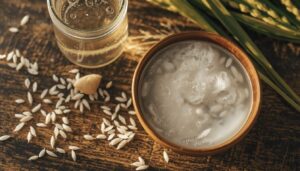
Making rice water at home is straightforward, but the method you choose does affect what ends up in the final liquid.
Each technique pulls different nutrients from the rice, so picking the right one matters for your hair goals.
what you’ll need and how each preparation works.
Ingredients and Tools Needed
Getting your setup right matters more than most people realize.
You’ll need ½ cup of white or brown rice, 2 cups of filtered water meeting basic Water Quality Standards, and a measuring cup for Measuring Ratio Accuracy.
Grab a fine mesh strainer, a clean bowl, and an airtight container for storage.
Sanitation Equipment—washed bowls, dry jars—keeps contamination out.
Fermentation Vessel Choice affects your results, so pick a lidded glass jar.
Soaking Method Step by Step
Once your tools are ready, the rice water soak method is straightforward. Rinse ½ cup of rice, then soak it in 2 cups of filtered water for 30–60 minutes—your Timing and Duration window.
Water Temperature Control matters here: room temperature works best. Strain thoroughly for a clean Starch Removal Rinse.
Refrigerate immediately in your airtight jar, preventing contamination of homemade rice water.
Boiling Method Step by Step
The boiling method pulls more from the rice than soaking alone. Combine ½ cup rice with 2 cups water, bring to a rolling boil, and keep it there for 10–20 minutes—your Boil Timing window for ideal Starch Extraction.
Strain with a fine-mesh strainer, then follow a simple Cooling Procedure: wait until steam stops. Refrigerate in a sealed Container of your choice.
Fermented Method Step by Step
Where boiling extracts through heat, fermentation works through time — and the difference shows up in your hair.
Start with your strained soak water. Pour it into a clean glass jar (Container Selection matters — avoid plastic). Leave it loosely covered at room temperature for 24–48 hours, adjusting for Temperature Control based on your climate.
- Watch for a mildly sour smell — that signals active fermentation
- Cloudy liquid with slight tanginess means your pH Monitoring is on track
- Strain again using your Straining Technique before refrigerating
Fermentation Timing shapes the fermentation process and its impact on nutrient content directly.
White Rice Vs. Brown Rice
Both rice types offer value, but they work differently. White rice delivers higher starch concentration, giving your rinse a slip and coating effect.
Brown rice brings stronger vitamin B levels and greater fiber content — its intact bran layer packs more nutrients into your protein-rich rinse.
The trade-off? Brown rice has lower shelf stability. Choose based on what your hair needs most.
Storage, Shelf Life, and Freshness Signs
Once you’ve made your batch, storage determines how much you’ll actually get out of it. Transfer rice water immediately into an airtight container and refrigerate — consistent refrigerator temperature limits spoilage considerably. Most batches stay fresh up to one week.
- Label each container with the prep date (batch labeling practices matter)
- Watch for freshness visual cues: darkening color, bubbling, or cloudiness
- Trust smell safety checks — a sharp, putrid odor means discard it
How to Apply Rice Water
Knowing what’s in rice water is one thing — knowing how to actually use it is where results happen. The timing, technique, and frequency all affect how your hair responds.
Here’s exactly how to apply it the right way.
Using Rice Water Before Shampooing
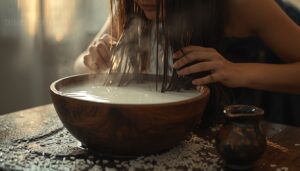
Think of a pre-shampoo rice water rinse as your hair’s first line of defense. Apply it before cleansing for ideal Application Timing — this is where pH Optimization matters.
The rinse coats strands, improving slip and reducing breakage during detangling.
Focus on Scalp Stimulation through gentle massage, use lukewarm Water Temperature, then prioritize thorough Residue Rinsing.
Your hair nourishment routine earns real shine and luster this way.
Using Rice Water After Shampooing
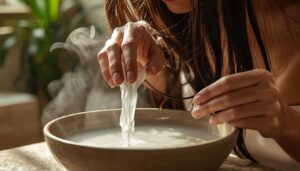
After shampooing, your hair shaft is open and ready to absorb. Apply your rice water rinse directly to clean, damp strands — this is when hair conditioning works best.
Rinse Temperature matters: use cool water to seal the cuticle and boost hair shine improvement.
Always prioritize Residue Rinsing to prevent buildup.
A quick Scalp Sensitivity Test beforehand keeps your hair health routine safe and effective.
How to Saturate Hair Evenly
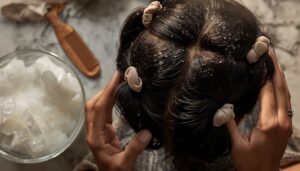
Even coverage starts with a sectioning strategy — divide your hair into four to six parts before applying. Work the rice water through each section using a finger rake technique, then follow with a wide-tooth comb for full comb distribution.
This DIY hair treatment approach ensures every strand benefits from the hair rinse, maintaining moisture balance without missed spots or uneven saturation.
Scalp Massage Techniques
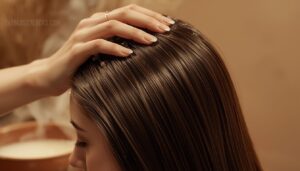
Once the rice water is distributed, use fingertip pressure — never nails — to work in small circular motions from your hairline toward the crown. Alternate between a kneading technique for tighter zones and tapping stimulation along the sides.
Keep hands clean for proper hygiene controls.
This promotes hair follicle stimulation and maximizes nutrient infusion from the treatment directly into the scalp.
How Long to Leave It On

After massaging, timing becomes your next decision point.
- Unfermented rice water: Leave on for 15–20 minutes — scalp tolerance is usually higher.
- Fermented rice water: Stick to 10–15 minutes; its acidic irritation window is narrower.
- High-concentration batches: Start at 10 minutes — concentration timing matters for hair texture response.
Always rinse before heat styling compatibility becomes a concern.
How Often to Use Rice Water
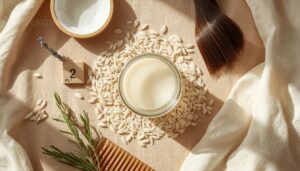
Timing shapes results, but so does frequency. For most hair types, 1–2 times per week hits the sweet spot on your weekly schedule.
Dry or damaged hair may benefit from 3 sessions weekly initially. Monitor buildup closely — stiffness signals overuse.
Fermentation timing and hair type frequency both influence your ideal rhythm, so adjust seasonally as your hair’s needs shift.
Best Hair Types for Rice Water
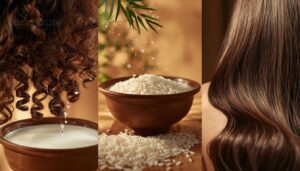
Rice water doesn’t work the same way for every hair type — and knowing where it shines can save you a lot of frustration. Some textures respond beautifully to it, while others need a more cautious approach.
Here’s how it plays out across different hair types.
Natural Hair
Natural hair thrives when moisture retention stays consistent — and that’s where a rice water rinse earns its place.
The amino acids coat each strand, supporting texture shift tips from rough to smooth, while fermented rice water adds probiotics that support scalp health basics.
Use it weekly as part of your natural hair care routine for steady volume boosting and stronger-feeling growth.
Curly Hair
Curly hair has its own rulebook. Rice water works with your curl pattern memory by reinforcing disulfide bond dynamics — the structural reason curls snap back after washing. It also improves wet-to-dry behavior, keeping spirals defined instead of frizzy.
For curly hair specifically, rice water offers:
- Volume and elasticity without heaviness
- Hair texture smoothing from follicle architecture outward
- Better hair porosity and product compatibility
- Results for both high-porosity and low-porosity hair types
Fine or Dull Hair
Fine hair is structurally delicate — each strand has a smaller diameter, fewer cuticle layers, and breaks more easily under product weight.
Rice water’s amino acids support protein strengthening and hair repair without heaviness, delivering weightless volume and a silky finish. Its nutrients aid scalp hydration and hair softness, while improved hair texture improvement through rice water helps reduce that flat, dull look.
Color-treated Hair
Color-treated hair faces a real structural challenge. Dye chemicals lift the cuticle to deposit color, increasing porosity and leaving strands vulnerable to moisture loss, oxidative stress, and cuticle damage over time.
Rice water works as a protein-rich rinse that promotes hair strengthening and hair moisturizing simultaneously.
For a step-by-step look at how often to use it and what results to expect, see this guide to using rice water for hair growth.
Focus on these specific benefits:
- Helps smooth raised cuticles, reducing roughness and tangling
- Promotes color fade management by reinforcing the hair shaft
- Tackles increased hair porosity without triggering scalp irritation
Damaged and Thinning Hair
Damaged and thinning hair responds well to rice water’s protein-rich rinse, especially when Mechanical Breakage, Heat Styling Damage, or Chemical Processing Effects have weakened your strands. Scalp Inflammation and Nutrient Deficiency compound the problem further.
| Concern | Rice Water Benefit |
|---|---|
| Breakage | Strengthens hair shaft |
| Thinning | Promotes hair growth stimulation |
| Inflammation | Soothes scalp environment |
Use it consistently for hair loss prevention.
Low-porosity Hair Considerations
Low-porosity hair is the cuticle that won’t budge — products pool on the surface instead of sinking in. rice water rinse works best here when you use a Warm Water Soak first to lift those cuticles.
Keep it lightweight, follow smart Oil Layering Order, and build an Extended Dwell Time into your routine. Stick to a Clarifying Schedule to prevent protein buildup from stiffening your strands.
Rice Water Risks and Safety
Rice water can do a lot of good for your hair, but it’s not without its downsides. Like most treatments, using it the wrong way — or too often — can backfire.
Here’s what you need to watch out for before making it part of your routine.
Protein Overload and Stiffness
Too much of a good thing is still too much. Rice water is a protein‑rich rinse, and repeated use can trigger protein overload — which your cuticle rigidity increases and hair elasticity loss becomes noticeable.
Watch for these signs of excess protein load:
- Hair feels stiff or "crispy" when dry
- Strands snap instead of stretching
- Moisture imbalance leaves hair rough to the touch
- Curls lose flexibility despite regular protein treatment
Protein load management matters. Balance is your goal.
Dryness, Buildup, and Rough Texture
Starch residue and protein film buildup are quiet saboteurs. Without an sufficient rinse, rice water deposits cling to your strands, disrupting hair moisture retention and blocking your natural conditioner from doing its job. Hard water minerals compound this quickly.
| Cause | Effect | Fix |
|---|---|---|
| Overuse Frequency | Rough, dry texture | Use 1–2x weekly |
| Starch Content | Reduced hair detangling | Clarify monthly |
| Hard Water Minerals | Dull, coated strands | Use filtered water |
| Insufficient Rinse | Protein film buildup | Rinse thoroughly |
| Starch Residue | Blocked moisture retention | Follow with conditioner |
Consistent habits drive real hair texture improvement.
Sensitive Scalp, Dandruff, and Eczema Concerns
If your scalp already suffers from dandruff or eczema, rice water deserves more caution. High starch content can worsen Malassezia-driven irritation and compromise pH balance, undermining the barrier repair your scalp needs.
Environmental triggers like humidity or product residue intensify this.
Dermatologist concerns about starch are real — without soothing botanicals or a pH-balanced hair rinse, dermatological safety becomes a genuine risk.
Patch Testing Before Full Use
Before applying rice water fully, patch testing protects you from unexpected reactions. Choose a small site — inner forearm, upper arm, or behind the ear — clean it gently, and apply a small amount.
Watch for redness, itching, or swelling over 24–48 hours.
If any positive reaction signs appear, stop immediately.
Repeat testing confirms results before full use.
Fermentation Spoilage and Contamination
Patch testing tells you how your skin reacts — but fermentation introduces a different risk: spoilage. When Oxygen Exposure goes unchecked, the wrong microbes take over fast.
Watch for these red flags before using your batch:
- Sour or musty smell signals bacterial overgrowth
- Slime or Biofilm Formation on container walls means contamination
- Discoloration indicates pH Monitoring failure
- Poor Container Sealing lets airborne spores in
- Fermentation Time beyond 48 hours increases spoilage risk
Common Mistakes to Avoid
Beyond spoilage, everyday habits quietly undermine your results.
Over‑frequency usage coats strands with starch buildup. Inadequate rinsing traps residue, leaving hair tacky. Uneven distribution means some sections get treated while others don’t. Skipping a patch test before full application risks delayed reactions. Improper fermentation — going past 48 hours — invites contamination rather than benefit.
| Mistake | What Happens |
|---|---|
| Over‑frequency usage | Protein buildup, stiffness |
| Inadequate rinsing | Tacky, dull strands |
| Improper fermentation | Spoilage, scalp irritation |
Top 4 Rice Water Products
Not everyone wants to make rice water from scratch every week, and that’s completely fine. Plenty of well-formulated products deliver the same key ingredients without the prep work.
Here are four worth knowing about.
1. Briogeo Rice Water Protein Treatment
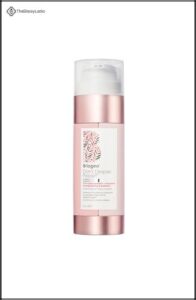
The Briogeo Don’t Despair, Repair! Rice Water Protein Treatment works like a structural reset for damaged strands.
Its fermented rice water and hydrolyzed rice protein complex reinforce the cuticle from within, while B‑vitamins — including biotin and B5 — improve texture, body, and shine.
Rosehip and sweet almond oils balance the protein boost with deep moisture, so your hair won’t feel stiff after use.
Clinically shown to cut breakage by roughly 60% after one use, it’s best applied weekly on all textures.
| Best For | Anyone with seriously damaged, bleached, or chemically treated hair who wants a weekly protein treatment that actually holds up across all hair textures. |
|---|---|
| Rice Water | Rice-water ferment + hydrolyzed rice protein |
| Vegan Formula | Yes |
| Paraben-Free | Yes |
| Hair Type | All types |
| Product Form | Treatment/mask |
| Cruelty-Free | Yes |
| Additional Features |
|
- Clinically cuts breakage by around 60% after just one use — real results, not just marketing talk.
- Nearly 98% naturally derived, with no sulfates, silicones, or parabens, so it plays nice with color-treated hair too.
- The rice water and oil combo strengthens without leaving hair feeling stiff or dried out.
- The dual-chamber dispenser can be inconsistent, so you might get too much of one side and not enough of the other.
- Some bottles have arrived without a cap, which is a hassle and can mess with the product.
- Results aren’t guaranteed for everyone — a small number of users saw little to no difference, especially those with fine or very thin hair.
2. UNITE 7SECONDS Detangler Leave In Conditioner
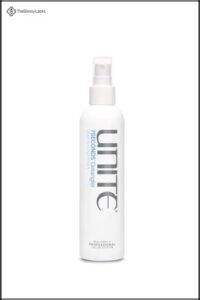
UNITE 7SECONDS Detangler Leave-In Conditioner earns its place in a serious hair care routine. It detangles instantly — fine, curly, thick, or extension-bearing — without weighing strands down.
The lightweight formula balances light protein with moisture, strengthening while softening. UV and thermal protection seal the cuticle and lock in color, shielding hair through daily styling.
It’s paraben- and sodium chloride-free, which matters if you’re managing a sensitive scalp. At $42.50 for 8 oz, it’s an investment — but salon-grade results often are.
| Best For | Anyone who deals with tangles, frizz, or color-treated hair and wants a lightweight daily leave-in that also protects against heat and UV damage. |
|---|---|
| Rice Water | Not specified |
| Vegan Formula | Yes |
| Paraben-Free | Yes |
| Hair Type | All types |
| Product Form | Leave-in spray |
| Cruelty-Free | Yes |
| Additional Features |
|
- Detangles fast without weighing hair down — works on fine, curly, thick, and extension hair
- Built-in UV and heat protection means one less product to layer on
- Safe for color-treated hair and helps keep vibrancy longer
- At $42.50 for 8 oz, it’s pricier than most drugstore leave-ins
- The fragrance is noticeable — not ideal if you’re sensitive to scents
- Won’t deeply repair seriously damaged hair on its own; you’d need something more intensive alongside it
3. Function of Beauty Wavy Hair Shampoo
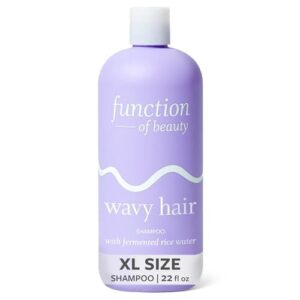
Function of Beauty’s Wavy Hair Shampoo brings fermented rice water into your daily wash routine — and that distinction matters. Fermentation boosts B and E vitamins while adding beneficial probiotics, making it more bioavailable than plain rice water.
The sulfate-free, paraben-free formula cleanses without stripping, and glycerin keeps moisture balanced. At $16.99 for 22 oz, it’s accessible.
One caveat: if you want pronounced curl definition, some users find, it softens wave structure more than it maintains it.
| Best For | People with wavy (type 2) hair who want a gentle, everyday shampoo that reduces frizz and adds softness without weighing waves down. |
|---|---|
| Rice Water | Fermented rice water |
| Vegan Formula | Yes |
| Paraben-Free | Yes |
| Hair Type | Wavy (Type 2) |
| Product Form | Shampoo |
| Cruelty-Free | Yes |
| Additional Features |
|
- Fermented rice water strengthens hair and boosts elasticity, which helps cut down on breakage over time.
- Sulfate- and paraben-free formula cleans without stripping moisture — good for daily washing.
- At $16.99 for 22 oz, you get a solid amount of product without a steep price tag.
- The fragrance runs strong — if you’re sensitive to scent, it might be a lot.
- Some users didn’t notice much difference compared to their regular shampoo.
- Can soften wave structure rather than define it, so it’s not the best pick if you want bold, bouncy waves.
4. As I Am Rice Water Hair Spray
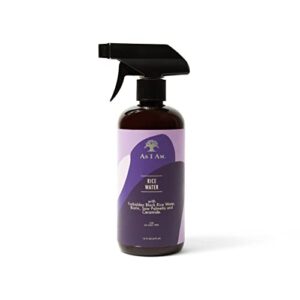
At just $9.00 for 16 oz, Rice Water Hair Spray punches well above its price point.
It’s built around forbidden black rice water — a more antioxidant-dense variety — paired with biotin, saw palmetto, inositol, ceramide, and copper peptides.
That combination targets moisture retention, shedding reduction, and scalp barrier support without protein overload.
The fine-mist spray works across all hair types, including braids and curls.
Daily use is safe, though don’t expect strong hold — this is hydration, not hairspray.
| Best For | Anyone looking for a lightweight, daily moisturizing mist that supports hair growth and works across all hair types — especially natural, curly, or protective styles. |
|---|---|
| Rice Water | Forbidden Black Rice Water |
| Vegan Formula | Yes |
| Paraben-Free | Yes |
| Hair Type | All types |
| Product Form | Leave-in mist |
| Cruelty-Free | Yes |
| Additional Features |
|
- Great value at $9 for 16 oz — hard to beat for a daily-use spray
- Solid ingredient lineup (black rice water, biotin, saw palmetto) that targets shedding and moisture without protein overload
- Fine-mist design works well for braids, curls, and twists without weighing hair down
- No hold whatsoever — if you need a styling spray, this isn’t it
- Some users felt it didn’t do much, calling it basically water
- Bottle seal issues have caused leaks, which can be a frustrating (and messy) problem
Frequently Asked Questions (FAQs)
What are the negatives of rice water for hair?
Rice water isn’t a miracle fix. Overuse can cause protein buildup, leaving hair stiff and brittle. Starch residue adds heaviness, and fermented batches can spoil, irritating a sensitive scalp.
Can rice water affect hair dye color?
Yes, rice water can affect dyed hair. Its pH and starch coating may influence how the cuticle behaves, which can impact color vibrancy and how quickly pigments fade.
How does rice water interact with scalp oils?
When you apply rice water, its starch and amino acids form a light coating on each strand.
This temporarily softens how scalp oils distribute, making hair feel less greasy and easier to manage.
Is rice water suitable for daily use?
Daily use isn’t always the kindest choice for your hair. Most people do best with one to two times per week — enough to see benefits without risking buildup or stiffness.
Can rice water change hair texture?
Yes, it can.
Rice water’s starch and amino acids coat the hair shaft, reducing friction and smoothing the cuticle.
You’ll likely notice softer, shinier strands with less frizz after just a few uses.
Does rice water influence hair porosity?
Porosity isn’t fixed — it shifts with every product you use.
Rice water’s amino acids and acidic pH temporarily flatten cuticles, making strands feel smoother and less porous, though the effect won’t last forever.
Can rice water replace regular conditioner entirely?
Rice water can’t fully replace conditioner. It lacks the film-formers and conditioning agents that deliver reliable slip, softness, and detangling. Think of it as a complement, not a substitute.
Does rice water expire faster in hot climates?
Yes, it does. Heat speeds up microbial growth, so your batch can turn sour much faster in warm conditions. Refrigerate promptly and discard anything that smells off.
Can children safely use rice water on hair?
Children’s scalps are more delicate than adults’, so gentle is the word here.
Rice water can be used on kids, but dilute it, limit use to once a week, and always patch test first.
Does rice water interact with hard or chlorinated water?
Hard and chlorinated water can both affect your results. Hard water leaves mineral residue that makes hair feel rough; chlorinated water dries strands and scalp.
Rinse thoroughly to minimize both effects.
Conclusion
The proof is in the pudding—centuries of practice backed by real science. Used correctly, rice water for hair delivers measurable improvements in strength, texture, and manageability.
Used carelessly, it causes protein overload and breakage. You now know the difference.
Start with the soaking method, limit applications to once weekly, and watch how your hair responds before committing further.
Small, consistent steps reveal the results that most people abandon too early to ever see.