This site is supported by our readers. We may earn a commission, at no cost to you, if you purchase through links. This content is for general informational and educational purposes only and is not a substitute for professional medical, dermatological, or nutritional advice.
Search "sea salt for acne" and you’ll find thousands of testimonials swearing by ocean dips and DIY salt scrubs. Here’s what those posts leave out: no clinical trial has ever tested sea salt against acne. Zero.
That gap matters, because your skin barrier doesn’t care about anecdotes, it reacts to chemistry. Sea salt does bring real minerals to the table, magnesium especially, and lab studies show some antibacterial punch at specific concentrations.
Below, you’ll get the actual evidence, safe application ratios, and where sea salt fits next to treatments that dermatologists actually trust.
Table Of Contents
Key Takeaways
- No clinical trials have ever tested sea salt against acne, so most claims rely on anecdotes and lab studies rather than real-world proof.
- Sea salt’s antibacterial effect only shows up at 7% concentration in labs, far stronger than the roughly 0.5% you’d ever use on your face.
- Used correctly (diluted, patch-tested, and followed by moisturizer), sea salt can offer mild exfoliation and oil absorption, but overuse risks drying out and damaging your skin barrier.
- Proven treatments like salicylic acid, benzoyl peroxide, and retinoids outperform sea salt for clogged pores, inflammation, and long-term acne prevention.
Does Sea Salt Help Acne?
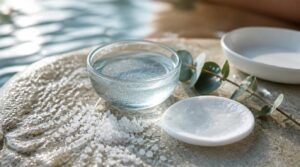
Sea salt gets a lot of credit online for clearing up breakouts, but the real picture is more mixed. Some of its effects hold up reasonably well, while others get oversold. Here’s what actually happens to your skin when salt touches it.
If you’re prone to irritation, choosing the best water softener salt for sensitive skin can make a bigger difference than the salt in your skincare routine ever will.
What Current Evidence Suggests
Does sea salt actually clear acne? The honest answer: evidence is thin. No randomized controlled trial has tested it, so claims rest on anecdotal reports and lab studies, not real-world clinical outcomes.
- No RCTs exist
- Lab data isn’t clinical proof
- Guidelines exclude sea salt
- Anecdotes lack controls
- Research gaps remain wide
That’s a real research gap worth knowing before you rinse.
Magnesium and Skin Inflammation
Where the anecdotes get more interesting is magnesium, sea salt’s main active mineral.
| Magnesium Role | Mechanism | Skin Effect |
|---|---|---|
| Anti-inflammatory | Regulates immune activity | Reduced redness |
| Barrier support | Cofactor for enzymes | Better hydration |
| Deficiency risk | Immune dysfunction | Worsened inflammation |
Bath studies show magnesium-rich soaks improve barrier function and calm inflammation, though results center on atopic skin, not acne specifically.
Exfoliation and Clogged Pores
Beyond magnesium, sea salt’s coarse texture works as a physical exfoliant, sloughing dead cells that clog pores. But surface scrubbing alone won’t clear debris lodged deeper. Skip pore strips and blackhead extraction tools; they irritate skin with little payoff.
For persistent buildup, a dermatologist can perform professional pore extractions using specialized tools to remove sebum plugs safely.
Gentle exfoliation paired with noncomedogenic cleansing does more for pore clearing than aggressive scrubbing ever will.
Oil Absorption and Dryness
Once your pores are clear, oil control becomes the next job. Sea salt pulls excess sebum through osmotic action, drawing moisture and oil to the surface during warm water application.
- Soak 15-20 minutes for best sebum extraction
- Use warm water (38-40°C) to open pores first
- Rinse cool to protect your skin barrier
- Moisturize immediately for post treatment hydration
- Limit sessions to prevent dry skin
Limits of Antibacterial Claims
Here’s where marketing gets ahead of the sea salt’s antibacterial properties only show up at 7% concentration in lab tests, far above the 0.5% you’d ever put on your face.
That said, sea salt’s real edge lies in its trace minerals—zinc, iron, and potassium—which is why so many people still turn to sea salt rinses for stronger hair growth rather than antibacterial claims alone.
Sea salt’s antibacterial power only appears at 7% concentration in labs, far above the 0.5% you’d ever apply to your face
| Setting | Effective Against C. acnes |
|---|---|
| Lab (7%) | Yes |
| Home rinse (0.5%) | No |
That’s the Concentration Threshold Issue, plus a narrow Bacterial Spectrum, real Clinical Proof Gap.
Choosing Sea Salt for Acne-Prone Skin
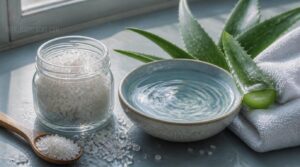
Not all sea salt works the same way on your skin. The type you choose affects how gentle or harsh your treatment ends up being. Here’s what to look for before you reach for a jar.
Dead Sea Salt Mineral Profile
Dead Sea salt isn’t your average sea salt. Its brine runs roughly 51% magnesium chloride, giving magnesium concentrations near 45,900 mg/L, about 40 times ocean levels. That’s why its antiinflammatory punch feels stronger.
It also carries a bromide rich brine, the highest of any surface water, plus calcium sodium balance skewed toward calcium. Seasonal composition changes mean mineral content shifts batch to batch.
Fine-Grain Unrefined Sea Salt
Grind size matters more than people assume. Fine-grain unrefined sea salt (0.2-0.5mm) offers greater surface area, dissolving in 20-30 seconds, gentler on your skin barrier than coarse crystals.
Solar evaporation preserves magnesium, calcium, and zinc that refining strips away. The 6-7% moisture content keeps crystals softer, reducing micro-tearing during exfoliation, ideal for acne-prone skin needing mineral benefits without harsh abrasion.
Himalayan Salt Benefits and Limits
Eighty-four trace minerals sounds impressive, but here’s the honest picture. Himalayan salt’s mineral content helps with pH balancing and mild anti-inflammatory effects, plus gentle exfoliation for clogged pores.
Even so, don’t expect miracles. Evidence stays limited, absorption reaches only your outer skin layer, and overexfoliation risks climb if you scrub too often. Treat it as a helper, not your main treatment.
Why Table Salt May Irritate
Chemically, table salt and sea salt are both sodium chloride, so why the different reaction on your skin?
Table salt irritation comes from processing, fine granulated crystals dissolve fast, creating concentrated sodium chloride effects on the surface. That triggers osmotic dryness and barrier stress. Anticaking additives add further risk.
Result: more skin irritation for sensitive skin, without the trace minerals that offset sea salt’s pH balance.
Avoid Fragrances and Additives
Check the fine print before you buy. Many sea salts get blended with "fragrance," "parfum," or essential oil mixtures, all common irritants for acne-prone skin.
Run a fragrance-free product check: scan labels for masking chemicals, since disclosure gaps mean blends aren’t always fully listed.
Pick unscented, organic ingredients only, then trust your own DIY sea salt spray for a truly gentle exfoliation.
How to Use Sea Salt for Acne Safely
Once you’ve picked the right salt, technique matters just as much. A good method protects your skin barrier while still giving you real results. Here’s how to work sea salt into your routine safely, step by step.
Diluted Sea Salt Face Rinse
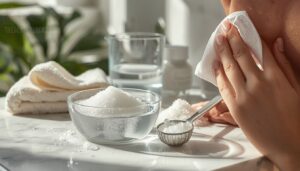
Once you’re ready to try it, keep the ideal salt ratio simple: 1 teaspoon fine sea salt per cup of cooled water. A room temperature solution protects pH balance and limits stinging.
Apply with a cotton pad using a gentle patting technique, never scrubbing. Follow a weekly rinse schedule of 1-2 uses, and moisturize right after for moisture retention.
DIY Sea Salt Spray Recipe
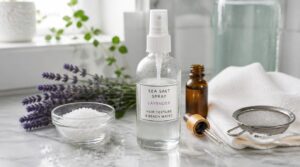
For targeted spots, a spray works better than a rinse. Mix 1 teaspoon fine sea salt per ½ cup warm water, cool completely, then add 5-6 drops lavender oil for extra antiinflammatory properties.
Strain through mesh, store in a glass bottle, and use within 2-3 weeks. Spritz onto clean skin, let dry, then moisturize.
Sea Salt Body Acne Soak

For back or chest breakouts, a full soak beats a spray. Add about 30 ounces of fine sea salt to warm bathwater and soak for 30 minutes, giving minerals time to work without over-drying skin.
Fine granules dissolve fastest, protecting your skin barrier from harsh scrubbing. Follow with a post soak moisturizer to lock in hydration.
Safe Application Frequency
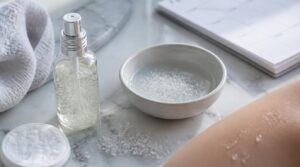
How often you reach for sea salt matters as much as how you use it. Oily skin tolerates daily mists; dry or acne-prone skin does better with once-daily spot use, max.
Weekly usage limits depend on skin type:
- Oily skin: daily, diluted
- Dry skin: 1-2x weekly
- Acne-prone: daily mist only
- Body: 1-2x weekly
- Eczema-prone: avoid entirely
Moisturizing After Each Treatment
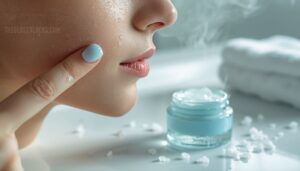
A salt rinse strips more than grime, it pulls moisture from your skin barrier. That’s why moisturizer isn’t optional here.
| Skin State | Moisturizer Type | Key Benefit |
|---|---|---|
| Damp | Hyaluronic acid | Barrier hydration boost |
| Post-treatment | Noncomedogenic moisturizer | Won’t clog pores |
| Compromised | Occlusive ingredients | Locks in hydration |
| Recovering | Ceramide-based | Post treatment recovery |
Apply within minutes, while skin’s still slightly damp, using damp skin application for better absorption.
Sea Salt Risks and Skin Barrier Damage
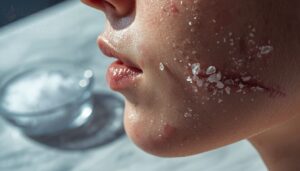
Sea salt isn’t risk-free, even when you use it correctly. Your skin barrier can take a hit faster than you’d expect, especially if you’re already prone to sensitivity. Here’s what to watch for before you reach for that shaker.
Signs of Over-Exfoliation
Your skin talks before problems show up, so listen closely. Watch for tightness after washing, a shiny or waxy look, or flaking that won’t quit. Products you once tolerated may suddenly sting. Even breakouts can spike.
These are classic signs of a stressed skin barrier, and they mean it’s time to pull back on exfoliation immediately.
Dryness, Stinging, and Redness
That burning feeling isn’t your imagination. Salt concentration effects matter here: solutions above 10% sting almost instantly, while diluted mixes near 5% feel tolerable.
Redness and dryness often follow, signs your skin barrier is under stress. For redness relief, cut back frequency and moisturize immediately after rinsing to support dryness management and faster barrier recovery.
Patch Testing Before Use
Never skip this step. Apply a pea-sized amount to your inner forearm, a dermatologist-recommended test location since skin thickness mirrors your face. Watch for 24 to 72 hours, checking at each interval for redness or itching. A negative result means no reaction at 72 hours. Any stinging or swelling signals skin sensitivity, so stop before it becomes real skin irritation.
Sensitive Skin and Eczema
If your barrier’s already compromised, sea salt makes things worse, not better. Eczema-prone skin runs alkaline (pH 6.0 vs. healthy 4.5-5.5), lacks 30% of normal ceramide NP, and loses water fast, TEWL often exceeds 15 g/m²/24h. Salt disrupts this further:
- Worsens transepidermal water loss
- Strips remaining ceramides
- Raises pH further
- Triggers flares
- Delays barrier recovery
Skip it entirely with eczema or rosacea.
Avoid Retinoids and Exfoliating Acids
Mixing sea salt with retinoids or exfoliating acids stacks two aggressive processes at once, and your skin barrier pays for it.
Space these out: use salt on off days, or wait several hours between products.
Prefer retinoid-free alternatives or acid-free skincare while your barrier heals.
Timing between products matters more than potency here.
Sea Salt Vs. Proven Acne Treatments
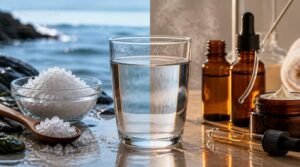
Sea salt has its place, but it’s not a replacement for treatments with real clinical backing. Once you know how it stacks up against options dermatologists actually recommend, you can decide where it fits in your routine. Here’s how it compares to the ingredients proven to get results.
Salicylic Acid for Clogged Pores
Salicylic acid outworks sea salt for one reason: it’s oil-soluble, so it slips into pores and dissolves buildup rather than just scrubbing the surface.
| Feature | Salicylic Acid | Sea Salt |
|---|---|---|
| Action | BHA exfoliation | Mechanical exfoliation |
| Best for | Blackheads, clogged pores | Mild surface buildup |
| Typical strength | 0.5%-2% | Not standardized |
Start low, watch for irritation.
Benzoyl Peroxide for Inflamed Acne
For inflamed, angry breakouts, benzoyl peroxide beats sea salt. It’s bactericidal against C. acnes, not just exfoliating. Concentrations of 2.5%-5% work as well as 10%, with less irritation.
| Feature | Benzoyl Peroxide | Sea Salt |
|---|---|---|
| Action | Kills bacteria | Mechanical exfoliation |
| Best for | Inflammatory lesions | Surface buildup |
| Start | Once daily | 1-2x weekly |
Moisturize after both.
Topical Retinoids for Acne Prevention
Where sea salt exfoliates, topical retinoids prevent the clog from forming. Adapalene or tretinoin bind retinoic acid receptors, cutting abnormal shedding inside follicles before microcomedones start.
| Retinoid Use | Detail |
|---|---|
| Start schedule | Every other day |
| Full effect | 12+ weeks |
Expect dryness early; irritation eases with tolerance building. They also fade hyperpigmentation, once inflammation calms, faster than salt ever could.
Building a Gentle Acne Routine
Retinoids and salt both have a place, just not on the same day. Build routines around order, not overlap.
| Step | Product |
|---|---|
| Cleanse | Low pH cleanser |
| Treat | Retinoid or salt (alternate) |
| Moisturize | Barrier repair cream |
| Protect | SPF (AM only) |
Evening cleanse, treat, then moisturize. Gentle exfoliation stays occasional, never stacked with actives.
When to See a Dermatologist
Know your limits before salt becomes your only tool.
Persistent acne that ignores DIY care needs real evaluation, not another home remedy.
| Warning Sign | Action |
|---|---|
| Severe outbreak | See dermatologist |
| Mole changes | Get checked now |
| Uncertain diagnosis | Don’t guess |
Skin cancer screening matters too. A dermatologist-recommended plan beats guessing at acne severity when irritation and sensitivity keep flaring.
Frequently Asked Questions (FAQs)
Can sea salt clear acne?
Don’t expect a cure. Sea salt can temporarily calm mild breakouts through mild exfoliation and oil absorption, but it won’t fix clogged pores or bacteria long-term, and overuse risks skin barrier damage and worse inflammation.
What naturally kills acne?
Options with real backing include tea tree oil (terpinen-4-ol against C. acnes), apple cider vinegar toner, zinc supplements, aloe vera gel, and a copper pillowcase.
Sea salt offers mineral content and mild antibacterial action, but weaker evidence for inflammation control.
How do Koreans clear acne?
Koreans lean on a double cleanse, oil cleanser then water cleanser, plus BHA exfoliation, cica soothing, and niacinamide sebum control. Sea salt isn’t part of that routine, though its mild exfoliation and mineral content offer a similar barrier-friendly approach.
Will salt draw out a pimple?
Picture a needle popping a blister, does salt really work that way? Not quite. There’s no true pimple fluid extraction happening, just osmotic desiccation, a temporary drying effect that shrinks surface swelling without draining the clog underneath.
Is it okay to put sea salt on your face?
Yes, occasionally and with caution. Keep salt concentration limits low, stick to gentle exfoliation, and always follow with a moisturizer to protect your skin barrier. Sensitive skin often reacts poorly, so patch test first or choose calmer alternatives instead.
What is sea salt acne therapy?
It’s a mineral-based skincare approach: diluted sea salt rinses, sprays, or soaks work as a natural exfoliator, easing inflammation and absorbing oil.
Long-term results stay modest though, and misconceptions about "curing" acne overstate what mineral absorption alone can realistically do.
Is Himalayan salt good for pimples?
Think of it as pink-tinted sea salt: same tool, different label.
Trace minerals offer mild anti-inflammatory support and gentle exfoliation, but Himalayan salt still risks dryness and skin barrier irritation if overused, without proven benefits beyond salicylic acid or benzoyl peroxide.
Does sea salt cause acne?
On its own, salt won’t trigger breakouts. But salt concentration matters: strong mixes cause osmotic drying, stressing your skin barrier. Sensitive skin reacts faster. Always patch test first, since mineral content varies between Dead Sea salt and other types.
Is Dead Sea salt good for acne?
Picture skin drawing calm from ancient mineral-rich water. Dead Sea salt carries 21+ therapeutic minerals, including concentrated magnesium, and shows more evidence for easing acne inflammation than regular sea salt, though it still demands patch testing and moderate use.
Does sea salt help with acne?
You’ll get modest results at best. It can absorb oil and offer light exfoliation, but strong antibacterial or anti-inflammatory claims aren’t backed by solid evidence, so it won’t outperform proven options like salicylic acid.
Conclusion
Here’s the twist your bathroom cabinet never tells you: the same ocean that calms your skin can wreck it in one careless soak.
Sea salt for acne works best as a supporting player, not a cure. Dilute it, patch test first, and pair it with proven actives like salicylic acid. Skip it during flares or retinoid weeks. Respect the ratio, respect your barrier, and you’ll get calmer, clearer skin without gambling on guesswork.