This site is supported by our readers. We may earn a commission, at no cost to you, if you purchase through links.
Your barber charges $30 per visit, and you go every three weeks. That’s over $500 a year walking out the door before you factor in tips and gas. Now imagine this: a solid clipper set costs around $50 and delivers dozens of cuts without scheduling headaches or small talk you didn’t ask for.
The benefits of cutting hair at home with clippers go beyond wallet relief. You’re claiming control over your schedule, sharpening a skill that builds confidence with every pass, and ditching the waste that comes with traditional salon trips.
Once you nail the basics, touch-ups happen on your terms—early mornings, late nights, whenever the mirror says it’s time.
Table Of Contents
Key Takeaways
- Cutting your own hair with clippers pays for itself within months and can save families over $1,000 annually while eliminating travel time, appointment hassles, and the constant coordination drain of salon schedules.
- Home clipping puts you in complete control of your grooming timeline and technique, letting you fix uneven spots immediately, experiment with styles on your terms, and build a practical skill that compounds in value with every session.
- DIY haircuts slash environmental waste by eliminating single-use salon products, chemical runoff, and unnecessary car trips while giving you full authority over hygiene standards through personal tool maintenance.
- Quality clippers with proper guards and blades, combined with consistent practice and a well-lit workspace, deliver professional-level results once you master basic techniques like sectioning, blade alignment, and overlapping passes.
Cost Savings of At-Home Haircuts
Cutting your own hair with clippers isn’t just about convenience—it’s about taking control of your wallet. Those $25 to $50 haircuts every few weeks add up fast, and investing in a decent clipper set can pay for itself in just a few months.
Let’s break down exactly where the savings come from and how much you’ll keep in your pocket over time.
Reducing Salon and Barber Expenses
Freedom from the barber chair starts with one number: $28 to $40 per visit. That’s what you’re dropping every few weeks, and it adds up fast.
Skip the salon for a year with DIY haircuts, and you’ll pocket anywhere from 20% to 60% of what you used to spend.
Factor in tips—usually 15% to 20%—and those savings strategies suddenly look even sharper.
Long-Term Value of Quality Clippers
Quality hair clippers deliver more than one-time savings—they’re built for the long haul. Professional-grade models run 6,000 to 12,000 hours, keeping blade longevity and motor efficiency strong across years of DIY haircuts.
Maintenance costs stay low, usually under $20 annually for oil and occasional blade sharpening.
With solid resale value and clipper durability that outlasts cheaper alternatives, cutting your own hair becomes a smart, sustainable investment in hair maintenance.
Affordable Maintenance and Upkeep
Keeping your clippers sharp and reliable won’t drain your wallet. Clipper blade care runs around $20 to $40 annually—just oil, cleaning spray, and occasional sharpening. Energy efficiency adds less than $2 yearly to your electric bill. Compare that to salon visits, and the budgeting tips write themselves. Maintenance costs stay predictable, tool longevity stretches your investment, and you’re in full control of your hair maintenance routine.
- Drop 2-3 drops of clipper oil after each session
- Clean blades with disinfectant spray every few cuts
- Sharpen or replace blades every 6-12 months
- Store guards properly to avoid cracks and breaks
Family-Wide Financial Benefits
Once you’ve got the maintenance rhythm down, multiply those savings across your whole household. A family of four spending $25 per haircut racks up $1,200 yearly at the salon—your clipper investment pays for itself in two months. That’s financial freedom through smart budget planning and cost analysis.
Check out how home haircuts slash household expenses and deliver serious financial benefits of DIY grooming:
| Family Size | Annual Salon Cost | Clipper Investment | Year-One Savings | Five-Year Savings |
|---|---|---|---|---|
| 1 person | $300 | $80 | $220 | $1,420 |
| 2 people | $600 | $80 | $520 | $2,920 |
| 3 people | $900 | $80 | $820 | $4,420 |
| 4 people | $1,200 | $80 | $1,120 | $5,920 |
| 5 people | $1,500 | $80 | $1,420 | $7,420 |
Cutting your own hair at home becomes a salon alternative that transforms household expenses into financial savings. Your savings strategies expand as each family member learns the ropes, turning one clipper set into a long-term ticket to financial freedom.
Convenience and Flexibility for Busy Schedules

You don’t need to rearrange your life around a haircut anymore. When you pick up the clippers and handle your own grooming, you’re taking back control of your schedule and your routine.
Let’s break down exactly how cutting at home gives you the freedom and flexibility most people don’t realize they’re missing.
Cutting Hair on Your Own Time
When you control the clippers, you control the clock. Cutting your own hair at home puts personal autonomy front and center, letting you trim whenever it fits your day. Flexible scheduling means no more reshuffling meetings or family time around salon hours, and you’ll see immediate results without appointment drama.
- Early morning touch-ups before important presentations become seamless
- Weekend experiments with guard sizes happen at your self pace
- Late-night quick fades align perfectly with irregular work shifts
- Spontaneous trims between professional visits keep your look sharp
- Home haircuts adapt to your rhythm, not a barber’s calendar
Time management improves when hair cutting happens on demand. You decide the timing, the length, and the technique—total mastery over your grooming routine.
Eliminating Travel and Waiting Times
Between salon drives and reception-area delays, you’re watching valuable hours evaporate. Home haircuts slash travel reduction and waiting elimination completely—urban dwellers reclaim 30 to 60 minutes per session, while rural folks dodge multi-hour commutes.
Cutting own hair delivers scheduling freedom and commute savings that compound fast, especially when families consolidate personal grooming under one roof. Time efficiency becomes your new normal.
Immediate Results and Touch-Ups
Precision becomes yours the moment you notice a stray tuft or uneven neckline. Same-day adjustments don’t wait for a barber’s calendar—you correct misalignments in fifteen to thirty minutes with the right guard and consistent haircutting techniques.
- Quick trims between full cuts keep fades fresh without scheduling hassles
- Hair adjustments fix growth asymmetry as soon as you spot it
- Fade maintenance stays crisp with weekly home styling sessions
- DIY touchups replicate salon results through practiced strokes
- Cutting own hair delivers reproducible outcomes when you follow proven methods
Home haircuts grant instant control over every detail.
Customizing Haircuts to Fit Your Lifestyle
Your daily rhythm shapes the cut you wear. Lifestyle cuts adapt to irregular work hours or weekend travel plans, letting you refresh custom fades in under thirty minutes without leaving home.
Using hair clippers enables adaptive grooming that shifts with hair trends and personal style, while consistent haircutting techniques give you control over personal grooming and hair maintenance and care when cutting hair at home.
Skill Building and Personal Confidence

Learning to cut your own hair isn’t just about saving money—it’s about taking the reins and owning a skill that builds real confidence. Each time you pick up those clippers, you’re sharpening your technique, understanding your hair better, and proving you don’t need someone else to look sharp.
Learning to cut your own hair builds real confidence and proves you don’t need anyone else to look sharp
Here’s how mastering home haircuts transforms your grooming routine and puts you in the driver’s seat.
Developing DIY Haircutting Techniques
Think of your first DIY haircut as a rough draft—it gets better every time you practice. Regular practice with technique-focused DIY tutorials cuts haircutting errors by 40% after just four weeks. Using hair clippers with a standardized cutting sequence—consultation, sectioning, elevation, tapering—reduces touch-ups by 30% on typical short cuts.
Master these fundamentals for precision trimming:
- Start with basic fades before attempting complex layers
- Practice scissor-over-comb and clipper-over-comb methods for 25% better segment control
- Use proper guard positioning and consistent hand angles
- Check your work frequently with dual mirrors
- Maintain clipper maintenance routines between sessions for sharp, even results
Cutting hair at home rewards patience. Measured audits show even trims improve from 60% to 85% within two months of consistent practice, proving that haircut maintenance and deliberate technique beat raw talent every time.
Gaining Control Over Personal Grooming
When you hold the hair clippers, you’re not just cutting hair—you’re claiming personal autonomy over your appearance. Studies show at-home grooming raises satisfaction by 20%, while consistent practice trims about 30 minutes per session. That’s haircut mastery and grooming freedom in action.
Home haircutting techniques with quality grooming tools transform personal grooming from obligation into a skill-building ritual, giving you the style empowerment professionals guard closely.
| Self Care Metric | Impact |
|---|---|
| Grooming confidence | Higher control over styling outcomes |
| Schedule adherence | 62% fewer missed appointments |
| Problem-solving speed | Uneven edges fixed in one session |
| Style empowerment | Complete independence from salons |
Creative Expression and Style Experimentation
Once you’ve gained grooming control, hair design becomes your creative outlet. At-home clipping unlocks style freedom—experiment with fades, textured crops, and sharp lines without salon commitment.
Multiple guards let you adjust for personal expression, refining haircutting techniques through trial and error. You’re not following fashion trends; you’re setting them, one creative cutting session at a time.
Environmental and Health Advantages

Cutting your own hair doesn’t just save money—it’s actually better for the planet and your health than you might think. Home clipping eliminates a surprising amount of waste and travel emissions while giving you full control over hygiene standards.
Let’s break down how your DIY haircuts create real environmental and health wins.
Reducing Waste From Salon Visits
When you cut hair at home with clippers, you’re choosing a smarter salon alternative that promotes green living. Traditional salon visits generate mountains of waste—single-use products, packaging, and chemical runoff that burden local water systems. Your home haircare routine eliminates these problems while delivering financial savings.
Here’s how your clippers support sustainable practices:
- Zero single-use materials – You won’t contribute to the 10% to 20% of urban solid waste that comes from salon operations in some areas.
- No chemical runoff – Home clipping with quality clippers means zero harsh dyes or treatments washing into your community’s water supply.
- Long-term eco-friendly investment – One durable clipper set replaces years of wasteful salon appointments, proving waste reduction and smart hair cutting go hand in hand.
Lowering Carbon Footprint From Travel
Your drive to the salon might seem minor, but short local trips multiply into hundreds of miles annually—boosting your household’s CO2 emissions with every appointment. By choosing eco-friendly clippers and sustainable grooming at home, you’ll achieve carbon offset naturally.
Here’s what travel reduction delivers:
| Trip Distance | Annual Salon Visits | CO2 Saved (lbs/year) |
|---|---|---|
| 5 miles | 12 | 60 |
| 10 miles | 12 | 120 |
| 15 miles | 12 | 180 |
| 5 miles | 24 | 120 |
| 10 miles | 24 | 240 |
Green haircuts at home transform your grooming routine into a salon alternative that respects the planet while sharpening your hair-cutting skills.
Safe and Hygienic Home Haircuts
Beyond shrinking your carbon footprint, home haircuts deliver health and safety precautions that salon equipment can’t always match. Proper sanitization methods—alcohol-based wipes on blades and guards—kill 99% of bacteria between uses, while dedicated clipper maintenance keeps your grooming and hygiene personal and controlled. Your infection control starts with simple steps:
- Wash your hands thoroughly before cutting own hair with clippers.
- Disinfect blades and guards after every session.
- Use a clean cape to prevent hair contact with skin.
- Store tools in a dry, dust-free space.
Personal hygiene practices like these transform your setup into a safer alternative than shared salon tools, giving you command over hair care and maintenance standards.
Choosing Sustainable Clipper Products
Eco-friendly materials like stainless steel or ceramic-coated blades give you clipper durability that outlasts bargain models by years, so corded models from brands like Wahl Elite Pro with green manufacturing standards and sustainable packaging become smart investments.
Energy efficiency ratings, blade materials designed for longevity, and regular clipper oil applications keep hair clippers running longer, reducing waste while you maintain full control over your grooming routine.
By using high-quality clippers, you can guarantee a methodological rigor in your maintenance process, leading to better performance and longer lifespan.
Essential Equipment and Pro Tips
You don’t need a barbershop full of gear to cut hair at home, but you do need the right essentials to pull off clean, consistent results. The tools you choose, how you set up your space, and the techniques you practice will make the difference between a rough DIY job and a cut that rivals what you’d pay for downtown.
Let’s break down what actually matters when you’re building your home setup and sharpening your skills.
Must-Have Tools for Home Clipping
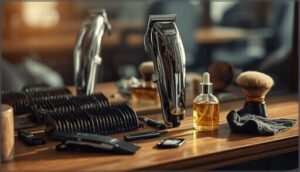
You can’t cut like a pro without the right gear in your corner. Start with high-quality hair clippers featuring durable metal or ceramic blades, paired with a complete set of clipper attachments and guard sizes.
Add a precision trimmer for detailed edges, plus cleaning kits with clipper oil and sanitizer for proper clipper maintenance. Quality tools make all the difference.
Selecting The Right Guards and Blades
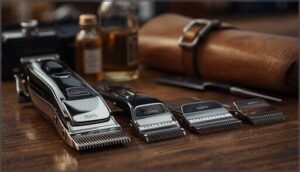
Guard size selection directly shapes your final hair length, with measurements ranging from 1.5 mm to 25 mm across clipper guide combs. Match guard sizes to your desired style: shorter for fades, longer for uniform trims.
Here’s what matters most:
- Blade material: Stainless steel offers durability, while ceramic stays cooler during extended cuts.
- Guard compatibility: Verify clipper attachments snap securely onto your specific model to prevent mid-cut detachment.
- Blade sharpening: Oil blades before and after each session to maintain edge performance and extend lifespan.
- Hair length testing: Start with longer guard sizes, then work shorter to avoid over-cutting mistakes.
Regular clipper maintenance keeps your tools sharp and reliable for years.
Setting Up a Comfortable Cutting Space

Your workspace makes the difference between a frustrating hack job and a clean cut. Position your station near a window for natural daylight, or install bright LED fixtures with a CRI above 90 to eliminate shadows.
Use an adjustable chair with non-slip footing for ergonomic seating arrangements, and organize clippers, guards, and combs on a level surface within arm’s reach.
Proper ventilation systems and storage solutions keep your personal grooming area hygienic and focused.
Key Techniques for Even, Professional Results

Blade alignment sets the foundation—check that your edges sit parallel before every session, because even a slight tilt creates uneven patches. Master sectioning strategies by working in vertical strips from nape to crown, lifting hair to the same elevation with your comb.
Guard selection matters for length consistency, while overlapping passes by half blend zones smoothly. Finish with light, grain-following strokes using hair clippers for professional polish.
Frequently Asked Questions (FAQs)
Can clippers work on all hair types?
Most hair clippers manage multiple hair types, but curly hair and thick textures need wider blades, proper clipper settings, and sometimes thinning tools. Blade quality matters when haircutting diverse hair textures.
How often should clipper blades be replaced?
You’ll want to swap out your blades every six to twelve months with regular use.
Watch for tugging, uneven cuts, or pulling—those are clear signs your clipper blades need replacing soon.
What mistakes do beginners make when self-cutting?
Like trying to paint without stepping back from the canvas, beginners often skip checking their work with mirrors.
Poor head positioning, rushing clipper technique, using one guard size everywhere, and ignoring safety precautions create uneven home haircut cutting errors.
Are cordless clippers better than corded models?
Neither type wins outright—your choice hinges on priorities. Cordless clippers offer ergonomic design and mobility, while corded models deliver uninterrupted motor performance.
Battery life and clipper durability shape long-term satisfaction differently.
How do you fix uneven spots yourself?
Spot correction starts with tapering tips and feathering methods. Use a guiding comb to blend surrounding hair toward the uneven area.
Lift your hair clippers slightly, creating gradual texture through controlled, overlapping passes for smooth results.
Conclusion
Imagine this: a client of mine ditched his barber after realizing he’d spent $640 in one year on basic fades. Six months into home clipping, he’s saved enough for a weekend trip and manages touch-ups between meetings.
The benefits of cutting hair at home with clippers aren’t just about money—they’re about reclaiming time, building a skill that compounds with every cut, and refusing to let your grooming routine live on someone else’s calendar.