This site is supported by our readers. We may earn a commission, at no cost to you, if you purchase through links. This content is for general informational and educational purposes only and is not a substitute for professional medical, dermatological, or nutritional advice.
Coconut oil slips 18.7 µm into your hair’s cortex. Almond oil never makes it past the surface. That single gap changes everything about how each one works.
One oil protects your strands from the inside and cuts protein loss. The other adds instant gloss and delivers 39 mg of vitamin E per 100 g to your scalp. Pick wrong, and you get greasy roots, clogged pores, or hair that still feels dry.
The almond oil vs coconut oil for hair debate has a clear answer, but it depends on your texture, your scalp, and your goals. Here’s how to match the right oil to your hair.
Table Of Contents
- Key Takeaways
- Almond Oil Vs Coconut Oil: Core Differences
- Benefits of Coconut Oil for Hair
- Benefits of Almond Oil for Hair
- Best Oil for Your Hair Type
- How to Use Almond and Coconut Oil
- Frequently Asked Questions (FAQs)
- Which is better for my hair, coconut oil or almond oil?
- Which oil is most powerful for hair growth?
- What is the best oil to put in your hair?
- What oils should not be used on hair?
- Can almond or coconut oil cause allergic reactions?
- Is it safe to use these oils on colored hair?
- How often should you apply hair oils weekly?
- Do these oils protect hair from heat styling damage?
- What are the side effects of overusing hair oils?
- Can you mix almond and coconut oil together?
- Conclusion
Key Takeaways
- Coconut oil’s small lauric acid molecules slip into the hair shaft and cut protein loss, while almond oil stays on the surface and gives you instant gloss and less friction.
- Pick coconut oil if your hair is dry, coarse, curly, or color-treated, and pick almond oil if your hair is fine or oily or your scalp is sensitive.
- Neither oil will make your hair grow faster, but both help you keep length by reducing breakage, so expect healthier-looking hair rather than new growth.
- Use oil sparingly on mid-lengths and ends, apply coconut oil before shampooing and almond oil as a light finisher, and patch test first, since too much leaves hair greasy and almond oil can trigger nut allergies.
Almond Oil Vs Coconut Oil: Core Differences
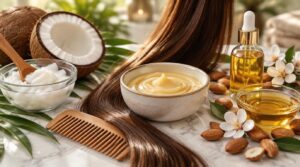
When you compare almond oil and coconut oil, the biggest difference is how each one works on your hair. Coconut oil is rich in lauric acid, a small, straight-chain fatty acid that slips past the cuticle and into the cortex. That’s why it protects against protein loss. Almond oil, built on bulkier oleic acid, stays on the surface and coats the strand.
If smoother, sleeker strands are your goal, this guide to using coconut oil for hair straightening shows how to get the most from that protective, penetrating effect.
Vitamin E tells a different story. Almond oil carries roughly 39mg per 100g, while coconut oil has just 0.1mg. That gives almond oil the edge for scalp health and antioxidant care.
Texture matters too. Coconut oil is thick, solid at room temperature, and high comedogenic risk for clogged pores. Almond oil is light, liquid, and absorbs without residue. Mixing two parts coconut oil with one part almond oil creates a pre-wash hair mask that combines shaft penetration with cuticle sealing.
Your hair type selection starts here.
Benefits of Coconut Oil for Hair

Coconut oil earns its spot in your hair routine for good reason. Below, you’ll see exactly how it works, who it suits, and how to use it. Read on and take control of your hair care.
Deep Penetration Into Hair
The size and shape of an oil’s fatty acids decide how far it travels. Coconut oil’s lauric acid is small and straight, so it slips through cuticle gaps for real hair shaft penetration. It reaches 18.7 µm into the cortex. Almond oil’s bent oleic acid stays on the surface.
Pick coldpressed, virgin coconut oil. Higher hair porosity boosts oil absorption.
Protein Loss Protection
Getting inside the shaft matters most for protein loss. Every wash strips keratin, and coconut oil slows that drain.
- Apply coconut oil before you shampoo.
- Coat strands from mid-length to ends.
- Wait 30 minutes.
- Skip almond oil for this job.
- Repeat weekly for lasting hair strength.
That pre-wash habit helps real hair repair. Almond oil just coats the surface instead.
Frizz
starts when raised cuticles soak up humid air. Coconut oil helps you fight back. A thin coat adds smoothness and cuts friction, so flyaways settle down.
Use a small amount on damp mid-lengths and ends. Too much leaves hair limp.
Your hair texture decides the winner. Coarse or curly strands love coconut oil. Fine hair? Reach for almond oil.
Shine
Radiance starts inside the strand. Coconut oil slows protein loss, so your hair keeps its natural sheen longer.
If frizz keeps creeping back despite your routine, this guide on why your hair gets so frizzy and poofy can help you pinpoint the cause.
Picture the payoff:
- Mirror-like lengths
- Soft, light-catching ends
- Calm, even smoothness
- Glossy color without dullness
- Healthy-looking movement
Almond oil gives instant gloss as a finisher. Coconut oil builds lasting hair shine from within. Use it before washing, and you’ll see the difference.
and Strength
Strength starts inside the strand. Coconut oil cuts protein loss, so your hair resists the weakening that leads to hair breakage prevention problems over time. That’s real, lasting support.
Almond oil works on the outside. It smooths friction, so combing stresses your hair less.
Both help hair elasticity. Use small amounts, though. Too much leaves hair stiff.
Antifungal Scalp Care
Picture flakes drifting onto your shoulders like unwelcome snow. Yeast is often the culprit, and coconut oil fights back. Its lauric and caprylic acids have real antifungal properties, disrupting yeast membranes. Massage it in before shampooing.
Almond oil soothes scalp inflammation but won’t fix yeast. Pair it with tea tree for antidandruff power. Severe cases need medicated treatment, not oil.
Best Hair Types
Coconut oil is a deep conditioner in a jar. It works best when your hair is thirsty.
- Thick hair that needs serious moisture
- Curly hair that craves definition
- Dry hair that feels brittle
- Bleached or color-treated strands
- Dandruff-prone scalps
Skip it if you have fine hair or oily hair. It can weigh strands down. Pick almond oil for lightness instead.
How to Apply
Great hair oil application starts with technique. Warm the oil, work it through damp lengths, then comb.
| Oil | Best Use |
|---|---|
| Coconut | DIY Coconut Hair Mask |
| Almond | DIY Almond Oil Scalp Serum |
Got fine hair? Use a drop or two. Layering with the LOC method? Oil goes second, sealing moisture before cream. Start small, because you can always add more later.
Benefits of Almond Oil for Hair
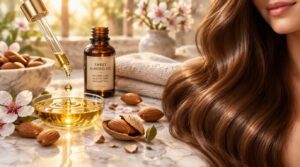
Almond oil is the lightweight option, and it works hard for your hair. Here’s what it can do for you, from surface moisture to scalp comfort. Read on and see which benefits match your goals.
Lightweight Surface Moisture
Want moisture without the heaviness? Almond oil delivers. Its oleic acid forms a light, hydrophobic film that fills gaps between lifted cuticle scales. Your hair gets smooth, glossy, and soft.
Coconut oil sinks deep. Almond oil stays mostly on the surface. That makes it ideal for fine hair, where hair hydration matters but buildup doesn’t.
Try 1-2 drops on damp hair.
Reduces Split Ends
Smooth hair snags less. That’s where almond oil earns its keep on split ends. It flattens frayed cuticles and cuts friction while you comb and style, so fewer new splits form.
Be realistic, though. Oil can’t fuse a split. Only a trim removes it.
Pair coconut oil deep conditioning with almond oil on your damp ends for steady hair nourishment.
Soothes Irritated Scalp
Your ends are covered. Now look at the skin underneath.
Almond oil is your go-to for scalp irritation. Its antiinflammatory action calms itch and redness, and it sits lightly on sensitive or eczema-prone skin. Massage a few drops in for two minutes.
Flaking from dandruff? Coconut oil’s antifungal edge fits better. Keep it off an easily clogged scalp. Your scalp health comes first.
Supports Hair Growth
Here’s the honest truth about hair growth. Neither almond oil nor coconut oil wakes up follicles. Your hair grows about 1 cm a month, whatever you put on it.
Neither almond oil nor coconut oil wakes up your follicles, because hair grows about one centimeter a month no matter what you apply
What oil does is protect length. Coconut oil’s lauric acid cuts protein loss, and almond oil reduces friction. Less breakage means more visible length. Oil won’t fix thinning, nor will biotin.
Suits Fine
Fine hair needs a light touch, and that’s where almond oil shines. Coconut oil can feel waxy on thin strands, but almond oil stays soft.
Check your hair porosity and oil absorption first:
- Apply to mid-lengths and ends only.
- Use 3–6 drops, nothing more.
- Limit it to once weekly.
- Expect better manageability without losing any volume at your fine roots.
Oily Hair
needs a light touch. Your scalp makes its own sebum, so adding scalp oil only piles more grease on top.
Keep almond oil or coconut oil on your mid-lengths and ends. Roots stay clean. Oil absorption is slow near the scalp, and heavy roots clump fast.
Pick almond oil for a lighter feel. Use coconut oil sparingly, before shampooing. Protect your scalp health.
Simple Application Methods
Warm a few drops of almond oil between your palms and smooth it over dry ends. That’s your easiest natural hair treatment.
- Use it as a hair serum on ends.
- Mix it into DIY recipes for a hair mask.
- Massage your scalp for five minutes.
- Leave it on overnight for softness.
In any hair oil comparison, almond wins on lightness.
Best Oil for Your Hair Type
The right oil depends on your hair, not on the trend. Your hair type and scalp decide which oil works for you and which one weighs you down. Here’s how to match your strands to the right pick.
Fine and Oily Hair

Fine, oily hair has one enemy: heaviness. Choose almond oil.
It sits on the surface, so it adds shine without weighing strands down. Its low comedogenic rating also protects your scalp health.
Skip coconut oil. It’s heavy and clogs easily.
Use just 2-3 drops, once every week or two. Your oil absorption stays balanced, and your volume stays put.
Dry, Coarse, or Curly Hair

Picture each curl bending like a tiny hinge, catching on every comb tooth.
Coconut oil suits dry, coarse curly hair best. Work a little through the lengths before washing to cut protein loss.
Almond oil works as a light finishing coat. It reduces friction and helps seal in moisturization. Pair either with water-based nourishment products. Use less than you think.
Sensitive Scalp Considerations
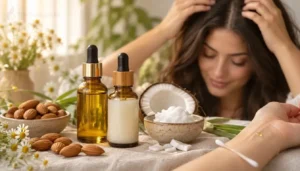
Sensitive scalp? Pick your oil carefully.
Almond oil is your safer starting point. It calms scalp inflammation and rarely clogs pores. Coconut oil brings antifungal properties, but it’s heavier.
- Patch test both oils for 24 to 48 hours.
- Use almond oil 2 to 4 times weekly.
- Limit coconut oil to once or twice weekly.
- Rinse after 30 to 60 minutes.
Protect your scalp health.
How to Use Almond and Coconut Oil

You know which oil fits your hair, so now it’s time to put it to work. The method matters as much as the oil, and the right technique makes all the difference. Here are two simple ways to use almond and coconut oil, starting with your pre-shampoo and leave-in treatments.
Pre-Shampoo and Leave-in Treatments
Pick your timing, then pick your oil.
Use coconut oil before shampoo for 30 minutes to overnight. Use almond oil as a light leave-in.
| Oil | Best use | Amount |
|---|---|---|
| Coconut oil | Pre-shampoo, curly hair | 1–2 times weekly |
| Almond oil | Leave-in, oily hair | 2–3 drops daily |
Keep every hair treatment light. Less works better. Overdo it and you’ll fight greasy buildup daily.
DIY Oil Blends and Masks
Once you know your timing, mix your own recipes. Combine one tablespoon of coconut oil with one teaspoon of almond oil for a balanced base.
- Warm the oils between your palms.
- Add two drops of an essential oil mix, like rosemary and lavender.
- Smooth through mid-lengths and ends.
This simple DIY mask fits any hair care routine.
Frequently Asked Questions (FAQs)
Which is better for my hair, coconut oil or almond oil?
Think of your hair as a lock and each oil as a different key. Coconut oil fits dry, coarse, or damaged strands. Almond oil suits fine hair and sensitive scalp health. Your hair type decides the winner.
Which oil is most powerful for hair growth?
Neither wins. No clinical evidence shows almond oil or coconut oil triggers new hair growth. Coconut oil, with its lauric acid, protects against protein loss, so you keep length. Almond oil, rich in vitamin E, just coats.
What is the best oil to put in your hair?
Studies show coconut oil cuts protein loss. Still, the best oil is the one your hair loves. Choose coconut oil for coarse strands, vitamin E-rich almond oil for fine hair. Expect nourishment, not hair growth.
What oils should not be used on hair?
Skip mineral oil, lemon oil, camphor oil, castor oil, and heavy olive oil. They clog pores, irritate your scalp, or weigh hair down. Mind your hair porosity, and never dab essential oil mix neat.
Can almond or coconut oil cause allergic reactions?
Picture a red, itchy patch creeping along your hairline after oiling. Yes, both can trigger reactions. Almond oil carries more risk if you have a tree-nut allergy. Coconut oil rarely does. Patch test first, but know it’s no guarantee.
Is it safe to use these oils on colored hair?
Picture Mia, freshly dyed copper, oiling her whole head on day one. Her color dulled fast. Wait three days. Then yes, almond oil and coconut oil work for hair care. Use a little on ends, strand test first.
How often should you apply hair oils weekly?
Think more oil means more shine? Not true. Consistency beats volume. Most hair needs oil one to three times weekly. Dry hair can handle three. Fine or oily hair? Once weekly, max.
Do these oils protect hair from heat styling damage?
Yes, but not equally. Almond oil holds up to heat styling better, since its higher smoke point means it won’t break down on your tools. Coconut oil works for low to moderate heat. Don’t lean on either for high temperatures.
What are the side effects of overusing hair oils?
Too much hair oil backfires. You’ll get greasy, limp hair, scalp buildup, itching, and clogged pores along your hairline. Washing harder to fix it dries your scalp and invites hair damage, split ends, and dandruff.
Can you mix almond and coconut oil together?
Coconut oil turns solid below about 24°C, so warm it first. Then yes, mix it with almond oil.
Both natural oils mix easily, though no proven hair care ratio exists. Skip the essential oil mix.
Conclusion
Coconut oil works from the inside. Almond oil works from the outside. Neither is better, and both are right for someone.
Settle the almond oil vs coconut oil for hair question by reading your strands. Fine, oily, or sensitive? Reach for almond oil. Dry, coarse, or curly? Choose coconut oil. Still unsure? Mix them.
Test a small amount, watch how your hair responds, and adjust. Your hair already knows the answer. Now you do too.