This site is supported by our readers. We may earn a commission, at no cost to you, if you purchase through links. This content is for general informational and educational purposes only and is not a substitute for professional medical, dermatological, or nutritional advice.

Frosted tips died in the 90s and came back stronger, cleaner, and way easier to mess up than people think. One wrong move with bleach and you’re stuck explaining a chemical burn or a patchy orange mess to your barber. That’s the gap between a fresh, editorial look and a bathroom disaster: prep, technique, and timing.
Most guys skip straight to slapping bleach on and hoping for the best. Healthy hair with the right porosity lifts evenly; damaged hair snaps, breaks, or grabs color unevenly.
Get the fundamentals down (strand tests, developer strength, timing) and you’ll pull off frosted tips at home that look like you dropped $150 at a salon.
Table Of Contents
- Key Takeaways
- Prepare Men’s Hair for Frosted Tips
- How to Do Frosted Tips on Men’s Hair
- Tone Frosted Tips for Clean Color
- Maintain Frosted Tips and Prevent Damage
- Best Frosted Tips Styles for Men
- Frequently Asked Questions (FAQs)
- Are frosted tips in style for men?
- What is the 3:2:1 rule for haircuts?
- What do you need for frosted tips?
- Can you do frosted tips without a cap?
- Can you do frosted tips at home?
- What are frosted tips for men?
- What products are needed for frosted tips?
- Can I use frost and tip without the cap?
- Can I do frosted tips at home?
- What products do I need for frosted tips?
- Conclusion
Key Takeaways
- Your prep work matters more than the bleach itself, so test your hair’s porosity and strength (aim for 30% elongation) before you even think about mixing anything.
- Run a hidden strand test near your nape first, since that 5-7 minute trial run tells you exactly how your real application should go.
- Match your toner to your brass: purple cancels yellow, but blue-violet is what you need for orange or copper streaks.
- Your aftercare routine decides whether those tips stay sharp or turn to straw, so wash just 2-3 times a week, deep condition weekly, and keep heat tools capped at 350°F.
Prepare Men’s Hair for Frosted Tips
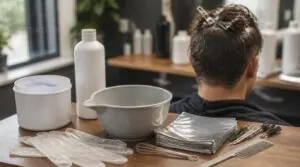
Frosted tips live or die on the prep work, not the bleach itself. Skip a step here and you’re rolling the dice with your hair’s health. Here’s exactly what you need to check and gather before you mix a single thing.
Assess Hair Color and Texture
Before you touch bleach, read the hair. Check natural color level, since darker strands need more lift time. Run a quick texture pattern check and porosity assessment:
If your ends still look patchy after all this prep, this guide to fixing uneven bleached hair walks you through evening out the tone safely.
- Straight, wavy, curly, or coily
- Fine, medium, or coarse diameter
- High or low porosity
- Density across the tips
- Undertone (yellow vs orange risk)
Porosity is especially important to test carefully, since sliding your fingers along a dry strand toward the scalp reveals hair porosity levels that determine how the hair will absorb and process the bleach.
This shapes your whole plan.
Check for Damage or Breakage
Once you know the texture, check the strength. Grab a strand and gently stretch it, healthy hair hits 30 percent elongation and snaps back fast. Under 10 percent means stop, damage’s too deep for bleach right now.
Scan for lifted cuticles, thinning patches, or tinsel-like breaks too. These are red flags your hair can’t take lightener yet.
Choose Bleach and Developer Strength
Passed the strength check? Good. Now pick your weapon: developer strength decides how fast and how far you lift.
- 20 volume: safe workhorse, lifts 3-4 levels
- 30 volume: faster, riskier on scalp
- Fine hair: stick low, it overlifts quick
- Coarse or porous strands: adjust up or down
Mix bleach powder at a strict 1:2 ratio for even consistency.
Perform a Hidden Strand Test
Got your developer picked? Time to test it before it touches your whole head.
Grab a hidden strand near the nape, isolate it, and mix bleach powder with 20 volume developer. Process 5-7 minutes, checking every 2. Record the timing. Too fast? Cut bleach concentration by 5%. Too slow? Bump the developer up. That data drives your real application.
Gather Tools and Protective Gear
Chemistry gear beats a bathroom towel raid. Grab nitrile gloves, safety goggles, and a smock before anything else, plus a mixing bowl, plastic spoon, tinting brush, and widetooth comb.
- Splashed bleach on bare skin
- Fumes stinging your eyes
- Ruined shirts you actually liked
- Burning scalp with no barrier cream
- Rushed mixing without a respirator
Apply barrier cream along your hairline. Optional respirator for mixing days.
If you’re new to color correcting, this guide to neutralizing red and brassy tones at home walks through picking the right ash level for your strand test results.
How to Do Frosted Tips on Men’s Hair
Prep’s done, so now it’s game time. This is where you actually put bleach on hair, and every step matters for getting clean, even tips. Here’s exactly how to run the process, start to finish.
Protect Skin, Hands, and Clothing
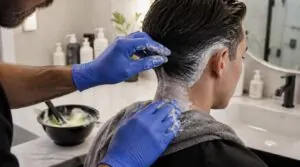
Bleach doesn’t care about your skin, so gear up before you touch the mix. Snap on latex gloves, throw on an apron or old tee, and smear barrier cream along your hairline and neck for scalp protection.
Grab a plastic spoon and mixing bowl instead of metal, plus conditioner nearby for post-rinse care. Chemical handling safety starts here, not after.
Choose Cap or Comb Application
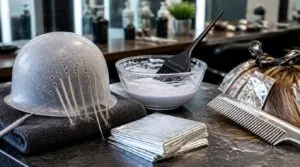
Before mixing anything, decide how you’re getting bleach onto those tips.
The cap method pulls strands through numbered holes for fine, controlled highlights and faster drying, ideal for short hair.
The comb method offers section flexibility and reduces scalp exposure, working better on longer or curly hair where caps just don’t fit.
Mix Bleach to Proper Consistency
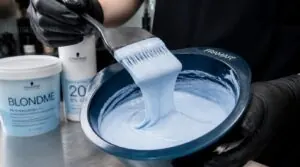
This step makes or breaks your lift, so don’t rush it. Grab a non-metallic bowl (metal reacts with bleach), and mix powder with 20-volume developer at a 1:1 or 1:2 ratio. Use cool water only if thinning, never to mix. Stir until you hit a pancake batter consistency. Run your brush through it: it should level back slowly, no separating liquid.
Apply Bleach to Exposed Tips
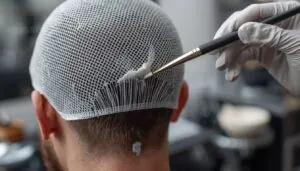
Now the fun part. Isolate your tips using the frosting cap or comb method, pulling only exposed ends through.
Load your brush and paint bleach in thin, even strokes, working bottom-up. Never touch the roots. Keep strokes uniform so lift stays consistent tip to tip, and don’t overlap previously bleached sections.
Monitor Lift and Rinse Promptly
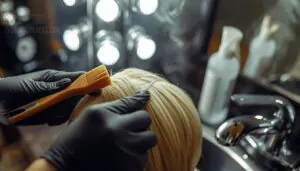
Set a timer, but don’t trust it blindly. Check lift progression every 10 minutes, watching for pale yellow.
Hair feels weak or stretchy? Stop processing early, no exceptions.
Rinse when you hit your target shade. Emulsify before rinse with a quick water massage, then rinse with lukewarm water. Never exceed 45 minutes processing time.
Tone Frosted Tips for Clean Color
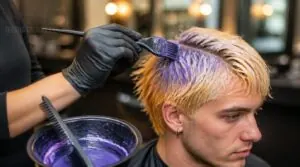
Bleach lifts your hair, but it rarely lifts it evenly, so you’re bound to see some warmth show up. That yellow or orange isn’t a mistake, it’s just your next step calling. Here’s how to read those tones and knock them out for good.
Identify Yellow or Orange Brassiness
Before you tone anything, check what you’re actually working with, because brass shows up different depending on how far you pushed the lift.
- Yellow in low light
- Orange or copper streaks
- Dull, glassy shine
- Warmer roots vs. tips
- Brass worse on porous ends
Spot yellow brassiness fast, judge severity, then pick your fix.
Choose Purple or Blue-Violet Toner
Yellow tips call for purple toner, it cancels warm gold tones and leaves a cool, neutral finish.
Orange or copper streaks need blue-violet toner instead, since blue counteracts red-orange better than purple can.
Match your undertone to the right pigment. Guess wrong and you’ll fight brassiness for weeks instead of days.
Mix Toner With Developer Safely
Grab a clean bowl and check your ratio, most toners run 1 part toner to 2 parts developer. Wear gloves, protect skin, mix at room temp until creamy. Never store leftovers, discard after use.
- Weigh precisely
- Rinse tools first
- Room temp only
- No lumps
- Use fresh batch
Avoid Over-Toning and Ashiness
Timing makes or breaks this step. On level 9-10 hair, process for 5-8 minutes max, never past 15. Test a strand first, apply to damp hair, and rinse the second warmth returns but yellow’s gone. Porous strands grab pigment fast, so dilute your formula. Overdo it and you’re stuck with dull ash blonde instead of clean frost. Purple shampoo fixes minor brassiness later, not this mistake.
Rinse and Deep Condition
Once toner’s rinsed, switch to a cool water rinse on your tips only, sealing porous strands shut.
Apply deep conditioner to damp ends, focus contact on lightened tips, and let it sit 5-10 minutes.
Rinse out fully so no residue lingers. This postbleach conditioning step restores softness before styling.
Maintain Frosted Tips and Prevent Damage
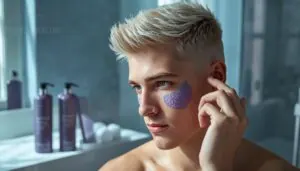
Bleaching does the damage, so your routine after decides whether those tips stay sharp or turn to straw. This isn’t complicated, but it does mean breaking a few bad habits you might already have. Here’s exactly what your hair needs from here on out.
Limit Washing to Three Times Weekly
Fresh bleach hates overwashing. Stick to 2-3 washes weekly, using sulfate-free shampoo, gentle 45-second scalp massage, and lukewarm water (32-38°C).
Rinse until it runs clear, then blow-dry fully. This wash frequency protects lift, prevents fading, and keeps your scalp balanced, so your tips stay bright without the damage overwashing causes.
Use Purple Shampoo as Needed
Brassiness creeps in fast on lightened tips, and purple shampoo is your fix. Use it 1 to 3 times weekly, leaving it on damp hair for 2-5 minutes depending on tone:
- Platinum or porous hair: 1 minute max
- Stubborn brass: up to 5 minutes
- Wet hair fully first
- Rinse cool to lock in tone
Pair with hydrating conditioner after.
Deep Condition Bleached Ends Weekly
Bleach strips moisture fast, so your ends need weekly backup. Alternate a hydrating mask with a protein treatment to rebuild strength without stiffness.
Look for keratin, hyaluronic acid, or shea butter on the label, real repair ingredients, not filler. Apply to damp hair, leave 10-30 minutes, then rinse cool to seal the cuticle and lock in that shine.
Limit Heat and Apply Protectant
Heat and bleached hair don’t mix well, so keep your tools in check. Apply protectant to damp strands before blow drying, dry hair before flat ironing.
- Cap tools at 350°F
- Hold blow dryers 6 inches back
- Choose ceramic for even heat
Ceramic plates cut damage, protect moisture balance, and keep your frosted tips looking sharp, not fried.
Plan Touch-Ups or Grow-Out
Your hair grows about half an inch a month, and that’s the clock you’re working with. Book touch-ups every 4-6 weeks, sooner for bold contrast, later for subtle frosting.
Hair grows half an inch a month, that’s the clock deciding your next touch-up
| Style | Touch-Up | Grow-Out |
|---|---|---|
| Bold | 4 weeks | 3 haircuts |
| Subtle | 6-10 weeks | Gradual fade |
| Seasonal | Slower in winter | Refresh in summer |
Best Frosted Tips Styles for Men
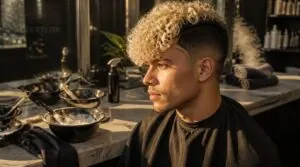
Frosted tips aren’t one-size-fits-all, so your hair type and personality should call the shots. Whether you’re rocking curls, an undercut, or just want to test the look without commitment, there’s a version built for you. Here are five ways to wear it, so you can find your fit.
Short Brushed-Up Frosted Tips
If your hair sits short and you like it brushed forward, this style delivers max contrast for minimal fuss.
Use a strand test first, mix bleach powder with 20 volume developer, and apply only to exposed tips with a narrow brush.
Tone out brass, then brush up with matte pomade for lift that actually holds.
Frosted Undercut and Faux Hawk
Want more edge? Pair frosted tips with an undercut fade for serious contrast between skin and color.
Shave the sides, fade them clean, and let a faux hawk crest run 1-5 inches down the center. Run your strand test, mix bleach powder with 20 volume developer, and load only the crest tips using a frosting cap for control.
Asymmetrical Blonde Tips
Split the part, bleach one side only. That’s the whole game with asymmetrical blonde tips.
Use selective foiling technique on 3-5cm of tip length for asymmetry contrast, 20-volume developer, then tone. Style tousled, not neat.
Touch up every 4-6 weeks. Apply heat protectant before styling, always.
Frosted Tips for Curly Hair
Curls change the math. Bleach only the outer curl tips, since coils naturally shield mid-lengths, keeping contrast crisp without frying your roots.
Sectioning techniques matter most here, part small, work slow. Watch bleach processing time closely, curls lift fast and uneven.
- Run a strand test first
- Section curls before applying
- Check lift every 5-10 minutes
- Tone for clean color
- Deep condition for curl definition maintenance
Bleach-Free Temporary Tip Options
Not ready to commit to bleach? Test frosted tips risk-free first.
Temporary color sprays and coloring waxes coat tips instantly, rinsing out after one wash. Temporary chalks and plant-based tints deposit bold hues that fade fast. Non-bleach lighteners with foils lift color slightly, damage-free.
| Method | Lasts |
|---|---|
| Sprays/chalks | 1 wash |
| Waxes/tints | Days |
| Non-bleach lighteners | Weeks |
Frequently Asked Questions (FAQs)
Are frosted tips in style for men?
Yes, and they’re back like an old playlist you forgot you loved. Frosted tips resurgence is real, fueled by celebrity influence and social media impact, blending fades, quiffs, and textured crops with cool blonde accents.
What is the 3:2:1 rule for haircuts?
It’s clipper guard shorthand: a 3 on top, 2 on the sides, 1 around the neckline. That tapered gradient sets the stage perfectly before you layer on frosted tips for extra contrast up top.
What do you need for frosted tips?
Don’t put the cart before the horse: grab bleach powder and 20-volume developer, a mixing bowl, gloves, barrier cream, a frosting cap or tint brush, plus a strand test kit first.
Can you do frosted tips without a cap?
No cap needed. Try freehand painting with a tint brush, foil-based sectioning, or comb-through application for natural tips. Precision brush painting gives you control without the cap method, still nailing clean, targeted bleach placement on your ends.
Can you do frosted tips at home?
Definitely doable in your bathroom. Grab a bleach powder kit, comb, and gloves, run a strand test first, then use the comb method on short cuts, since upright hair sections easier for beginners than you’d think.
What are frosted tips for men?
Frosted tips bleach only your ends into pale blond, leaving roots dark for bold contrast. Born in the 90s, this hair lightening trend spikes up with gel, delivering an edgy men’s look that’s making a serious comeback.
What products are needed for frosted tips?
Less can mean more: a full kit is small but mighty. Grab bleach powder, 20-volume developer, a highlighting cap, purple or blue-violet toner, barrier cream, a glass mixing bowl, and hydrating aftercare products.
Can I use frost and tip without the cap?
Yes, ditch the cap and go freehand. Section dry hair with foil, paint tips using a tint brush for precision, and control intensity strand by strand, subtle to dramatic frosting, all without capless coverage headaches.
Can I do frosted tips at home?
Absolutely, DIY frosted tips work with a frosting cap and bleaching kit. Run a strand test first, pick the right developer strength, and respect processing times. It’s budget-friendly and safe for short to medium hair when done carefully.
What products do I need for frosted tips?
Grab bleach powder with 20-volume developer, a frosting cap, tint brush, and mixing bowl. Add barrier cream, gloves, purple toner, and a color-safe aftercare pack, your kit’s the difference between salon results and a bathroom mishap.
Conclusion
Bleach doesn’t forgive guesswork, but preparation turns risk into reward. You now know how to do frosted tips on mens hair without gambling your color or your confidence. Test strands, mix carefully, tone with purpose, and rinse the second you hit that perfect gold. Your ends carry the proof of patience, not panic. Keep conditioning, keep watching your porosity, and those tips will stay sharp, bright, and unmistakably yours. That’s the real payoff: control.