This site is supported by our readers. We may earn a commission, at no cost to you, if you purchase through links.
A beard can look sharp in the mirror, and crooked ten minutes later once the hairs settle. That’s why plenty of men get better results with scissors than with a trimmer guard that chops off more than planned.
Beard scissors let you sneak up on the shape, clean the cheeks, soften bulk, and keep texture intact instead of leaving the ends rough and frayed. If you want to learn how to trim a beard with scissors without turning your sink into a regret factory, the trick starts with setup, patience, and a few small snips in the spots that matter.
Table Of Contents
- Why Use Scissors for Beard Trimming
- How to Trim a Beard With Scissors
- Wash, Dry, and Detangle The Beard First
- Comb Downward to Reveal Uneven Hairs
- Start at The Chin as Your Guide Point
- Move Up to The Cheeks With Small Snips
- Use Scissor-over-comb for Bulk Control
- Trim The Mustache Without Cutting Too High
- Define The Neckline With a Natural Curve
- Re-comb and Check Symmetry From Both Sides
- Tools You Need Before Trimming
- Trim Short and Long Beards Correctly
- When You Shouldn’t Use Scissors
- Finish The Trim and Maintain It
- Frequently Asked Questions (FAQs)
- Can a beard cause sinus problems?
- How to trim your beard and neck for a short boxed beard?
- Are beard trimming scissors the same as regular scissors?
- What are the best scissors for a beard & mustache?
- Can you trim a beard with just scissors?
- How do you trim a beard for beginners?
- What is the two finger rule for beard?
- How to set a beard at home without a trimmer?
- Is it OK to trim beard with scissors?
- What not to do when trimming a beard?
- Conclusion
Why Use Scissors for Beard Trimming

Regarding shaping your beard, scissors offer a level of control that’s hard to beat. They’re not just for barbers—anyone can use them to get the look they want at home.
If you want tips on mastering this technique, the beard trimming guide at The Glossy Locks breaks down how scissors can elevate your grooming routine.
Here’s what makes scissors such a smart choice for trimming your beard.
Precision for Shaping and Thickness Control
When you want barberlevel precision, scissors let you sculpt every detail—think Tip Angle Control for crisp edges and Sectional Snip Consistency for even thickness.
Here’s how you master precision beard trim:
- Layered Thickness Mapping
- Comb Lift Blending
- Visual Guide Lines
- Edge detailing
- Beard density control
Finish with posttrim conditioning for a healthy, polished look.
Safer Gradual Trimming Than Taking Off Too Much at Once
Precision is great, but speed is the enemy here. Each Incremental Snip removes only what’s necessary, so you stay in control.
Use Dry Settling—let your beard rest between passes—so you’re not chasing length that was never really there.
The Comb Breakpoint keeps your guide consistent, the Symmetry Loop keeps both sides honest, and Gradual Bulk removal prevents overtrimming before you even realize it happened.
Better for Preserving Texture and Minimizing Split Ends
Sharp scissors aren’t just about control — they’re your first line of defense for Split End Prevention and Texture Retention. A dull blade crushes hair instead of slicing it cleanly, leaving jagged edges that split faster.
Focus on Controlled Snip Pressure and Blade Angle Optimization to protect each strand.
Use Sectional Length Guides for hair texture preservation, and pair it all with a solid post-trim beard care routine.
How Scissors Compare With Trimmers and Clippers
Think of it as Speed vs Accuracy — clippers clear bulk fast, but scissors give you the control to sculpt. Trimmers sit somewhere in the middle.
For Skin Irritation Risk, scissors win hands down; they never drag a blade across your skin.
Yes, there’s a Learning Curve, but the Benefits of using beard scissors over electric trimmers — precision, texture, Cost Efficiency — make it worth it.
Beard Lengths and Hair Types Scissors Handle Best
Scissors shine brightest on beards with a story — curly, wavy, or coarse textures where clippers leave blunt patches.
Wavy Beard Control and Coarse Hair Management both come down to working with your hair’s natural path, not against it.
Whether you’re shaping a long beard or refining a short beard, the Length Gradient Technique and Bulk Reduction Strategy let you dial in Fine Hair Precision that no clipper guard can match.
How to Trim a Beard With Scissors
Now that your beard is clean, dry, and combed out, the real work begins. Trimming with scissors isn’t complicated, but doing it in the right order makes a big difference in the final result.
Here’s exactly how to work through it, step by step.
Wash, Dry, and Detangle The Beard First

Before a single snip, your beard needs a clean slate. Pre-Trim Cleansing with a dedicated beard shampoo removes oil buildup and lets hair fall at their true length.
After rinsing, Gentle Towel Drying by blotting — never rubbing — keeps strands straight. Finish with Conditioner Application to soften coarse hair, then Wide-Tooth Detangling from ends upward for clean Hair Alignment before cutting.
Comb Downward to Reveal Uneven Hairs
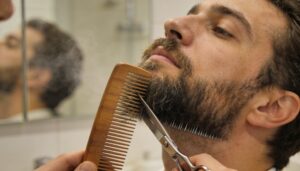
Once your beard is clean and dry, grab your Beard Comb and work it downward with Even Tension — not too hard, not too light.
This Downward Comb Angle lifts the Hair Grain Visibility, exposing Spotting Hidden Strays that clump beneath longer hairs.
It creates a natural Reference Line Creation for your scissor technique, making trimming a beard with scissors far more accurate.
Start at The Chin as Your Guide Point
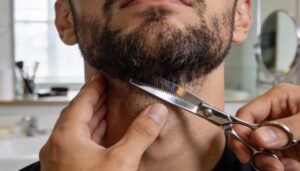
Your chin is the anchor for everything. Start at the chin as your first cut — this is your Length Matching Technique in action.
The Chin Baseline Benefits are real: it gives your Beard Scissors a flat, stable reference for Angle Consistency Tips and a natural Symmetry Check Method. Set that foundation right, and the rest of your step‑by‑step guide to trimming a beard with scissors flows naturally upward.
Move Up to The Cheeks With Small Snips
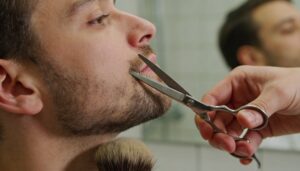
Once your chin’s locked in, work upward with Cheek Angle Control — hold your grooming scissors at a slight angle and let Snip Timing Rhythm guide you. No rushing.
- Use Sectioning By Zones: left cheek, right cheek, separately.
- Density Snipping keeps sparse patches from thinning out further.
- Flyaway Management ends with a quick brush across the cheek line.
Small snips win every time.
Use Scissor-over-comb for Bulk Control
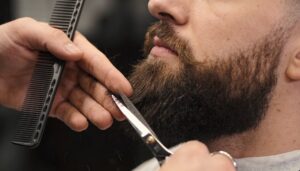
Think of the scissor-over-comb technique as your built-in guard height — the comb controls exactly how much hair your beard scissors can reach.
Hold your beard comb at a slight comb angle, lift sections steadily, and take small Pass Increments with each snip.
Snag Prevention starts with detangling first.
Work in Section Passes, side to side, for even bulk removal every time.
| Comb Position | Guard Height Effect | Pass Increment |
|---|---|---|
| Flat against beard | Minimal removal | Light cleanup pass |
| Slight upward angle | Moderate bulk reduction | Standard trimming pass |
| Higher lift | Deeper length removal | Heavy reduction pass |
Trim The Mustache Without Cutting Too High
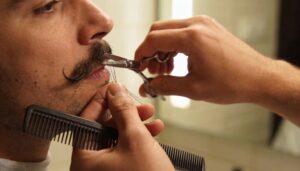
Now the mustache deserves its own careful moment. Comb the hair downward, then use Finger Pinch Guidance to isolate strays.
Lip Line Alignment your anchor — hair should sit just above it, never covering it.
Rely on Incremental Snipping, removing under 2mm per pass. Mustache Height Gauge stays consistent when you pause, check, and use Edge Shift Control to blend toward your cheek line naturally.
Define The Neckline With a Natural Curve

Now that the mustache is handled, the neckline is where many guys lose the plot. Use your Adam’s Apple Reference as a starting point — set your line a finger-width or two above it.
Jawline Alignment matters here: follow a natural curve, not a straight slash.
Use Skin Gap Identification to spot where the beard thins, then trim conservatively.
A Curved Mirror Check and Symmetrical Height Adjustment keep both sides honest.
Re-comb and Check Symmetry From Both Sides
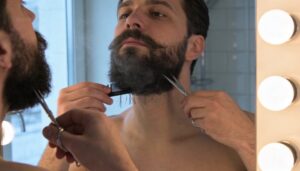
With the neckline curved and clean, don’t put the scissors down just yet. Re-comb both sides using the same Comb Stroke Count and direction — that’s your Dual-side Comb check. Use your mirror with good lighting for a Mirror Angle Check from the front and a slight angle.
- Align your Reference Line Alignment at the chin center
- Confirm Symmetry Markers at both cheek line trimming points
- Compare the sides of your face at eye level
- Trim consistency means cutting only stray hairs — nothing more
Tools You Need Before Trimming
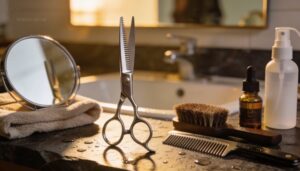
Before you touch a single hair, make sure you’ve got the right tools lined up — because the wrong ones will cost you more than just a bad trim. A sharp pair of dedicated beard scissors is the foundation, but there are a few other must-haves that separate a clean result from a frustrating one.
Here’s exactly what you need before you start.
Choosing Sharp Beard Scissors Over Household Shears
Grabbing regular kitchen scissors from the drawer might seem harmless — but those blades weren’t built for beard hair.
| Feature | Beard Scissors | Household Shears |
|---|---|---|
| Blade Material | SUS440C stainless steel | Low-grade mixed steel |
| Edge Geometry | Convex, hair-shearing edge | Flat grind, fabric-focused |
| Pivot Tension | Adjustable for control | Fixed rivet, no fine-tuning |
| Corrosion Resistance | High — tolerates oils and moisture | Prone to rust and staining |
| Ergonomic Grip | Offset, finger-fitted rings | Bulky, general-purpose handle |
Purpose-built beard scissors deliver sharpened scissors precision that household shears simply can’t match. Maintaining sharpness of grooming scissors matters too — scissor sharpening keeps your cuts clean and your skin irritation‑free.
Using a Wide-tooth and Fine-tooth Comb
Having two combs isn’t overkill — it’s strategy.
Start with your wide-tooth comb for Bulk Reduction Technique and Snag Minimization Tips; its spaced teeth glide through tangles without yanking.
Then switch to your fine-tooth comb for Precision Edge Alignment and Sectioning With Comb, exposing uneven hairs so your beard scissors catch nothing but strays.
Follow a simple Comb Care Routine: rinse off oil buildup after every session.
Why a Beard Brush Helps Longer Beards
Once your beard reaches serious length, a beard brush becomes less of a luxury and more of a necessity.
It manages Flyaway Control by smoothing unruly hairs into alignment, promotes Sebum Distribution so natural oils coat every strand, and combats Knot Prevention before tangles form.
Regular brushing also delivers Skin Stimulation and Split End Reduction — making your trimming techniques for long beards cleaner and your post-trim beard care routine, finished with beard oil, far more effective.
Setting Up Front and Side Mirrors
Most guys underestimate how much a mirror or two can change the entire trim. Eye-Level Placement matters — set your front mirror at chin-to-forehead height so you’re not stretching your neck.
For Side Mirror Alignment and Viewing Distance, follow these basics:
- Position side mirrors at nose-corner width, angled slightly inward
- Stand an arm’s length away for full beard visibility
- Mirror Cleanliness — smudges kill Lighting Contrast and hide uneven edges
Importance of Bright, Even Lighting
Dim lighting is a sneaky enemy of a clean trim. Shadows swallow stray hairs whole, and you won’t see them until you’re standing under the fluorescent lights at work. Even lighting paired with smart Mirror Placement eliminates Shadow Reduction blind spots and ensures Color Accuracy across your beard patches.
| Lighting Factor | Poor Setup | Ideal Setup |
|---|---|---|
| Light Temperature | Warm yellow only | Neutral white or daylight |
| Shadow Reduction | Heavy chin shadows | Even overhead + eye-level |
| Eye Fatigue Prevention | Single dim bulb | Balanced dual-source lighting |
| Mirror Placement | One angle only | Front + side mirrors combined |
Using a mirror or two under proper lighting means grooming safety stays front and center — you’ll spot irritated skin, missed strays, and uneven patches before they become real problems.
Keeping a Towel, Cape, and Sanitizer Nearby
Think of this trio — towel, cape, and sanitizer — as your grooming pit crew. Here’s how to stage them right:
- Towel Placement: Lay a dark cotton towel under your work area for Quick Cleanup and easy hair spotting.
- Cape Accessibility: Clip your hair cutting cape at shoulder height before picking up scissors.
- Sanitizer Proximity: Keep sanitizer at countertop level — wipe hands between sides for a solid Hygiene Workflow.
- Reset-Ready Setup: Pre-staging everything facilitates cleaning and disinfecting grooming tools efficiently after your post‑trim beard care routine wraps up.
Trim Short and Long Beards Correctly

Short and long beards aren’t trimmed the same way — and treating them like the same is where most guys go wrong. The length of your beard changes everything from how you hold the scissors to which hairs you target first.
Here’s what you need to know to get it right for your beard length.
How to Trim a Short Beard Without Creating Patches
Short beards are unforgiving — every snip shows. Start with a cool blow-dry to settle flyaways, then use comb lift to expose uneven hairs hiding underneath. Keep finger taut against the skin for a cleaner scissor angle, and take tiny passes.
| Step | Tool | Purpose |
|---|---|---|
| Dry first | Cool blow-dryer | Prevent wet-hair shrinkage |
| Lift and expose | Fine-tooth comb | Patch detection |
| Snip gradually | Beard scissors | Avoiding overtrimming |
How to Trim a Long Beard in Small Sections
Long beards need a game plan.
Use Horizontal Band Division — split the beard into horizontal sections and work one band at a time.
This Section Band Planning keeps things manageable.
With beard scissors, apply Snip Length Control: small 3–10mm cuts only.
Use the Alternating Side Technique, switching sides after each pass, and lock in Reference Point Consistency by rechecking the same anchor spot every time.
Cutting Stray Hairs Versus Reducing Overall Length
After you’ve sectioned your beard, you’ll face two choices: Stray Hair Targeting or Length Uniformity Strategy.
Stray hairs get snipped for a crisp outline—think precise haircut, not a full reset.
For overall length, Comb Guided Cutting and Snip Frequency Control help balance bulk.
Trimming scissors remove split ends, preserve hair length, and keep your posttrim beard care routine straightforward.
Following Natural Growth Patterns for a Softer Finish
Once you’ve tackled stray hairs, focus on Grain-Aligned Snipping and Directional Comb Guidance. Understanding beard growth patterns means trimming along the direction your beard naturally falls, not against it.
Tip-Only Shaping and Sectional Length Taper keep edges soft—no harsh lines. That’s Soft Edge Blending in action, setting you up for a beard that looks lived-in, not sculpted.
Blending Sideburns Into The Beard Evenly
After you’ve shaped with the grain, it’s time for Blending and Shaping Tips on sideburns. Use a gentle Tilt Angle and steady Comb Tension—think Gradual Taper, not abrupt steps.
Sectioning Technique helps match both sides. Snip along Hair Direction, holding the comb as your guide. Beard Sc precision keeps the blend natural, so aftercare for beard stays easy.
When to Switch to a Trimmer for Major Bulk Removal
If your beard’s Bulk Length Threshold is way past your target—think several centimeters, not just millimeters—grab an electric trimmer. Trimmer Guard Strategy lets you step down length evenly across cheeks and chin, especially for Dense Curly Beards.
Scissors struggle here, leading to ragged ends. For major reduction, trimmers win the comparison of scissors and clippers for beard grooming.
When You Shouldn’t Use Scissors

Scissors aren’t always the right tool for every beard situation. There are times when reaching for them can do more harm than good.
Here’s what you need to before you start snipping.
Why Stubble Under One Inch is Better With a Trimmer
Ever tried snipping stubble with scissors? It’s like using chopsticks to eat soup—messy and slow.
For short beards under one inch, an electric trimmer wins every time thanks to:
- Length Precision: millimeter-level control.
- Even Coverage: uniform finish across cheeks and jaw.
- Fast Touch-ups: quick resets for neat edges and clean lines.
Edge Definition and Skin Safety come standard. Remember that face shape considerations guide the ideal beard style.
Risks of Trimming With Dull or Damaged Scissors
When you reach for dull scissors, you invite a ragged edge and uneven length—classic common mistakes in DIY beard trimming. Damaged blades snag, causing hair breakage and split ends, while extra passes can lead to skin irritation.
Maintaining sharpness of grooming scissors is key to preventing nicks while trimming, so always keep your blades sharp and your skin taut for clean results.
Avoiding Scissors Over Acne, Pimples, or Irritated Skin
Have you ever noticed how trimming over beard acne or irritated skin feels like rubbing salt in a wound?
When not using scissors for beard trimming, skip any area with active lesions.
Scissor Sanitization and a Protective Skin Barrier are essential, but the Dry Hair Technique and Pre-Trim Spot Treatment matter even more for skin irritation prevention and preventing nicks while trimming.
Tight Areas Beginners Should Approach Carefully
Tight spots demand steady hands and sharp eyes—think of them as the hair equivalent of threading a needle. If you’re new, slow down around four zones:
- Chin Angle Control for even lines
- Cheek Edge Snipping near cheek lines
- Adams Apple Curve for neckline shaping
- Sideburn Shift Blending and Stray Clump Isolation—always use a mirror for grooming!
Signs You Need Sharpening, Cleaning, or Replacement
Think scissors are slicing clean?
If you spot Blade Rust, Edge Fraying, or feel a Sticky Joint, it’s time for sharp blade maintenance.
Hair Pulling and a Loose Pivot mean you’re overdue for cleaning and disinfecting grooming tools.
Here’s a quick guide:
| Symptom | Cause | Solution |
|---|---|---|
| Blade Rust | Moisture, neglect | Clean and dry thoroughly |
| Edge Fraying | Dull blade | Sharpen or replace |
| Hair Pulling | Misaligned edge | Adjust or sharpen |
| Loose Pivot | Worn screw | Tighten or replace |
| Sticky Joint | Residue buildup | Clean, lubricate |
Common Mistakes That Lead to Uneven Results
Spotting blade issues is one thing—avoiding Beard Trimming Mistakes is another.
Common mistakes in beard scissor trimming include the Dull Blade Effect, Wet Hair Trimming, and Skipping Detangling.
Cutting against your beard’s natural grain (Growth Direction Mistake) or Excessive Snipping sets you up for uneven cuts.
When not to use scissors for beard trimming?
If you want to avoid patchiness, follow these tips.
Finish The Trim and Maintain It

Once you’ve finished trimming, a few key steps will help your beard look its best. These habits keep your shape sharp and your tools ready for next time.
Here’s what you’ll want to do right after your trim.
Final Mirror Checks Under Good Light
While you’re wrapping up, don’t underestimate the power of a good mirror check. Bright, daylight-balanced lighting cuts shadows and reveals every edge and silhouette. Angle variation helps you spot hidden unevenness, especially around the neckline and cheek lines. For a true PostTrim Ritual, step back, review the beard’s shape, and confirm clean edge definition—your mirror is your best grooming ally.
A mirror under bright, balanced light is your best ally for catching uneven edges before the trim is truly done
- Shadow Elimination: Use bright, even light to reveal hidden uneven areas.
- Angle Variation: Tilt the mirror and check from multiple perspectives for symmetry.
- Silhouette Review: Step back and assess overall beard shape, focusing on edge definition.
Brushing Out Loose Hairs After Trimming
Once you’ve checked your beard’s shape, grab your beard brush and sweep along your natural growth pattern—this Brush Timing keeps things tidy.
Brushing separates cut hairs from healthy strands, and loose hair collection on a towel shows what’s left.
Comb again if needed, and use Post Brush Inspection to spot missed strays. It’s a simple step in your Posttrim beard care routine.
Applying Beard Oil or Balm for Hydration
Now that loose hairs are gone, it’s time for Moisturizing and conditioning beard after trim. Warm a few drops of beard oil—Carrier Oil Selection matters for Penetration vs Surface—then massage into skin and hair.
For Cold Weather Hydration or extra hold, use beard balm. Keep your posttrim beard care routine sharp:
- Apply oil before balm for best absorption
- Focus on roots, not just tips
- Preventing Product Buildup by starting light
Letting The Beard Settle Before Making Corrections
After your post‑trim beard care routine—oil, balm, and brushing—give your beard Hair Relaxation Time. Let it settle for a few minutes; this Post-Trim Settling helps hairs drop naturally and reveals true length.
Comb Consistency matters here, too. Lighting changes how freshly cut ends reflect, so check under bright light before correcting.
Lift vs. Drop makes all the difference in symmetry.
Cleaning and Disinfecting Scissors After Each Use
Once your posttrim beard care routine is done, give your scissors some attention.
Start with Blade Rinsing—wipe off hair, then use warm soapy water for cleaning. Alcohol Disinfection comes next; let it air-dry fully.
Drying Techniques matter for Rust Prevention, so towel every seam.
Finish with Hinge Lubrication. Sharpness and tool maintenance keep your grooming tools checklist—and results—on point.
How Often to Do Touch-up Trims to Keep Shape
Regularly, I recommend a maintenance trim every 1–2 weeks—especially if your beard’s growth rate timing is fast or seasonal thickness adjustments make things unruly. Edge line refreshes are key; touch up the neckline and cheeks before they blur.
Stick to length safety limits, removing just 1–3 millimeters. Your lifestyle impact matters—daily washing or heat styling means more frequent beard maintenance trims.
Frequently Asked Questions (FAQs)
Can a beard cause sinus problems?
A beard won’t cause true sinus problems, but Allergen Accumulation and poor beard hygiene impact can trigger nasal irritation or folliculitis discomfort.
Keeping up with proper beard hygiene and facial hair grooming helps minimize airflow obstruction and promotes overall beard health.
How to trim your beard and neck for a short boxed beard?
To shape a short boxed beard, start by defining the neckline arc a few centimeters above the Adam’s apple.
Use beard scissors with scissor grip comfort for gradual snips, maintain boxed beard proportions, and follow trimming techniques for short beards.
Are beard trimming scissors the same as regular scissors?
Just as Excalibur outshines an ordinary sword, beard trimming scissors are built for precision—think sharper blade geometry, specialized edge grind types, ergonomic finger loop design, and stainless steel.
Regular scissors can’t match their control, sharpness, or maintenance frequency for grooming.
What are the best scissors for a beard & mustache?
The best beard scissors feature high steel grade like 440C, rounded tip shape for safety, ergonomic grips, and adjustable tension mechanism.
Choose trimming scissors in a mid price tier—sharpest of blades, essential tools for beard scissors trimming, outperforming clippers.
Can you trim a beard with just scissors?
Absolutely, you can trim a beard with scissors alone if your Scissor Skill Level is solid and your blades are sharp.
This scissor-based facial hair grooming saves money, fits any DIY Grooming Kit, and offers precise control over the Hair Growth Cycle.
How do you trim a beard for beginners?
Ever wondered how barbers get those clean lines?
For beginners, start with Pre-Trim Skin Exfoliation, visualize your beard shape, use sharp scissors with proper Scissor Angle Control and Finger Loop Comfort, then finish with a simple post-trim beard care routine.
What is the two finger rule for beard?
The two-finger rule is a Finger Spacing Guide for Neckline Positioning.
Place two fingers across your throat, keeping skin taut, to set a Buffer Zone Technique—helping you achieve symmetry verification and adjustable measurement for precision cutting with trimming scissors during a hand trim.
How to set a beard at home without a trimmer?
Funny enough, Beard Shape Planning needs Budget Tools, beard scissors, a comb, and patience.
For DIY beard trimming, use small snips, keep symmetry, then finish with Post-Trim Skin Care and a post‑trim beard care routine.
Is it OK to trim beard with scissors?
Yes, trimming your beard with scissors isn’t just OK—it’s a classic method for precision and control.
With a bit of a learning curve, sharp tools, and good technique, you’ll outshine clippers for detail, comfort, and skin sensitivity.
What not to do when trimming a beard?
Measure twice, cut once—especially true for beard work.
Don’t trim a wet beard, rush the process, or use uneven pressure. Avoid improper angles, ignore skin health, or overtrim.
Common mistakes in DIY beard trimming can cause split ends and ingrown hairs.
Conclusion
I recall a client who switched to trimming with scissors and was amazed at how his beard looked more defined and healthy. Mastering how to trim a beard with scissors takes practice, but with the right tools and techniques, you’ll achieve an ideal look.
Regular trims maintain shape and prevent stray hairs. By following these steps and tips, you’ll confidently trim your beard like a pro, enhancing your daily grooming routine with precision and ease, always.
- https://news.mit.edu/2020/why-shaving-dulls-razors-0806
- https://healthcare.utah.edu/healthfeed/postings/2015/04/042215_cvarticle-beard-health.php
- https://www.healthline.com/health/how-to-grow-beard-on-cheeks
- https://statestreetbarbers.com/tweezerman-facial-hair-scissors/
- https://baldingandbeards.com/scissors/best-beard-mustache-scissors/