This site is supported by our readers. We may earn a commission, at no cost to you, if you purchase through links. This content is for general informational and educational purposes only and is not a substitute for professional medical, dermatological, or nutritional advice.
A single popped pimple shouldn’t leave a mark for two years. Yet in my practice, that’s exactly what happens to patients with melanin-rich skin, where even mild inflammation flips melanocytes into overdrive. The culprit isn’t the acne itself, it’s what melanin does in response to it.
That’s the frustrating part: you did everything right, skipped the picking, and still watched a faint spot turn into a stubborn brown patch. Hyperpigmentation treatment for dark skin demands a different playbook than what works for lighter tones. Get the sequence right, from ingredients to sun protection, and those marks fade faster than you’d expect.
Table Of Contents
- Key Takeaways
- Why Hyperpigmentation is Different in Dark Skin
- Best Skincare Routine for Dark Spots
- Best Ingredients for Hyperpigmentation Treatment
- Dermatologist Treatments for Stubborn Hyperpigmentation
- Preventing Hyperpigmentation and Maintaining Results
- Frequently Asked Questions (FAQs)
- Can you permanently get rid of hyperpigmentation?
- How do dermatologists treat hyperpigmentation & dark spots?
- What is the treatment for pigmentation on skin?
- Can hyperpigmentation be treated?
- How to lighten hyperpigmentation on black skin?
- How do you get rid of hyperpigmentation on dark skin?
- How can I lighten my hyperpigmentation fast?
- How do dermatologists remove hyperpigmentation?
- What is the best professional treatment for hyperpigmentation?
- What over-the-counter creams help with hyperpigmentation?
- Conclusion
Key Takeaways
- In melanin-rich skin, even mild inflammation from acne, eczema, or irritation can trigger overactive melanocytes, so treating breakouts early and skipping the picking matters more than the blemish itself.
- Daily broad-spectrum SPF 30+ with iron oxides is non-negotiable since it blocks both UV rays and visible light, two triggers that keep reigniting dark spots in deeper skin tones.
- Your routine works best in order, gentle cleanser, brightening serum (like niacinamide, vitamin C, azelaic, or kojic acid), barrier-repairing moisturizer, then sunscreen, since skipping steps or overdoing actives just irritates skin and worsens pigmentation.
- Most shallow marks fade in 6 to 12 months with consistent care, but stubborn or spreading spots call for a dermatologist who can safely use peels, microneedling, or laser therapy suited to darker skin.
Why Hyperpigmentation is Different in Dark Skin

If you have deeper skin tones, you already know your skin plays by different rules, and honestly, most generic advice doesn’t account for that.
This guide to choosing the best sunscreen for dark skin tones breaks down formulas that won’t leave behind that dreaded ashy or gray cast.
Melanin-rich skin reacts to injury, hormones, and even light in ways that catch a lot of patients off guard.
Here’s what’s actually driving those stubborn dark spots.
Post-Inflammatory Hyperpigmentation After Acne
That dark mark lingering weeks after a pimple fades? That’s postinflammatory hyperpigmentation, not a scar. In dark skin, melanin overproduction kicks into overdrive after even mild acne, no popping required. Pimple picking prevention matters most here since trauma worsens it.
Niacinamide helps calm inflammation early, supporting skin barrier repair before dark spots set in. Acne-related PIH is especially common in skin of color, with studies showing it affects the majority of African-American acne patients.
Melasma and Hormonal Pigmentation
PIH isn’t the only culprit behind stubborn discoloration.
Hormonal triggers melasma, especially during pregnancy or with oral contraceptives, creating those symmetric brown-gray patches across cheeks and forehead. The estrogen pigmentation link explains why women face higher risk, and hormone therapy can worsen it too. Since it’s chronic and relapse-prone, tranexamic acid often becomes part of long-term management under dermatologist guidance.
UV and Visible Light Exposure
Melasma isn’t your only worry, sunlight itself keeps the cycle going. UV rays and visible light both trigger light-induced pigmentation, and HEVL (blue light from screens and sun) worsens PIH in melanin-rich skin.
That’s why broad-spectrum SPF 30+ with iron oxides matters so much, it delivers real visible light protection, not just UV defense.
Irritation and Skin Barrier Damage
Your skin barrier takes the hit long before spots appear. Overzealous scrubbing or a harsh surfactant raises skin pH, spikes transepidermal water loss, and triggers irritant dermatitis, all of which prolong inflammation and darken marks.
- Patch test new products first
- Choose fragrance-free moisturizers with ceramides
- Keep cleansing gentle, never stripping
- Support barrier repair to calm inflammation
Common Areas for Dark Spots
Ask patients where their spots live, and a pattern emerges fast.
Face, chest, and shoulders take the brunt of sun exposure, while hands show it from daily UV hits.
Acne breakouts leave PIH along the jaw; dark underarms and scalp friction round things out.
Hyperpigmentation in dark skin rarely picks just one spot.
Best Skincare Routine for Dark Spots
Fading dark spots isn’t about one miracle product; it’s about building a routine where each step does its job, in the right order. I’ve seen patients undo months of progress by skipping sunscreen or layering actives wrong, so sequence matters as much as ingredients.
If you’re wondering which actives actually belong in that routine, this rundown of skin care ingredients for hyperpigmentation and dark spots breaks down what works and how to layer it safely.
Fading dark spots isn’t about miracle products, it’s about doing each step in the right order
Here’s what belongs in your daily lineup, step by step.
Gentle Exfoliating Cleansers

Your cleanser sets the tone for everything after it, so gentle matters more than strong here. Look for pH-balanced formulas with LHA, non-comedogenic and fragrance-free. Enzyme exfoliation or microfiber alternatives beat scrubs, which tear skin and trigger PIH. Ceramides support barrier repair. Cleanse 2-3 times weekly, not daily, for sensitive melanin-rich skin.
Targeted Brightening Serums

A few drops, twice daily, do the real heavy lifting against dark spots. Look for vitamin C, niacinamide, kojic acid, or arbutin, paired for multiple pigment pathways.
Let serum absorb fully, sixty seconds or so, before layering moisturizer. Higher concentrations aren’t always better; they just irritate melanin-rich skin faster, worsening the very hyperpigmentation you’re treating.
Barrier-Supporting Moisturizers
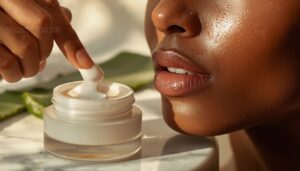
Think of moisturizer as your treatment’s bodyguard, not an afterthought. Ceramides rebuild lipid structure, ceramide moisturizer benefits include real barrier repair. Humectants like hyaluronic acid pull in a hydration boost, while occlusives lock it there.
Choose fragrance-free moisturizers with emollients for skin barrier repair, since irritation triggers more pigment production. Fragile, dry skin darkens faster, so calm skin fades spots better.
Tinted Sunscreen With Iron Oxides

Plain SPF 30 sunscreen skips half the problem. Zinc oxide and titanium dioxide block UV rays but barely touch high-energy visible light, the wavelengths that keep reigniting dark spots in skin of color. Iron oxides fill that gap. In tinted sunscreen, their concentration determines real visible light attenuation, so check labels, not just the word "tinted," for Fitzpatrick IV through VI protection.
Correct Product Layering Order
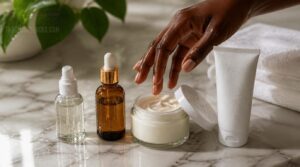
Order isn’t fussy, it’s physics. Thin to thick layering lets each product absorb: cleanser, serum, moisturizer, sunscreen. Water before oil, always. Give each layer sixty seconds before the next.
Morning serum sequence favors antioxidants; nighttime product order favors retinoids and repair. Skip a step’s order, and you’re just diluting your actives.
Best Ingredients for Hyperpigmentation Treatment

Not every brightening ingredient works the same way on melanin-rich skin, and knowing which one targets your specific problem makes all the difference. Some calm inflammation while others block pigment production at the source, so picking the right one depends on your skin’s sensitivity and your patience level.
Here are the five ingredients I reach for most often in my practice, starting with the one I trust for even the most reactive skin.
Azelaic Acid for Sensitive Skin
Reach for azelaic acid when redness and dark spots show up together. This nonanedioic acid calms inflammation, curbs acne bacteria, and blocks pigment production, all while staying gentle.
- Reduces redness and irritation
- Clears clogged pores
- Fades post-acne dark spots
- Suits reactive, sensitive skin
- Works at 15-20% concentrations
Start twice daily; ease off if burning or scaling develops.
Niacinamide and Vitamin C
Azelaic acid calms things down, but if brightening dark skin is your main goal, niacinamide and vitamin C are your workhorses. Niacinamide is gentle, stable, and regulates melanin transfer. Vitamin C blocks tyrosinase but can sting sensitive skin.
| Ingredient | Strength | Sensitivity |
|---|---|---|
| Niacinamide | Barrier support | Low irritation |
| Vitamin C | Antioxidant, brightening | Moderate |
Layer vitamin C first, then niacinamide.
Kojic and Tranexamic Acids
Kojic acid inhibits tyrosinase directly, though free kojic can irritate, so look for kojic dipalmitate, a stable, gentler ester.
Tranexamic acid works upstream, blocking plasminogen activation to calm the inflammatory cascade feeding melanin production.
Combination serums pairing both with niacinamide tackle hyperpigmentation from two angles at once.
Patch test first; apply after cleansing, before moisturizer.
Retinoids for Faster Cell Turnover
Where kojic and tranexamic work on melanin production, retinoids speed up epidermal turnover itself, cycling pigmented cells off the surface faster. Tretinoin’s the strongest option; adapalene suits sensitive, darker skin better since irritation itself can worsen dark spots. Start low, a few nights weekly, moisturizer first. Expect visible fading in three to six months, real results by six to twelve.
Glycolic and Salicylic Acids
Two workhorse acids, different jobs. Glycolic acid exfoliates the surface, boosting turnover and radiance, but raises photosensitivity, so keep it evening-only with SPF the next morning. Salicylic acid, oil-soluble, penetrates pores directly, clearing congestion behind breakouts.
- Glycolic: surface texture, tone, brightness
- Salicylic: pore-level, oil-soluble, blemish control
- Glycolic: nighttime use, sunscreen mandatory after
- Salicylic: better for oily, acne-prone skin
Dermatologist Treatments for Stubborn Hyperpigmentation

Sometimes your at-home routine plateaus, and those stubborn patches just won’t budge no matter how consistent you’ve been. That’s your cue to bring in professional-grade options, the kind only a dermatologist can safely prescribe or perform. Here’s what those expert treatments actually look like.
Prescription Retinoids and Hydroquinone
When over-the-counter fixes stall, prescription retinoids and hydroquinone bring real firepower. Retinoids speed cell turnover; hydroquinone blocks tyrosinase directly. Together they work synergistically, though combined use raises irritation risk, especially in dark skin prone to PIH.
I always start low, monitor closely, and cap hydroquinone duration, since long-term use carries risks clinicians must supervise carefully.
Chemical Peels for Dark Skin
Peel depth matters more than trend appeal here. I favor the mildest effective depth, salicylic or glycolic acid, with cautious TCA use since deeper peels risk worsening pigmentation.
Pre-peel assessment (history, prior isotretinoin, sensitivity testing) guides acid selection.
Post-peel healing shows melanin redistribution by 48 hours, collagen remodeling by day nine, so patience matters.
Microneedling for Persistent PIH
Needling stubborn PIH? Depth is everything. I stay between 0.5mm and 1.5mm, starting shallow on darker skin to avoid provoking melanocytes.
Sessions run 4-6 weeks apart, four to six total. RF microneedling adds thermal benefit for tougher cases.
Post-treatment care isn’t optional, think SPF 50+, no retinoids for a week. This always warrants professional consultation first.
Laser Safety for Melanin-Rich Skin
Lasers on melanin-rich skin? Handle with respect, not fear. Wavelength selection matters most, longer wavelengths and epidermal cooling protect Fitzpatrick IV-VI.
- Choose nonmelanin-absorbing wavelengths
- Start with conservative pulse duration
- Always run test spots first
- Confirm eye protection protocols
- Review isotretinoin history beforehand
A laser peel done recklessly worsens hyperpigmentation. Done right, with proper laser safety, it’s life-changing.
When to Consult a Dermatologist
Know your limits, and know when to call in backup. See a dermatologist for persistent dark spots, unresolved symptoms, unclear spot cause, or home treatment failure.
Higher risk lesions need earlier care too.
| Red Flag | Action |
|---|---|
| Spreading pigment | Book visit |
| Irregular borders | Book visit |
| No improvement | Dermatologist consultation for PIH |
| Recurring irritation | Same |
| New unusual spot | Urgent |
Patient education on pigmentation, plus a consistent skincare routine, prevents skin trauma.
Preventing Hyperpigmentation and Maintaining Results

Getting rid of dark spots is only half the job, keeping new ones from forming is what actually protects your progress. I tell my patients that maintenance isn’t glamorous, but it’s what separates lasting results from a frustrating cycle of treat-and-repeat. Here’s what that upkeep really looks like, day to day.
Sun protection works the same way patience does for facial hair—rushing the process undoes months of careful growth, which is why this beard trimming and shaping tutorial is worth a look before you reach for the clippers.
Apply Broad-Spectrum Sunscreen Daily
Sunscreen is non-negotiable, even on cloudy days. Choose broad-spectrum SPF 30 or higher with iron oxides for visible light protection, since UVA and blue light both worsen dark spots.
Apply daily, morning and 15 minutes before sun exposure, then reapply every two hours or right after sweating. This single habit anchors your daily skincare routine and prevents new UV-driven pigmentation from forming.
Treat Acne and Eczema Early
Your sunscreen habit protects against UV, but inflammation from acne and eczema drives just as much pigment. Treat breakouts and flares early, before they linger.
In melanin-rich skin, especially Fitzpatrick IV through VI, prolonged inflammation almost guarantees PIH. Managing both conditions together, gently and promptly, keeps irritation low and prevents new dark marks from forming.
Avoid Picking and Over-Exfoliating
That urge to squeeze a blemish? Resist it. Picking disrupts the skin surface, deepens inflammation, and turns a fading spot into a stubborn one.
Same goes for exfoliating. Gentle cleansing and light chemical exfoliants beat harsh scrubs every time. Over-exfoliating strips your skin barrier, making pigment linger longer. Let healing spots heal, undisturbed.
If you’re ready to go beyond basics, over-the-counter treatments proven to clear cystic acne can work alongside your gentle routine without compromising your barrier.
Minimize Irritation and Inflammation
Restraint matters just as much post-treatment. Every red bump or sting signals more inflammation, which fuels more pigment.
- Patch test new products first
- Choose fragrance-free, sensitive skin formulas
- Prioritize gentle cleansing and barrier repair
Soothing actives calm reactive skin. Inflammation reduction, not intensity, drives real fading.
Expected Dark Spot Fading Timeline
Most patients ask me the same thing: how long until this spot disappears?
For postinflammatory hyperpigmentation, fade rate depends on pigment depth, healing start time, and protection consistency. Shallow marks in Fitzpatrick types IV through VI often clear in 6 to 12 months with steady routines. Deeper, melanin-rich pigment can persist for years, especially without daily sun protection.
Frequently Asked Questions (FAQs)
Can you permanently get rid of hyperpigmentation?
Honestly, not always. Realistic outcomes mean fading, not erasure, since sun, hormones, and inflammation can trigger recurrence. Melasma and PIH respond to topical depigmenting agents, but long-term maintenance and recurrence prevention matter more than chasing a permanent cure.
How do dermatologists treat hyperpigmentation & dark spots?
Roughly 65% of dermatology visits for pigment concerns involve postinflammatory hyperpigmentation in skin of color.
Dermatologists combine topical depigmenting agents, prescription retinoid use, cautious chemical peels therapy, and strict laser safety protocols, always pairing treatment with daily broad-spectrum SPF 30.
What is the treatment for pigmentation on skin?
Effective pigmentation treatment layers topical brightening agents like vitamin C, niacinamide, and kojic acid with professional chemical exfoliation, occasional laser toning, or oral tranexamic acid, all anchored by daily broad-spectrum sunscreen to keep dark skin’s melanocytes from overreacting.
Can hyperpigmentation be treated?
Yes, with consistent home care using vitamin C, niacinamide, or kojic acid, plus daily SPF. Over-the-counter options fade marks in weeks to months; stubborn spots often need dermatologist-guided peels or prescription treatments for lasting results.
How to lighten hyperpigmentation on black skin?
Patience and persistence pay off: layer gentle exfoliation, targeted serums with kojic acid or arbutin, retinoids, barrier-repair moisturizer, then tinted sunscreen SPF 30+.
This routine order fades postinflammatory hyperpigmentation gradually, safely, without triggering more irritation-driven dark spots.
How do you get rid of hyperpigmentation on dark skin?
Clearing dark spots on melanin-rich skin takes daily broad-spectrum SPF 30+, gentle exfoliation, and brightening actives like kojic acid or arbutin.
Patch test new products, stay consistent, and see a dermatologist for peels or lasers when spot treatment alone isn’t enough.
How can I lighten my hyperpigmentation fast?
Reach for kojic acid and vitamin C serums plus overnight spot treatments, layer niacinamide underneath, then commit to daily sunscreen.
Quick-result retinoids speed cell turnover too.
Real fading in dark skin still takes weeks, so consistency beats shortcuts every time.
How do dermatologists remove hyperpigmentation?
Think of it as coaxing stubborn pigment into retreat: dermatologist-recommended tools like topical depigmenting agents, chemical peels, laser therapy, microneedling, and prescription retinoids each target dark skin differently, restoring an even skin tone through gradual, professionally guided skin brightening.
What is the best professional treatment for hyperpigmentation?
For dark skin, chemical peels, microneedling, and cautious laser therapy paired with prescription retinoids or supervised hydroquinone work best, always chosen by a dermatologist who understands ingredient compatibility, treatment duration, and your unique melanin risk.
What over-the-counter creams help with hyperpigmentation?
Ever wonder why some creams fade spots fast while others stall? Look for Vitamin C Serums, azelaic acid, and Niacinamide Boosters, proven Topical Brightening Creams that inhibit tyrosinase and calm inflammation, backed by consistent, patient use.
Conclusion
Patience and protection remain your most powerful tools. Effective hyperpigmentation treatment for dark skin isn’t about chasing quick fixes, it’s about respecting how melanocytes behave under stress.
Skip sunscreen for a week, and months of progress can fall apart fast. Stick with your regimen, though, and stubborn patches lighten on schedule, sometimes sooner.
I’ve watched patients transform their skin this way, not overnight, but steadily. Consistency decides whether your dark spots fade or linger.