This site is supported by our readers. We may earn a commission, at no cost to you, if you purchase through links. This content is for general informational and educational purposes only and is not a substitute for professional medical, dermatological, or nutritional advice.
Most men blame genetics the moment their beard grows patchy—and sometimes they’re right, but not always in the way they think. Your EDAR and FGFR2 genes shape follicle structure, while DHT, the hormone converted from testosterone, determines whether those follicles ever activate.
That’s two separate levers, and nutrition, sleep, and the right topical remedies can influence both more than most people realize.
A client of mine added rosemary oil blends and cleaned up his diet, and his patchiness softened noticeably within three months—no prescriptions, no gimmicks.
Thickening beard natural remedies work best when you understand what’s actually slowing your growth down.
Table Of Contents
- Key Takeaways
- Beard Growth Basics
- Nutrition for Thicker Beard Growth
- Natural Beard Thickening Remedies
- Daily Beard Care Routine
- Lifestyle Habits for Beard Density
- Frequently Asked Questions (FAQs)
- What are the best natural remedies for beard growth?
- How can I make my beard grow longer & thicker?
- How to maintain a fuller & thicker beard naturally?
- How can I boost my beard follicles?
- How to grow a beard naturally?
- What makes a beard thicker?
- How to make a beard thicker naturally?
- Can a beard be thickened?
- What is the 3 month beard rule?
- How can you stimulate beard growth naturally?
- Conclusion
Key Takeaways
- Your beard’s thickness is shaped by two separate levers — genes that set the structure and DHT that flips the switch — and you can influence both through nutrition and topical remedies.
- Natural oils like rosemary, castor, and jojoba work best when massaged into the skin consistently, because it’s the circulation boost and daily habit that actually moves the needle.
- What you eat shows up in your beard — protein, biotin, omega-3s, zinc, and vitamin C are the core nutrients your follicles need to produce thick, healthy strands.
- Sleep, strength training, stress management, and ditching smoking aren’t lifestyle bonuses — they’re the hormonal and circulatory foundation that makes everything else work.
Beard Growth Basics

Before you try any oil or tweak your diet, it helps to understand what’s actually driving your beard growth in the first place. A few key factors shape how thick and full your beard can get — and knowing them changes everything about how you approach it. Here’s what you need to understand before anything else.
Once you know what’s working against you, you can explore natural ways to stimulate beard growth that actually target the root causes.
Genetics and Natural Thickness
Before you blame your grooming routine, take a look at your family photos. Genetics shape beard thickness more than most people realize.
Genes like EDAR and FGFR2 directly influence hair shaft diameter, while follicle shape genetics determine whether your follicles even produce coarse, full strands. Wider follicles grow thicker hair — and that’s inherited, not earned.
Research shows the genetic basis of hair thickness is linked to keratin‑production genes.
DHT and Facial Hair
Genetics sets the stage, but DHT does a lot of the heavy lifting for facial hair.
DHT forms when testosterone meets 5-alpha reductase — an enzyme active inside your follicles. It then binds to androgen receptors, signaling your follicles to mature. That’s what drives the shift from fine vellus hairs to the thicker, darker terminal hairs you actually see in a beard.
Patchiness Versus Slow Growth
Not every patchy beard means slow growth — sometimes it’s just uneven timing.
| What You’re Seeing | What’s Actually Happening |
|---|---|
| Bare cheek patches | Follicles in resting phase |
| Thin, wispy areas | Vellus hairs, not terminal hairs |
| Uneven density | Follicle cycling at different rates |
Patch fill-in often happens naturally over weeks as more follicles complete their cycles.
Realistic Growth Timelines
So the patches might be cycling — but how long until things actually look different? Your beard grows roughly 0.3 to 0.5 mm daily, adding about 1–2 cm per month. Visible change takes time:
Since only active follicles contribute to growth at any given moment, your timeline may stretch longer than expected — explore the full breakdown in this guide to how fast beard hair actually grows.
If your beard seems to be sprinting ahead of everyone else’s, your genes are likely calling the shots — check out what makes facial hair grow so fast to see what’s really driving the pace.
- Stubble fills in around weeks 2–4
- Patches soften by weeks 6–8
- Real density shows after 3–4 months
Patience and consistency are everything.
Nutrition for Thicker Beard Growth
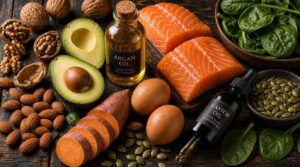
What you eat shows up in your beard — more than most guys realize. Your follicles need a steady supply of the right nutrients to produce strong, thick hair from the inside out. Here are the key foods and nutrients worth adding to your daily routine.
Protein for Keratin Production
Think of your beard hair as a construction project — and protein is the raw material. Keratin, the structural protein that builds every strand, is assembled from amino acids, your body sources directly from food.
Prioritizing a protein-rich diet for stronger hair growth ensures your follicles have the amino acids they need to keep building keratin around the clock.
Getting enough dietary protein daily is what actually fuels keratin production — the same foundation behind every short beard style worth growing.
Lean meats, eggs, legumes, and quinoa all deliver the amino acid profile, your follicles need to keep keratin production running strong.
Biotin-rich Foods
Biotin is the quiet workhorse behind keratin production — the same protein that builds every strand of your beard.
A single cooked egg covers about 33% of your daily biotin needs.
Liver goes even further, with chicken liver hitting 460%.
Nuts, seeds, legumes, and mushrooms round out your plate nicely, making it easy to hit your targets through food alone.
Omega-3 Fatty Acids
While biotin builds the strand itself, omega-3 fatty acids nourish the soil it grows from — your follicles.
Found in fatty fish, chia seeds, and walnuts, these fats reduce dryness and follicular inflammation. EPA and DHA from fish oil support cell membrane fluidity, keeping follicles responsive. Even flaxseed oil’s ALA counts.
Try a daily fish oil capsule if your diet falls short.
Vitamin C and Collagen
Vitamin C is the unsung architect behind your beard’s structural foundation. It drives collagen synthesis by activating key enzymes that hydroxylate proteins into stable, mature fibers — the very dermal matrix anchoring each hair.
Load your plate with citrus, peppers, and strawberries daily. A nutrient-rich diet rich in vitamin C keeps your skin healing efficiently and your follicles firmly supported.
Zinc and Iron Support
Two minerals quietly run the show regarding beard growth: zinc and iron. Zinc drives keratin synthesis and keeps your oil glands balanced, while iron ensures your follicles get enough oxygen to stay active.
Find both in lean meats, shellfish, and leafy greens — and space your supplements apart, since zinc and iron compete for absorption.
Natural Beard Thickening Remedies
Your kitchen and medicine cabinet might already hold some of the best tools for a fuller beard. These remedies work by feeding your follicles directly, right at the skin level where growth actually starts. Here are five natural options worth adding to your routine.
Castor Oil for Fullness

Castor oil might just be the most underrated weapon in your beard-thickening arsenal. Its secret is ricinoleic acid, which binds moisture directly to each strand, reducing the dryness that causes breakage.
Apply it overnight, and that protective hair coating shields follicles while improving circulation beneath the skin — so your beard looks noticeably fuller within weeks.
Jojoba and Argan Oils
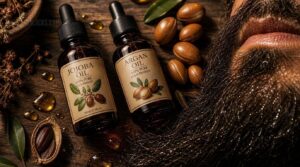
While castor oil works overnight, jojoba and argan oils bring something different to your daily beard care routine — lighter, faster-absorbing support that your skin actually recognizes.
Jojoba’s wax esters closely mimic your skin’s natural sebum, so it conditions without feeling foreign or greasy. Argan’s rich fatty acid profile — packed with oleic and linoleic acids plus polyphenol content and vitamin E richness — softens coarse strands and calms dry, tight skin underneath.
- Apply to damp beard skin for better absorption
- Use just a few drops — both oils spread easily
- Work jojoba in when you want a lighter, non-greasy feel
- Reach for argan when skin feels tight or flaky
- Layer either oil after washing to lock in moisture
Start small, and your beard will thank you.
Rosemary Essential Oil Blend

If jojoba and argan are your daily foundation, think of rosemary essential oil as the activator you add to the mix.
Rosemary oil stimulates circulation at the follicle level — its key compounds, 1,8-cineole and alpha-pinene, work together to wake up sluggish roots. Some research even puts its growth efficacy close to topical minoxidil.
Never apply it straight. Mix 15–20 drops per ounce of a carrier oil like jojoba, then massage it into your beard skin for five minutes. That’s your blend.
| Blend Element | Recommended Detail |
|---|---|
| Rosemary oil drops | 15–20 per ounce |
| Carrier oil | Jojoba or argan |
| Application time | 5–10 minutes massage |
| Frequency | 3–4 times per week |
| Aromatherapy bonus | Clarity and focus boost |
The scalp massage application matters as much as the oil itself — it drives nutrients deeper and gets blood moving where it counts.
Aloe Vera for Irritation
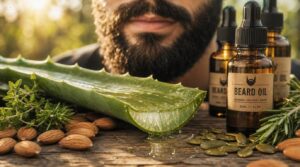
When oils and massage leave your skin a little irritated, aloe vera gel is your reset button. It works by calming inflammation through anti‑inflammatory compounds that reduce redness and discomfort fast.
After washing your beard, apply a thin layer directly to the skin underneath. It soothes, hydrates, and strengthens your skin barrier without clogging anything up.
Onion Juice Treatment
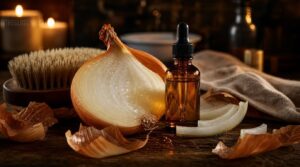
Aloe vera soothes, but if you want to go deeper, onion juice is worth trying. Its sulfur compounds support collagen production and may nudge dormant follicles awake.
Always do a patch test first — onion stings sensitive skin. Apply for 15–20 minutes, then rinse.
Expect gradual improvement over weeks, not overnight thickness.
Daily Beard Care Routine

What you put on your beard matters, but how you take care of it every day matters just as much. A solid routine doesn’t have to be complicated — it just needs to be consistent. Here are the five habits worth building into your daily flow.
Gentle Beard Cleansing
Think of your beard cleanser as the foundation of everything else you do. Sulfate-free, fragrance-free cleansters protect your skin’s natural oils while still removing sweat and grime.
Use lukewarm water — not hot — to keep dryness at bay. Massage gently in circular motions, reaching the skin beneath. Rinse thoroughly, then pat dry to avoid irritation.
Weekly Skin Exfoliation
Dead skin cells are the quiet enemy of beard growth — they clog follicles and slow everything down. That’s why skin exfoliation belongs in every serious beard care routine.
- Exfoliate once a week if your skin is sensitive
- Gentle scrubs work well for physical exfoliation
- Chemical AHAs like glycolic acid smooth texture without friction
- Patch test anything new before committing
Always follow up with a moisturizer to rebuild your skin barrier after exfoliating.
Moisturizing After Washing
Right after you rinse, your skin is primed — that’s your golden minute to lock in moisture before it escapes.
| Step | Product Type | Timing |
|---|---|---|
| Blot skin damp | Soft towel | Immediately after washing |
| Apply humectant | Glycerin or hyaluronic acid | Within 60 seconds |
| Seal with occlusive | Natural oils or castor oil | After humectant absorbs |
Apply your damp skin moisturizer while skin still holds surface water — this promotes barrier lipid restoration and prevents that tight, dry feeling. A hydrating beard conditioner works perfectly here too.
Facial Massage Techniques
A five-minute facial massage each morning does more than feel good — it wakes up blood flow right where your follicles need it most.
Start with effleurage gliding strokes, moving outward from the center of your face to ease the skin into the session. Follow with petrissage kneading along your jawline and cheeks, then finish with light tapotement tapping to energize circulation.
Trimming Split Ends
Split ends are silent saboteurs — left unchecked, they travel up the shaft and thin your beard from the inside out.
Spot split ends by looking for frayed, Y-shaped tips that appear lighter than the rest. Using sharp salon shears, section your beard into small zones and micro-trim just above the damage.
A quick dusting every few weeks keeps breakage in check.
Lifestyle Habits for Beard Density

What you do outside of your grooming routine matters more than most people realize. Your daily habits quietly shape your hormone levels, circulation, and the overall environment your follicles need to thrive. Here are the lifestyle shifts worth making if you’re serious about building real beard density.
Sleep and Hormone Balance
Think of sleep as your beard’s overnight repair crew. During deep sleep, growth hormone release peaks — and that’s when your follicles do their best rebuilding work.
Skimp on rest, and that crew never clocks in. Aim for 7–8 hours nightly to keep testosterone-derived DHT levels steady, cortisol low, and your beard’s natural growth cycle running smoothly.
Strength Training Benefits
Sleep gets your hormones primed — but resistance training takes them further. Lifting weights naturally boosts testosterone, which drives DHT production and feeds your follicles directly.
Compound moves like squats and deadlifts also improve blood circulation to your face, delivering the protein and nutrients your beard needs to grow thicker, faster.
Stress Reduction Methods
Your muscles aren’t the only thing that suffers under chronic stress — your beard does too. High cortisol actively suppresses testosterone, which means less DHT reaching your follicles.
Chronic stress floods your body with cortisol, starving your follicles of the DHT they need to grow
- Mindfulness practices like meditation and body scanning train you to observe stress instead of spiral into it.
- Deep breathing exercises activate your parasympathetic nervous system, lowering cortisol fast.
- Progressive relaxation — tensing and releasing muscle groups — melts physical tension in about 15–20 minutes daily.
Talking to a friend counts too. Social support is a legitimate stress management tool.
Hydration for Healthy Hair
Stress relief clears the path — now let hydration pave it. Water intake directly affects how well nutrients reach your follicles. Aim for around 8 glasses daily to support scalp hydration and keep skin from drying out.
When your scalp stays moisturized, follicles work in a healthier environment, and your beard looks fuller, not brittle.
Avoiding Smoking and Excess Alcohol
Two habits that quietly sabotage beard growth are smoking and drinking too much alcohol. Nicotine constricts blood vessels, cutting off the oxygen and nutrients your follicles depend on. Quitting smoking improves circulation over time, giving your beard a real chance to thicken.
Alcohol disrupts hormones and depletes key vitamins — moderation makes a bigger difference than most guys expect.
Frequently Asked Questions (FAQs)
What are the best natural remedies for beard growth?
The best natural remedies include castor oil, jojoba oil, and coconut oil for moisture and fullness. Add biotin and omega-3 fatty acids through diet, and try peppermint oil to boost circulation.
How can I make my beard grow longer & thicker?
Growing a longer, thicker beard comes down to genetics, diet, and consistency. Feed your follicles with biotin, omega-3 fatty acids, and protein. Stay patient — real beard growth unfolds over months, not days.
How to maintain a fuller & thicker beard naturally?
Maintaining a fuller beard comes down to consistent daily habits — nourishing your body with biotin, omega-3 fatty acids, and nutrient-rich foods, while pairing that with natural oils, a solid beard care routine, and restful sleep.
How can I boost my beard follicles?
Your follicles need two things above all: blood flow and nutrients. Microneedling sessions, daily facial massage, and a nutrient-rich diet work together to wake dormant follicles and support lasting beard follicle health.
How to grow a beard naturally?
To grow a beard naturally, focus on protein-rich foods, quality sleep, and consistent skin care. Patience matters most — many men see real progress around the three-month mark.
What makes a beard thicker?
A thicker beard comes down to genetics, hormones, and care. DHT stimulates your follicles, while keratin production builds each strand. Good nutrition and circulation do the rest.
How to make a beard thicker naturally?
Building a thicker beard naturally takes patience, the right nutrients, and consistent care. Focus on nutrient-rich diets, smart lifestyle habits, and targeted beard care routine practices to bring out your beard’s full potential.
Can a beard be thickened?
Yes, a beard can be thickened — though your genetics set the ceiling. The right nutrient-rich diet, consistent care, and natural remedies can help you get closer to your full potential.
What is the 3 month beard rule?
Ever wonder why your beard looks patchy after just a few weeks? The 3 month beard rule says wait 90 days before judging coverage or trimming — letting slower follicles fully catch up.
How can you stimulate beard growth naturally?
Stimulating beard growth naturally comes down to consistent daily habits — eating protein-rich foods, exercising regularly to boost circulation, managing stress, and applying nourishing oils to support healthy follicles over time.
Conclusion
The beard you want is already in motion—each small habit quietly stacking results you’ll notice in the mirror weeks from now.
Thickening beard natural remedies work not because they’re magic, but because they speak directly to what your follicles actually need: circulation, nutrition, and consistency.
Feed your body well, massage those oils in, sleep like it matters—because it does.
Stay the course, and your patience will grow something worth keeping.