This site is supported by our readers. We may earn a commission, at no cost to you, if you purchase through links. This content is for general informational and educational purposes only and is not a substitute for professional medical, dermatological, or nutritional advice.
Your curling iron gives up by lunch. A perm doesn’t quit for months.
That staying power comes down to chemistry, not styling tricks. A perm breaks and reforms the disulfide bonds inside each strand, locking hair into a new curl pattern that survives washing, sweat, and rainy days alike. It’s the same science a Hungarian hairdresser turned into a salon staple decades ago, and it still shapes how stylists approach texture today.
So what is a perm, really, beyond "curly hair that lasts"? It’s a process with real steps, real trade-offs, and real aftercare rules worth knowing before you sit in that chair.
Table Of Contents
- Key Takeaways
- A Perm Creates Long-Lasting Curls or Waves
- How The Perm Process Works
- Types of Perms and Curl Results
- Who Should Get or Avoid Perms
- How Long Perms Last and Cost
- Perm Aftercare and At-Home Safety
- Frequently Asked Questions (FAQs)
- How long does a perm last?
- Are perms bad for your hair?
- How much does a perm generally cost?
- Should a 14 year old get a perm?
- What does iperms stand for?
- How does the perm look after it’s done?
- Why do I have access to iperms?
- What does view as original mean in iperms?
- Is a perm just curly hair?
- How long does a perm last for?
- Conclusion
Key Takeaways
- A perm works by breaking and rebuilding your hair’s disulfide bonds, which is why the curl holds for months instead of washing out like a curling iron style would.
- Since perm chemicals only affect the hair shaft you already have, new growth always comes in straight, so you’ll need root touch-ups every 6 to 8 weeks and a full reperm every 12 to 16 weeks.
- Curls typically last three to six months depending on your hair type and aftercare, but the process can weaken hair strength by up to 30%, so bleached, keratin-treated, or damaged hair needs extra caution or should skip perming altogether.
- The first 72 hours matter most for lasting results: avoid washing for at least 3 days, hold off on heat styling or coloring, and switch to sulfate-free shampoo and leave-in conditioner once you do wash.
A Perm Creates Long-Lasting Curls or Waves
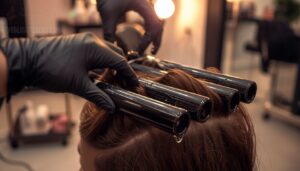
A perm isn’t just one simple trick with rollers and solution. There’s real chemistry behind why the curl sticks around for months instead of washing out. Here’s what’s actually happening to your hair, from the bond level up to the finished style.
The magic lies in reducing agents that break your hair’s disulfide bonds before reshaping them around the rods, a process explained in detail in this guide to how perming hair actually works.
What “Permanent Wave” Means
Ever wonder why it’s called "permanent" at all? A permanent wave isn’t a style trend, it’s a chemical process that restructures your hair’s protein bonds to hold a new curl pattern.
Unlike a curling iron, which fades by lunchtime, this change sticks around until treated hair grows out or gets cut. Definition and duration go hand in hand here. The term originated from early beauty innovations, such as the permanent wave machine developed by a Hungarian-born hairdresser, which helped professionalize modern hairdressing practices. permanent wave machine
How Hair Bonds Change
So what’s actually happening inside each strand? Your hair protein bonds come in three types: weak hydrogen bonds, ionic bonds, and strong disulfide bonds.
Perm chemicals target disulfide bonds specifically, breaking sulfur links so hair elasticity increases temporarily. The neutralizer then triggers disulfide bond reforming in a new curl shape, while pH shifts and heat cause ionic bond shifts alongside hydrogen bond breakage you’d get from styling alone.
Perms Affect Existing Hair Only
Here’s the catch: none of that bond-breaking touches your roots. Perm chemicals only work on the existing hair shaft, so new growth comes in completely natural.
Perm chemicals only reshape the existing hair shaft, so every new root grows in completely natural
That’s why regrowth eventually looks different from your curled ends, and why perm longevity really depends on your hair type, damage risk, and how well you keep up with aftercare between touch-ups.
Curls, Waves, Volume, and Texture
Rod size and wrap technique decide your final look. Small rods create tight, springy type 3 or 4 curl patterns; large rods give loose beach waves.
Concave rods add root lift and volume for flat hair. Mixed rod sizes create textured, multi-dimensional styles rather than one uniform curl throughout your length.
How The Perm Process Works
Getting a perm isn’t just rolling your hair up and waiting around. Every step, from applying the solution to the final rinse, plays a part in how your curls turn out. Here’s what actually happens in the chair, broken down step by step.
Applying The Perm Solution
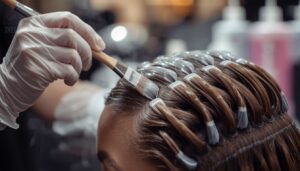
Before any solution touches your hair, your stylist sections it and applies a barrier cream along your hairline and ears to prevent irritation. Hair gets wrapped rod by rod, then the perm solution—alkaline or acid based—is saturated from mid-length to ends, avoiding rods. Rods get covered in plastic, trapping heat to help processing begin evenly.
Processing Time and Curl Checks
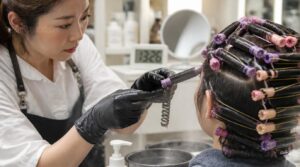
Once solution’s on, it’s not "set and forget." Your stylist checks curl formation every 5 to 10 minutes, testing a strand near the midshaft for curl definition. A quick strand test confirms elasticity before committing fully. If curls stall, processing extends in small increments. This careful timing prevents overprocessing and protects hair from damage.
Neutralizing and Setting Curls
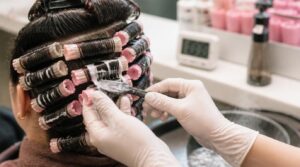
Once curls look right, the neutralizer takes over. This step triggers bond restoration, rebuilding the disulfide bonds your curl memory depends on. Neutralizer pH runs acidic, rehardening the cortex around your rods and rollers.
Setting time matters just as much as processing time:
- Apply neutralizer rod by rod
- Let it sit 10 minutes
- Rinse 3 minutes, rods still in
This locks in real curl durability.
Types of Perms and Curl Results

Not every perm gives you the same result, and that’s the point. Your hair type, curl goal, and even your styling habits help decide which method fits best. Here’s a look at the main types you’ll come across and what each one is built to do.
Since the chemical process varies by method, it also affects how long a perm takes to complete at the salon.
Cold Wave Perms
No heat, just chemistry doing the heavy lifting. Cold wave perms rely on ammonium thioglycolate, an alkaline solution that works at room temperature.
Rod selection determines your curl size, tight and kinky with small rods. Processing takes about 15 minutes. Then comes neutralizer application, locking in curl definition.
Salon sessions run 1-2 hours, and at-home kits with perm rods and rollers offer a cheaper option.
Acid-Balanced Perms
Gentler doesn’t mean weaker. Acid-balanced perms use a pH gentle formula around 6.5-7.2, easing bond reformation without harsh swelling.
This makes them ideal for color-treated hair or porous strands prone to hair damage. Processing time runs shorter, cutting overprocessing risk.
Expect soft, natural waves with real frizz reduction—plus easier perm aftercare and better hair moisture balance during neutralization.
Digital and Hot Perms
Think of a digital perm as a ceramic wave perm run by computer, not guesswork. Rods heat to 80–140°C, and machine-regulated curls form through precise temperature control.
- Soft, bouncy waves
- Less stiffness than cold perms
- Best on medium-thick hair
- Curls sharpen as hair dries
This hot perm rewards patience—natural wave formation takes hands-on skill and calibration.
Body, Beach, and Spiral Perms
Not every perm aims for tight curls—some just want lift or a wave.
| Perm Type | Rod/Technique | Best For |
|---|---|---|
| Body | Large rollers | Fine, flat hair |
| Beach | Loose wrap | Relaxed texture |
| Spiral | Vertical rods | Long hair, drama |
Rod selection shapes everything, from curl longevity to volume.
Root and Multi-Textured Perms
Some clients don’t want curl everywhere, just lift where it counts. A root perm targets the first 2–4 inches near your scalp, giving fine hair fullness without touching the lengths. A multitextured perm mixes rod sizes for blended waves and curls.
- Root lift technique for volume
- Rod size variation for texture
- Curl pattern blending, natural look
- Growth touch-up schedule keeps it uniform
Who Should Get or Avoid Perms
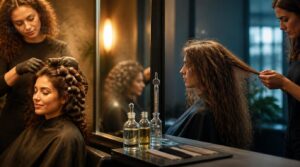
A perm isn’t a one-size-fits-all treatment, and your hair’s current condition matters more than the style you want. Some hair types take to the chemical process beautifully, while others need a pass or at least a healing period first. Here’s how to know which camp you fall into.
Fine, Straight, or Flat Hair
Flat by midday? A perm is often the fix. Straight fine to medium hair gains lift and body from added texture, since strands lack natural bend.
Root-focused rod placement builds volume without weight. Pair this with lightweight, volumizing products, since heavy formulas flatten fine strands fast.
Checking your hair texture first helps your stylist pick the right perm type for lasting fullness.
Short Hair Needing Texture
A choppy pixie or textured bob without natural bend can look flat by day two.
A body perm with larger rods builds soft movement, letting sea salt spray, diffuser blowouts, and light pomade actually hold shape instead of falling straight by noon.
Bleached or Chemically Treated Hair
If your hair’s been bleached recently, think twice before booking that perm.
Bleaching already lifts the cuticle and weakens protein bond integrity, so adding perm chemicals on top raises real chemical compatibility risks. Keratin-treated or relaxed hair faces the same problem. Your stylist should adjust processing time and check neutralizer effectiveness carefully, since compromised strands process unevenly and risk snapping.
Damaged Hair and Sensitive Scalps
A sensitive scalp deserves honesty, not a sales pitch.
Thio-based solutions raise scalp pH and can trigger allergic reactions in some clients. Watch for:
- Redness or burning
- Itching that lingers
- Flaking or tightness
Eczema history means higher risk. Damaged strands lose moisture and protein, so hair breakage becomes likely. Talk to your stylist first.
Hair Health and Lifestyle Assessment
Before booking, check what your body’s telling you: chronic stress and poor sleep both push follicles into shedding mode, while low protein or iron stalls growth entirely.
| Factor | Healthy Range | Impact on Perm |
|---|---|---|
| Sleep | 6+ hrs/night | helps follicle health |
| Protein | 20g/meal | Strengthens shaft |
| Cortisol | Below 20 µg/dL | Prevents shedding |
A quick self-assessment saves your curls—and your money.
How Long Perms Last and Cost

A perm is an investment, so it helps to know what you’re actually paying for and how long it’ll stick around. Cost and lifespan depend on more than just the chemicals used on your hair. Here’s what shapes both sides of that equation.
Typical Three-to-Six-Month Lifespan
Curls often hold for three to six months, with peak definition around months two to four.
- Fine hair fades near month three
- Coarse hair holds closer to six
- Humidity extends curl life
- High heat can shorten it by weeks
- Steady care sustains shape longer
Environment and hair health drive the range — your maintenance routine decides which end you land on.
Pricing by Hair Length
Length drives the bill more than most people expect.
Short hair costs the least, since it needs fewer rods and less product.
Medium length adds a 15–25% surcharge.
Shoulder length runs 20–40% higher.
Long to mid-back hair adds 30–60%, while very long hair can cost 50–100% more due to extra product and processing time.
Curl Type and Salon Factors
Not all curls cost the same to create. A loose beach wave needs fewer rods than a tight ringlet, so pricing shifts with the look you want.
Salons also factor in:
- Rod size selection for curl tightness
- Solution strength matching to your hair’s needs
- Porosity assessment for processing time
Skilled curl pattern analysis and proper tools justify pricing variability between salons.
Grow-Out and Touch-Up Timing
Once your stylist locks in rod size and solution strength, the next question is timing. Roots grow about 0.5 inches monthly, so outgrowth shows around 6 to 8 weeks. Book touch-ups then; plan a full reperm every 12 to 16 weeks.
Gentle care and protective styling stretch curl retention between visits.
Chemical Perms Versus Temporary Waves
That grow-out timeline only applies to true chemical perms, not temporary waves from a curling iron or mousse.
A perm alters disulfide bonds for months-long results; temporary waves wash out at the next shampoo.
Perms cost more and risk more damage, but offer real styling flexibility—no daily heat tools needed to keep your texture.
Perm Aftercare and At-Home Safety

Getting the perm is only half the job. What you do in the days and weeks after determines whether those curls stay bouncy or turn into a frizzy mess. Here’s what actually matters for keeping your new texture healthy and intact.
The First 72 Hours
Right after your perm, treat those first 48 hours like damage control: no water, no heavy workouts, no touching the curls.
Scalp stings or mild burns from the neutralization step should fade fast, not linger.
Skip washing for at least 3 days.
Hair may feel dry going in, so plan to moisturize once the waiting period ends.
Gentle Washing and Conditioning
Once that three-day wait ends, ease in with a sulfate-free shampoo, not your old harsh cleanser. Gentle washing protects the curl’s disulfide bonds while lifting buildup.
Follow with a lightweight leave-in conditioner for moisture retention and slip.
Imagine this:
- Lukewarm water cascading through loose spirals
- A creamy deep conditioner melting into thirsty ends
- Cuticles lying smooth, sealed, and frizz-free
Detangling and Frizz Prevention
Once curls settle, tangles sneak in fast, so grab a wide-tooth comb and start at the ends, working upward to cut root tension by 35%.
| Tool | Best Use | Frizz Benefit |
|---|---|---|
| Wide-tooth comb | Dry detangling | 27% less breakage |
| Vented brush | Curl separation | 78% less frizz |
| Leave-in conditioner | Damp mid-lengths | 22% smoother |
A silk pillowcase and nightly oil keep hair smoothing intact overnight.
Heat, Color, and Chemical Timing
Within days after your perm, hold off on heat styling and coloring. Heat speeds pigment oxidation, shifting tone unevenly.
Bleached, keratin-treated, or high-lift hair faces real breakage risk from added chemical stress. Wait at least two weeks before dyeing, and always run a strand test first to check how your hair reacts to further processing.
If you want a gentler way to cleanse fragile strands between treatments, this soapnut shampoo recipe cleanses without stripping already-stressed hair.
DIY Perm Kit Risks
Grabbing an at-home perm kit saves money, but skips the trained eye that catches trouble early. Risks include chemical burns, overprocessing, allergic reactions, fume exposure, and incorrect neutralization.
- Scalp burns from thioglycolate
- Hair breakage from overprocessing
- Skin irritation or dermatitis
- Ammonia fume exposure
- Weak curls from bad neutralizing
Patch test first, always.
Frequently Asked Questions (FAQs)
How long does a perm last?
Your curl’s shelf life isn’t forever—expect three to six months before it fades. Longevity depends on hair type, growth rate, curl size, and how well you follow aftercare, so root touchups keep things looking fresh.
Are perms bad for your hair?
Yes, to a degree. Breaking disulfide bonds brings chemical damage risk, cutting tensile strength up to 30%. Expect moisture loss, frizz, and possible scalp irritation. Proper aftercare and spacing treatments 12 months apart keep long-term weakening in check.
How much does a perm generally cost?
Picture your wallet after a salon visit versus a home kit. Perm prices usually run 60 to 250 euros, with short hair pricing lower and urban salons charging more than rural ones for the same curl.
Should a 14 year old get a perm?
Proceed cautiously. Teen hair is more fragile, with higher breakage risk and split-end rates than adult hair. A thorough hair consultation helps assess scalp sensitivity, chemical safety, and whether fine or damaged strands can handle the process safely.
What does iperms stand for?
You’ll see iperms used as shorthand across salon terminology for "international perm," a chemical process that rearranges hair bonds into lasting curls or waves—recognized in cosmetology literature and product labeling, distinct from temporary at-home styling methods.
How does the perm look after it’s done?
Like your hair just woke up styled by magic: curl definition runs root to end, evenly spaced, glossy from the neutralizer. Roots gain lift, ends stay soft, and frizz calms down once conditioned properly.
Why do I have access to iperms?
That question’s actually outside a stylist’s lane—iPerms is a military records system, unrelated to hair perms. You’d have authorized access through CAC credentials and unit sponsorship, not through anything discussed here about curl types or chemical treatments.
What does view as original mean in iperms?
That’s actually not a hair or perm term at all, it’s an unrelated records/IP concept from a different system. This article sticks to perm types, chemical treatment, and salon aftercare, so it won’t apply here.
Is a perm just curly hair?
Not quite, and mixing the two up leads to real disappointment at the mirror. A perm is chemical curl setting, breaking and rebuilding hair bonds for permanent texture, unlike natural curls, which are simply your hair’s genetic pattern all along.
How long does a perm last for?
Most perms hold for three to six months, depending on hair thickness, chemical history, and aftercare. Fine hair fades faster; coarse, virgin hair holds longer.
Root touch-ups every 8–12 weeks keep curls looking uniform as new growth comes in straight.
Conclusion
Curls fade, but the chemistry behind them never really changes, and that’s the coincidence worth remembering here. what’s a perm, really? It’s patience wrapped in science, a bond broken so a new shape can hold steady for months.
Choose the right type, respect the processing time, and treat those first 72 hours like they matter, because they do. Curls loosen eventually. Your hair’s health afterward depends entirely on the care you gave it today.